
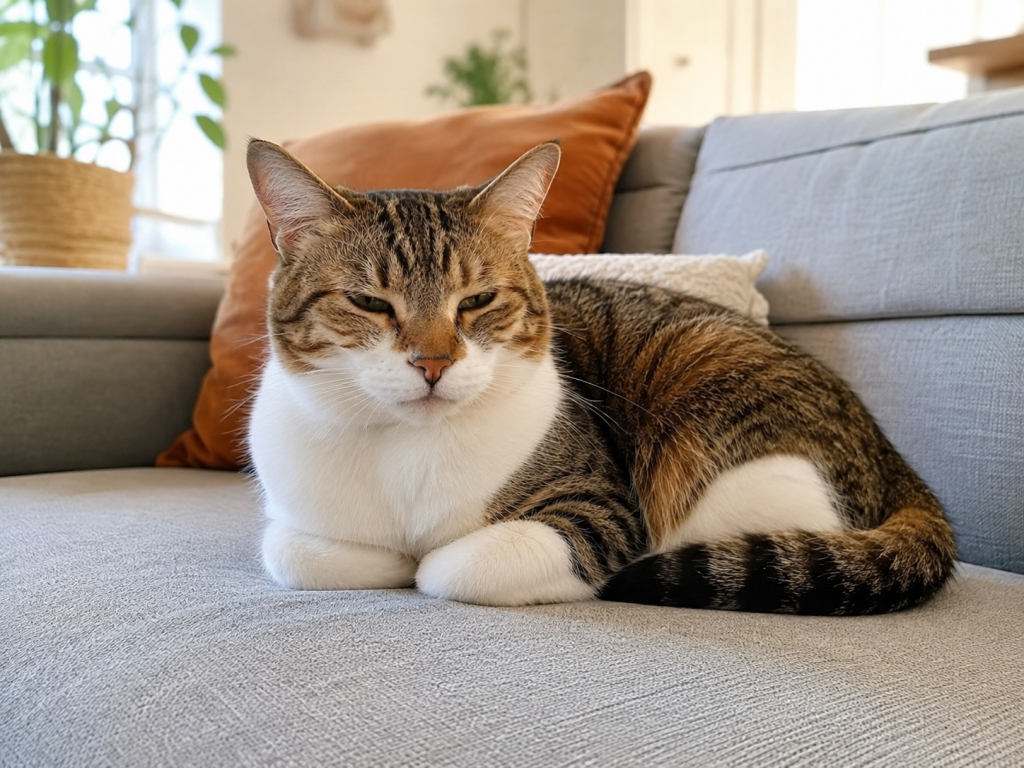
Understanding cat behavior and body language can completely change the way you communicate with your cat. Cats rarely rely on one signal alone. Instead, they combine posture, tail position, ears, eyes, facial tension, movement, vocalizations, scent, and distance to show how they feel.
A relaxed cat may approach with an upright tail, soft eyes, and loose muscles. A frightened cat may crouch, flatten the ears, widen the eyes, and try to create distance. Meanwhile, an overstimulated cat can switch from enjoying attention to wanting space within seconds. Learning to read these combinations helps you respond before stress turns into hiding, scratching, or biting. Merck Veterinary Manual describes defensive cats as commonly showing signs such as crouching and holding the ears backward.
However, body language is not a perfect dictionary. The same signal can have different meanings depending on the situation and the rest of the cat’s body. A moving tail, for example, does not always mean the same thing during play, hunting, irritation, or conflict.
For that reason, the most important rule is simple: read the whole cat, not one body part.
How Cats Communicate
Cats communicate in several ways at once. Body posture tells other animals whether they feel relaxed, confident, playful, defensive, or ready to move away. Vocalizations add information, while scent marking creates messages that can remain in the environment after the cat has left.
Humans naturally focus on sounds because spoken language is central to our communication. Cats often give us far more information through movement and posture. A small ear rotation, a twitching tail, or a shift in body weight may happen before a hiss or swat.
Cats also communicate through distance. Moving toward you, sitting beside you, backing away, hiding, or positioning themselves high above the room can all help them control how much interaction they want.
Understanding these quieter signals allows you to respect your cat’s choices instead of waiting until the animal needs to communicate more strongly.
Why Context Matters So Much
One of the easiest mistakes is giving a single cat behavior one fixed meaning. A cat rolling onto its back may feel relaxed and safe, but that does not automatically mean the cat wants its belly rubbed.
Similarly, purring is often associated with contentment, yet you should not use purring alone to decide how a cat feels. Merck notes that purring is one of several ways cats communicate, alongside rubbing and different types of vocalization.
Look at what happened immediately before the behavior. Consider where the cat is, who is nearby, whether another animal is present, and whether the cat has an easy escape route.
Then look at the whole body. Loose muscles and soft eyes tell a very different story from tense muscles, flattened ears, and enlarged pupils.
What a Relaxed Cat Looks Like
A relaxed cat usually appears physically soft rather than tense. They may lie on their side, curl comfortably on a bed, sit with the paws tucked underneath, or walk around with smooth, unhurried movements.
The ears are generally in a natural position instead of being pinned backward. The eyes may be partially closed, and the face usually appears relaxed rather than tight.
A comfortable cat may also groom, stretch, sleep openly, or approach familiar people voluntarily. Some cats rub their cheeks or sides against people and household objects. Merck explains that cats can show social behavior through purring and rubbing, and facial rubbing also deposits scent from glands around the face.
A relaxed cat does not need to constantly seek physical contact. Some cats prefer being several feet away while still feeling completely comfortable in your presence.
Understanding Your Cat’s Tail
A cat’s tail is one of the most visible parts of feline body language, but it should always be interpreted together with posture and context.
An upright tail often appears during friendly approaches. A cat walking toward a familiar person with the tail held vertically and the body relaxed is generally displaying very different emotions from a cat crouching with an enlarged tail.
Some cats curve the tip of an upright tail slightly. You may see this when your cat approaches you calmly or explores a familiar room.
By contrast, rapid tail movement can indicate increasing arousal. Unlike many dogs, a cat sweeping or lashing the tail from side to side is not necessarily expressing happiness.
If you are petting your cat and the tail suddenly starts moving sharply, pay attention to the rest of the body. That movement can be an early signal that the interaction is becoming too intense.
What Does a Puffed-Up Tail Mean?
A dramatically enlarged or “puffed” tail usually appears when the hairs stand on end. This can make the cat look physically larger.
Fear, intense excitement, defensive arousal, or sudden surprise can all contribute to this appearance. A frightened cat may combine the enlarged tail with an arched back, raised fur, hissing, or attempts to retreat. Merck specifically describes fearful cats as potentially arching the back, raising the fur, hissing, or spitting.
Kittens may also puff their tails during highly excited play. Context again determines how seriously you should interpret the behavior.
If your cat has just encountered an unfamiliar dog and suddenly becomes large and stiff, fear is much more likely than playful excitement.
What Does a Low or Tucked Tail Mean?
A lowered tail can appear when a cat feels cautious, uncertain, uncomfortable, or defensive. If the tail is pulled tightly around or beneath the body, the cat may be trying to make itself smaller.
Combine that signal with the ears and posture. A low tail alongside a crouched body and flattened ears suggests that the cat wants more distance.
Do not force an interaction in this situation. Give the cat a route away and allow them to decide whether they want to remain nearby.
A change from your cat’s normal tail carriage can also matter. If the tail suddenly hangs strangely or appears painful, a physical problem rather than communication may be involved.
What Your Cat’s Ears Are Telling You
Cat ears are highly mobile, which makes them useful indicators of attention and emotional state.
Forward-facing ears commonly appear when a cat is relaxed or interested in something ahead. The cat may be listening to you, watching a toy, or investigating an unfamiliar sound.
Ears rotating sideways can indicate that the cat is monitoring several sounds or becoming more uncertain. As tension increases, the ears may move farther backward or flatten.
Backward or flattened ears are especially important when they appear with a crouched posture, tension, hissing, growling, or defensive behavior. Merck identifies ears held back as part of defensive body language in cats.
When you see these combinations, stop advancing toward the cat and give them space.
Understanding Cat Eyes and Pupils
A cat’s eyes can provide useful information, but pupil size alone is not a reliable emotional test. Light levels naturally affect pupil size, so you should always consider the environment.
Wide pupils can occur during fear, excitement, play, hunting, or high arousal. A kitten preparing to chase a toy may have very large pupils without being frightened.
Narrower pupils can occur in bright light and during certain intense emotional states. Again, context matters more than a single visual detail.
Look at the shape of the whole face. Soft eyelids and relaxed muscles usually indicate something very different from a fixed stare combined with a stiff body and ears held backward.
Why Does My Cat Slow Blink at Me?
Slow blinking is commonly seen during calm social interactions between cats and people. A cat may partially close the eyes, open them again, and repeat the movement while remaining physically relaxed.
Owners often interpret this as affection. It is safer to describe it as a relaxed social signal rather than claiming that every slow blink means exactly the same thing.
You can gently return a slow blink without staring intensely. Avoid leaning suddenly toward the cat afterward, because that can change a calm interaction into an uncomfortable one.
The most meaningful sign is the full pattern: soft eyes, relaxed posture, voluntary proximity, and no attempt to escape.
Why Does My Cat Stare at Me?
Staring can have several explanations. Your cat may be watching because food is expected, because you are moving around the room, or because they have learned that looking at you gets attention.
A fixed stare during tension between cats has a different meaning. In those situations, staring may be part of a social conflict.
Look at whether your cat’s muscles are loose or rigid. Also check the ears, tail, distance, and what happened immediately before the staring started.
If your cat calmly watches you from the couch before dinner every evening, routine is a likely explanation. A cat standing stiffly in a doorway while staring at another cat deserves a different interpretation.
What Does an Arched Back Mean?
The classic image of a frightened cat includes an arched back, raised fur, and a puffed tail. These changes make the cat appear larger and may help discourage a perceived threat.
Merck lists an arched back, raised fur, hissing, and spitting among behaviors that can appear in fearful cats.
However, kittens sometimes arch dramatically during playful running and jumping. Their muscles may remain loose, and they may repeatedly return for more interaction.
The difference is usually visible in the complete behavior. Defensive cats often look tense and focus on increasing distance, while playful kittens move fluidly and voluntarily reengage.
Why Do Cats Crouch?
Crouching can mean different things depending on the situation. A hunting cat may lower the body before stalking a toy or prey, while a frightened cat may crouch to appear smaller and prepare to escape.
Defensive crouching often occurs with backward ears, large pupils, tense muscles, and a tail held close to the body. Merck describes crouching and ears held backward as common components of defensive feline body language.
A comfortable cat resting with the legs tucked underneath is different. The body usually looks soft, the ears remain neutral, and the animal does not appear prepared to flee.
Watch what your cat does next. Movement often clarifies the meaning of a static posture.
Why Does My Cat Show Its Belly?
A cat exposing its belly can be demonstrating relaxation and trust in the environment. The abdomen is physically vulnerable, so lying openly on the back can indicate that the cat does not currently feel threatened.
However, this is not automatically an invitation to rub the belly.
Some cats tolerate or enjoy belly contact, while many quickly grab, kick, scratch, or bite when someone touches that area. The cat may have been comfortable lying near you without requesting physical handling.
Instead of assuming, watch how your individual cat responds. If the body becomes tense, the tail moves sharply, the ears rotate back, or the paws prepare to grab, stop touching.
Respecting this boundary can reduce defensive reactions and make future interactions more predictable.
Understanding Purring
Purring is strongly associated with relaxed cats, especially when it occurs during resting, gentle petting, or friendly social interaction. Merck identifies purring as one form of feline communication.
However, purring should not be treated as proof that a cat feels happy or pain-free. Always combine the sound with posture, appetite, movement, facial expression, and the overall situation.
A relaxed cat purring on your lap with soft eyes is displaying a very different picture from a sick cat hiding, eating poorly, and purring while remaining tense.
If your cat’s behavior changes significantly, do not let the presence of purring stop you from investigating the change.
Why Do Cats Meow?
Domestic cats use meowing extensively when interacting with people. The sound can attract attention, request access, greet someone, or become associated with food and other predictable events.
Individual cats vary greatly. Some are naturally vocal, while others rarely meow.
Pay attention to changes from your cat’s normal pattern. A normally quiet cat that suddenly begins vocalizing frequently deserves more attention than a naturally talkative cat continuing its usual behavior.
Merck notes that softer sounds may occur when cats seek attention, while louder vocalizations can occur when they are upset or urgently need something.
Sudden vocalization can also accompany medical problems, especially when it appears with appetite changes, altered movement, confusion, or litter-box problems.
What Do Hissing and Growling Mean?
Hissing and growling are important warnings. They generally communicate that the cat feels threatened, uncomfortable, frightened, or unwilling to continue an interaction.
The correct response is usually to reduce pressure rather than punish the sound.
A hiss gives valuable information before physical contact escalates. If you punish warning signals, you may not make the cat feel safer. You may simply make communication more difficult to read.
Move away, reduce stimulation, and give the cat an escape route. If hissing begins suddenly during normal handling, pain should also be considered.
Why Does My Cat Chirp or Chatter?
Some cats make short chirping, chattering, or clicking sounds while watching birds, insects, or other potential prey through a window.
This behavior often occurs in a hunting context. The cat may become intensely focused, lower the body, move the tail, or track the animal visually.
Chirping can also occur in other social situations, depending on the individual cat. Therefore, the sound should be interpreted with the activity happening around it.
A cat chattering at a bird outside is usually showing a very different emotional pattern from a cat growling at another animal in the home.
Why Does My Cat Rub Against Me?
Cats frequently rub their cheeks, face, body, or tail against familiar people and objects. This behavior can serve a social function and also transfers scent.
Merck explains that cats rub their faces against things to deposit scent from facial scent glands and may also rub against people as part of friendly interaction.
When your cat walks toward you with relaxed muscles, rubs against your legs, and remains nearby voluntarily, the overall interaction is generally friendly.
Rubbing does not necessarily mean the cat wants prolonged petting. Some cats enjoy making contact and then continuing on their way.
Follow the cat’s response rather than assuming that one friendly behavior gives permission for every type of physical interaction.
Why Does My Cat Head-Butt Me?
Owners often call this behavior head-butting or “bunting.” A cat may press or rub the forehead and cheeks against a familiar person.
This can combine social contact with scent marking. Facial areas contain scent glands, and rubbing helps deposit the cat’s scent on familiar parts of the environment. Merck describes facial rubbing as a scent-marking behavior.
Many cats perform this behavior during relaxed greetings. Soft eyes, an upright tail, purring, and repeated voluntary approach can strengthen the impression of a comfortable social interaction.
Do not force your face toward the cat in response. Let the animal control how close they want to be.
Why Does My Cat Knead?
Kneading involves rhythmically pressing the front paws against a soft surface, person, or another comfortable location.
The behavior begins early in life when kittens knead around the mother’s mammary area while nursing. Many cats continue similar movements into adulthood during relaxed situations.
Adult cats may knead blankets before settling down or knead on a person’s lap while purring. For many cats, it appears during comfortable, familiar routines.
Kneading can hurt if the claws extend. Instead of punishing the cat, place a thick blanket between your body and the paws or gently redirect the cat to another comfortable surface.
Why Does My Cat Follow Me?
Following can develop for several reasons. Cats may follow familiar people because they expect food, interaction, access to another room, play, or simply companionship.
Routine strongly influences this behavior. If you feed your cat every morning immediately after entering the kitchen, your movement toward the kitchen can become a powerful signal.
Some cats prefer staying close without touching. Others follow from room to room and repeatedly seek direct contact.
A sudden dramatic change matters more than the behavior alone. If an independent cat suddenly becomes extremely clingy while also behaving unusually in other ways, consider whether stress or illness may be contributing.
How Cats Show Affection
Cats do not all show social attachment in the same way. One cat may sleep against your chest, while another considers sitting at the opposite end of the couch a comfortable social interaction.
Common friendly behaviors can include voluntary approach, rubbing, purring in relaxed situations, resting nearby, slow blinking, grooming another familiar animal, or sleeping in exposed positions.
Merck specifically describes rubbing and purring among behaviors cats use during friendly interaction.
Respecting individual preferences usually strengthens interactions more effectively than forcing physical affection. A cat repeatedly choosing to return to you is meaningful, even if they do not enjoy being held.
Why Does My Cat Lick Me?
Cats groom themselves extensively and may also groom familiar cats as part of social relationships. Some transfer similar licking behavior to people.
Your cat may lick your hand, hair, or arm during a calm interaction. This can form part of a familiar social routine.
However, repeated licking of people can also be reinforced by your reaction. Talking, laughing, petting, or moving your hand may make the behavior more interesting.
Excessive self-licking is different and deserves attention, especially if it creates bald patches, skin damage, or appears suddenly.
Understanding Cat Play Behavior
Healthy cat play often resembles hunting. Cats may stalk, chase, pounce, grab, bite, and kick toys because these actions reflect components of predatory behavior.
Merck explains that play in cats can involve ritualized aggressive-looking behaviors such as stalking, swatting, and biting.
This is why appropriate toys matter. Wand toys, lightweight objects, and toys that can be chased or captured give cats a safe outlet for these behaviors.
Avoid encouraging kittens to attack hands and feet as their primary toys. A playful bite from a tiny kitten may be amusing, but the same learned behavior can become painful when the cat reaches adulthood.
Is My Cat Playing or Fighting?
Play between cats can look rough, so focus on the pattern rather than individual movements. Balanced play often includes pauses, role changes, and voluntary reengagement.
One cat may chase and then later become the one being chased. The cats may separate briefly and choose to return.
Conflict is more concerning when one cat constantly pursues while the other repeatedly tries to hide or escape. Defensive vocalizations, flattened ears, persistent tension, blocking access to resources, or repeated injuries also deserve attention.
Do not assume that cats are “working it out” if one animal is consistently frightened.
Providing multiple resting areas, litter boxes, feeding locations, and escape routes can reduce competition in multi-cat homes.
Why Does My Cat Suddenly Bite While Being Petted?
Some cats enjoy petting only for a limited amount of time. The interaction may begin positively and then become uncomfortable as stimulation continues.
Often, the cat gives subtle warnings before biting. The tail may start twitching, ears may rotate, skin may ripple, the head may turn toward your hand, or the muscles may become tense.
Stopping when you notice these signals can prevent escalation.
This does not necessarily mean your cat is unpredictable. You may simply need to recognize the earlier part of the communication sequence.
If a cat suddenly becomes intolerant of touch in an area they previously enjoyed, pain should also be considered.
Understanding Fear in Cats
Fear can produce strong feline body language. A frightened cat may crouch, flatten the ears, widen the eyes, raise the fur, arch the back, hiss, spit, freeze, run away, or hide. Merck describes several of these signs in fearful and defensive cats.
The safest response is usually to provide distance and an escape route.
Do not pull a frightened cat from a hiding place unless there is an immediate safety or medical reason. Hiding can help the cat regulate exposure to something threatening.
Reduce noise and activity, then let the cat approach when ready. Food or play can sometimes help create positive associations, but only when the cat is comfortable enough to engage.
Signs of Stress in Cats
Stress can be obvious or subtle. Some cats hide, while others become irritable, vocal, restless, or less social.
You may also notice changes in appetite, grooming, interaction, sleep, play, or litter-box behavior. Because many medical problems can produce similar changes, do not automatically assume stress is the only cause.
Environmental changes can be important. New pets, visitors, construction noise, moving furniture, schedule changes, or conflict between cats may affect behavior.
Cats generally cope better when they have access to secure resting areas, hiding locations, predictable resources, and some control over social interaction.
Understanding Aggressive Cat Body Language
Aggression is a broad description rather than one emotional state. Cats may scratch, bite, swat, chase, or threaten because of fear, territorial conflict, pain, frustration, play, or other motivations.
Defensive cats commonly crouch and hold the ears backward. Merck also notes that play-directed aggression toward people can occur when normal play needs are not being appropriately met or when human reactions accidentally reinforce the behavior.
Look for tension building before physical contact. Flattening ears, fixed staring, tail movement, growling, hissing, freezing, and shifting body weight can all indicate that you should stop approaching.
Do not punish an aggressive cat physically. Create distance and determine why the behavior is occurring.
Sudden aggression in a previously tolerant cat deserves veterinary evaluation because pain and other medical problems can alter behavior.
Why Cats Scratch
Scratching is normal cat behavior rather than an attempt to damage your furniture intentionally. Cats use scratching surfaces as part of normal physical and communication behavior.
Provide sturdy scratching options in locations your cat actually uses. Vertical and horizontal scratchers can both be useful because individual preferences differ.
Place scratching surfaces near sleeping areas, common pathways, or furniture the cat already targets. A scratching post hidden in a distant room may be less useful than one positioned where the behavior naturally occurs.
Punishing scratching without providing an acceptable alternative does not remove the underlying behavioral need.
Why Cats Hide
Hiding is a normal behavior when cats want rest, privacy, security, or distance from something uncomfortable.
A healthy cat may regularly sleep under a bed or inside a covered resting area without anything being wrong.
The important factor is change. If a normally social cat suddenly spends most of the day hiding and also eats less, moves differently, or seems uncomfortable, a medical issue should be considered.
Providing safe hiding places is still valuable. Cats should have places where they can retreat without being repeatedly pulled out or disturbed.
Why Cats Like High Places
Elevated areas allow cats to observe their surroundings while maintaining distance from activity below. Many cats naturally choose shelves, cat trees, furniture, or window perches.
Vertical space can be particularly useful in multi-cat households because it increases the number of locations available without requiring a larger floor area.
A high resting area can also give a cautious cat more control over social interactions.
However, senior cats or cats with mobility problems may need easier access. Steps, lower platforms, or ramps can help them continue using favorite elevated areas safely.
Why Cats Bring You Toys or Prey
Cats are predators, and hunting-related behavior remains part of domestic cat behavior. Chasing, carrying, catching, and manipulating objects can appear during normal play.
A cat carrying a toy into another room or dropping it near you may be continuing a play sequence or trying to start interaction.
Outdoor cats may occasionally bring prey home. This does not necessarily indicate hunger, nor does it prove that the cat is giving you a gift in the human sense.
Providing regular interactive play indoors can give cats an appropriate outlet for stalking, chasing, and capturing behavior.
Why Cats Have Sudden “Zoomies”
Cats sometimes burst into rapid running, jumping, or chasing around the home. These periods are commonly called zoomies.
For many healthy cats, short bursts of energetic activity are simply normal play and exercise. Young cats may show them especially often.
The behavior can occur after resting, after using the litter box, or during naturally active periods of the day.
Concern is more appropriate when sudden hyperactivity appears with distress, disorientation, pain, persistent vocalization, or other major behavioral changes.
Understanding Litter-Box Behavior
A cat’s litter-box habits can provide valuable information about physical and emotional health.
Avoiding the box does not automatically mean a cat is being stubborn or taking revenge. Medical problems, pain, litter preferences, box cleanliness, location, social conflict, or fear can all contribute.
Behavioral changes involving urination or defecation deserve attention because urinary and gastrointestinal problems may cause similar signs.
If your cat repeatedly enters the litter box, strains, vocalizes, or produces little or no urine, seek veterinary care promptly.
Cat Behavior Changes With Age
Kittens, adults, and seniors can behave differently because their physical abilities, energy levels, experiences, and health change throughout life.
Kittens often show intense play, exploration, climbing, chasing, and mouthing. Adult cats may settle into more predictable routines while still requiring play and enrichment.
Senior cats may sleep more, move more slowly, or prefer easier access to resources. However, significant behavioral changes should not simply be dismissed as old age.
Merck lists sensory dysfunction and medical conditions among possible causes of altered responses, confusion, sleep changes, irritability, aggression, vocalization, and house soiling.
A senior cat that suddenly becomes confused, vocal at night, aggressive, or unable to use the litter box normally deserves veterinary evaluation.
Sudden Behavior Changes Can Be Medical
Behavior and physical health are closely connected. Pain can make a cat hide or become defensive. Sensory changes can alter how the cat reacts to people, sounds, and the environment.
Merck’s veterinary guidance lists several medical conditions that can cause behavioral signs, including changes in temperament, aggression, vocalization, house soiling, sleep cycles, or responses to stimuli.
Therefore, a dramatic behavioral change should not automatically be treated as a training problem.
Consider veterinary evaluation when a previously social cat suddenly hides, a tolerant cat begins biting during handling, or a clean cat begins eliminating outside the litter box.
Treating the medical cause may be essential before behavior can improve.
How to Approach an Unfamiliar Cat
Allow an unfamiliar cat to control the interaction whenever possible. Avoid immediately reaching over the head, picking the cat up, or cornering them.
Position yourself calmly and allow the cat to investigate from a comfortable distance. A cat that approaches voluntarily can be given time to sniff before you attempt gentle contact.
Watch the ears, tail, eyes, and muscles. If the cat backs away, freezes, flattens the ears, or becomes tense, stop advancing.
Respecting these signals helps reduce the need for stronger defensive communication.
How to Pet a Cat Without Getting Bitten
Begin with areas many cats commonly tolerate well, such as around the cheeks, head, or shoulders, while watching the individual cat’s response.
Keep early interactions brief. A few seconds of enjoyable contact can be better than continuing until the cat becomes irritated.
Watch for tail twitching, skin rippling, ear rotation, sudden staring at your hand, or body tension. These can indicate that it is time to stop.
Let your cat choose to return. When a cat repeatedly initiates interaction, you learn much more about their preferences than when you continuously hold them in place.
How to Build Trust With a Cat
Trust develops through predictability and choice. Provide food, water, clean litter boxes, safe resting places, play, and social contact without constantly forcing interaction.
Use gentle movements and avoid punishment. Let cautious cats investigate people and environments at their own pace.
Interactive play can be particularly useful because it allows the cat to engage without requiring direct physical contact.
Over time, your cat learns what your behavior predicts. Consistent, safe interactions can make communication clearer for both of you.
Common Mistakes People Make When Reading Cats
One common mistake is assuming that all cats enjoy being picked up. Some tolerate it, some enjoy it, and others strongly prefer keeping their feet on a stable surface.
Another is treating a wagging or moving tail like a dog’s tail. Rapid feline tail movement can instead accompany increasing arousal or irritation.
People also frequently ignore subtle warnings during petting and then describe the eventual bite as “random.” In many cases, earlier signals were present but easy to miss.
Finally, owners sometimes interpret unwanted behavior as spite. Cats do not need a human concept of revenge to explain scratching, hiding, urine marking, or avoidance. Behavior usually makes more sense when you consider health, environment, learning, resources, and emotional state.
How to Create an Environment That Supports Normal Cat Behavior
Cats benefit from environments that allow them to perform normal behaviors safely. This means providing appropriate places to rest, hide, scratch, climb, observe, play, eat, drink, and eliminate.
In multi-cat homes, resources should not all be concentrated in one small location. One confident cat can otherwise make access difficult for a more cautious animal.
Interactive play should imitate parts of the hunting sequence. Move toys away from the cat, allow stalking and chasing, and periodically let the cat capture the toy.
After play, provide an opportunity to settle. A predictable rhythm of activity and rest can fit naturally into a cat’s daily routine.
When Should You Contact a Veterinarian About Cat Behavior?
Behavior changes deserve veterinary attention when they begin suddenly, persist, worsen, or appear alongside physical symptoms.
Contact your veterinarian if your cat develops unexplained aggression, persistent hiding, appetite changes, weight loss, repeated vomiting, altered thirst, litter-box problems, mobility changes, excessive vocalization, significant grooming changes, or unusual confusion.
Medical problems can cause behavioral signs. Merck specifically identifies conditions that may contribute to irritability, aggression, altered sleep, vocalization, house soiling, confusion, and other behavioral changes.
Seek urgent veterinary help if your cat has difficulty breathing, collapses, experiences seizures, appears severely injured, or repeatedly strains to urinate while producing little or no urine.
Behavior should always be interpreted alongside physical health.
Frequently Asked Questions About Cat Behavior and Body Language
How Can You Tell if a Cat Is Happy?
A comfortable cat often has loose muscles, neutral ears, soft eyes, normal eating and grooming behavior, and an ability to rest openly in familiar surroundings.
Friendly cats may also approach voluntarily, rub against familiar people, purr, or remain close by. Merck describes purring and rubbing as forms of feline social communication.
No single behavior proves happiness. Look for a consistent overall pattern of comfort and normal daily activity.
How Can You Tell if a Cat Is Scared?
A frightened cat may crouch, flatten the ears, widen the eyes, arch the back, raise the fur, hiss, spit, hide, or attempt to escape. Merck documents several of these signals in fearful cats.
Give the cat space rather than forcing interaction.
How Do Cats Say “I Love You”?
Cats do not express affection exactly as humans do. However, relaxed social behaviors such as rubbing, purring, staying nearby, slow blinking, sleeping close to you, or voluntarily seeking interaction can indicate comfort and attachment.
Individual cats differ considerably, so learn your own cat’s preferred way of interacting.
Why Does My Cat Bite Me and Then Lick Me?
The behavior can occur during play, grooming-like interactions, or situations where the cat’s arousal level changes quickly.
If biting happens during petting, look for earlier signs of overstimulation such as tail movement, ear rotation, muscle tension, or turning toward your hand.
A sudden increase in biting during normal handling can also indicate pain and deserves veterinary attention.
Why Does My Cat Sit With Its Back to Me?
Turning away does not necessarily mean your cat dislikes you. A relaxed cat can sit in many positions while feeling safe in your presence.
Look at the overall posture. A cat sitting nearby with relaxed muscles and neutral ears may simply be comfortable.
Distance and voluntary proximity often tell you more than the exact direction the cat faces.
Why Does My Cat Sleep Next to Me?
Cats often choose sleeping locations based on comfort, warmth, familiarity, security, and routine.
A cat voluntarily choosing to sleep beside you is comfortable enough to rest in your presence. However, some equally secure cats prefer their own bed or another part of the room.
Individual preferences matter more than one universal rule.
Why Does My Cat Suddenly Hide From Me?
Temporary hiding can follow an unfamiliar visitor, loud noise, environmental change, or another stressful event.
However, sudden persistent hiding can also occur when a cat feels physically unwell or painful.
If hiding is unusual for your cat and appears with reduced appetite, vomiting, mobility changes, litter-box problems, or another symptom, contact your veterinarian.
Learning to Speak Your Cat’s Language
Understanding cat behavior and body language is less about memorizing a list of signals and more about learning how those signals work together. The ears, eyes, tail, posture, movement, vocalizations, and surrounding situation all contribute to the message.
A cat with soft eyes, relaxed muscles, neutral ears, and a loosely positioned tail is communicating something very different from a crouched cat with flattened ears, a puffed tail, and tense muscles. Merck’s veterinary behavior guidance emphasizes the importance of these combinations when describing defensive and fearful feline behavior.
Pay attention to changes as well as individual signals. Your cat’s normal behavior provides the most useful baseline. A naturally quiet cat becoming extremely vocal or a social cat suddenly hiding can tell you more than comparing them with another cat.
Most importantly, give your cat choices. Allow them to approach, retreat, rest, hide, play, and end physical interaction when they need to. Responding to subtle communication reduces the likelihood that your cat will need to escalate to hissing, scratching, or biting.
The better you understand your cat’s body language, the easier it becomes to recognize comfort, playfulness, fear, overstimulation, and possible signs of illness. Over time, this creates clearer communication and a more predictable relationship for both you and your cat.