
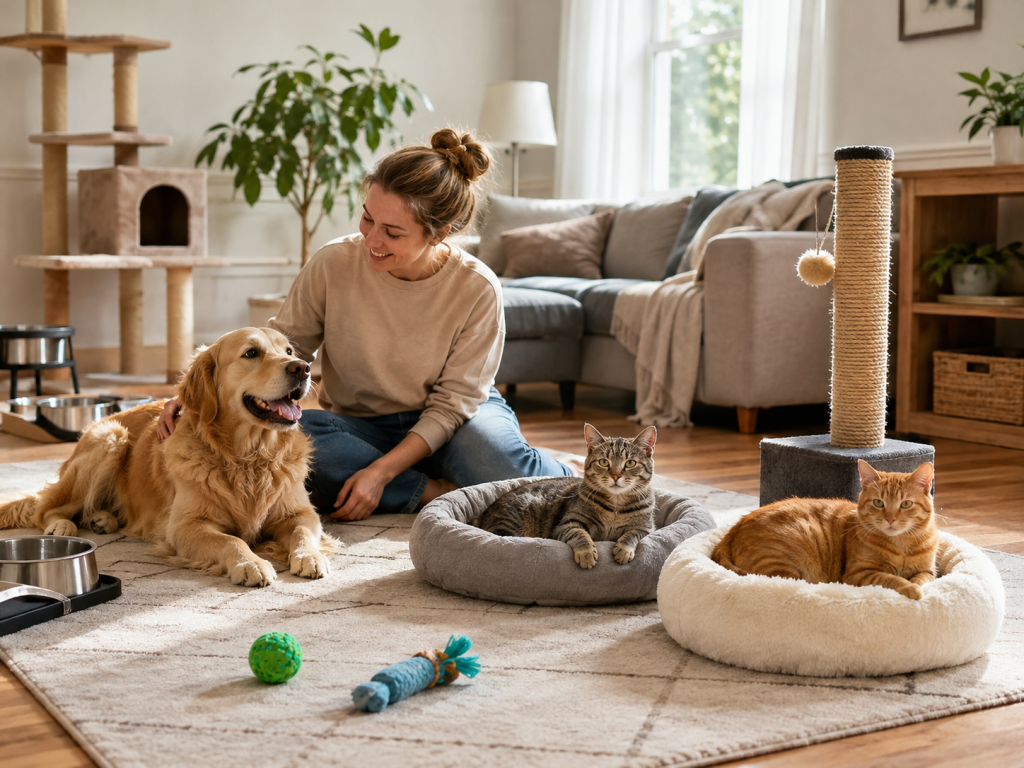
Pet ownership involves a long-term responsibility to provide appropriate food, clean water, veterinary care, exercise, enrichment, safe housing, social interaction, and protection from preventable harm. These responsibilities become more complex when several dogs, cats, or both species share the same home because each animal still needs individual access to important resources and appropriate care. The AVMA describes responsible pet ownership as providing suitable nutrition, water, shelter, healthcare, companionship, exercise, and an environment that protects animal health and welfare.
A successful multi-pet household is not simply a home where animals avoid fighting. Pets should be able to eat, drink, sleep, eliminate, play, and move through the home without persistent fear, competition, or harassment. For cats in particular, current feline guidance emphasizes providing multiple separated resources and recognizing subtle signs of tension before conflict becomes severe.
Good planning before adding another pet can therefore make an enormous difference to the wellbeing of every animal already living in the home.
Responsible Pet Ownership Starts Before Adoption
Choosing a pet should involve more than deciding which animal looks appealing.
Consider the expected lifespan, veterinary expenses, food, grooming, exercise requirements, training, housing restrictions, travel arrangements, and time needed for daily care. Adding another animal also increases the number of relationships and routines that must be managed.
A household that comfortably supports one pet may not automatically be able to support three.
Think realistically about space, finances, working hours, existing animals, and whether each pet can receive individual attention.
Every Pet Is an Individual
Species and breed tendencies can provide useful general information, but they do not determine exactly how one animal will behave.
One dog may enjoy living with cats, while another may become intensely excited by them. One cat may enjoy the company of another cat, while another prefers maintaining greater social distance.
Age also matters.
A highly energetic puppy or kitten may repeatedly attempt to play with an older animal that wants to rest. Feline behavioral guidance specifically notes that young cats may seek social play from mature cats that do not appreciate or reciprocate it.
Successful pet ownership therefore requires responding to the individuals in front of you rather than expecting every animal to follow a stereotype.
Do Not Assume Pets Need a Friend
Owners sometimes adopt another animal because they believe their current pet must be lonely.
That can work well when the animals are socially compatible, but companionship is not guaranteed.
Dogs are socially flexible and can form relationships with other dogs, including animals introduced during adulthood. Cats can also form close social bonds, but sharing a home does not automatically mean two cats consider one another companions.
Before adopting another pet, consider whether the existing animal actually appears comfortable around members of that species.
Adding another animal should benefit the household rather than simply satisfy the idea that every pet needs a companion.
Introductions Should Be Gradual
First impressions matter.
Do not immediately place unfamiliar pets together in a confined space and expect them to determine the relationship themselves.
New cats often benefit from beginning in a separate room with their own food, water, litter box, scratching resources, beds, and hiding areas. FelineVMA guidance recommends gradual introductions when bringing a new cat into a household.
Dogs should also be introduced in controlled circumstances where excitement can be managed and both animals have room to move away.
A slower introduction is usually easier to accelerate than a frightening first encounter is to repair.
Introduce Cats Through Scent First
Cats communicate heavily through scent.
Before direct interaction, allow each cat to become familiar with the other’s smell through bedding, resting materials, or carefully managed room exchanges.
This allows information about the unfamiliar animal to become part of the environment without immediate physical pressure.
When both cats appear comfortable, controlled visual contact can gradually be introduced.
Do not rush to unrestricted access simply because no hissing occurred during one brief meeting.
Dog-to-Dog Introductions
When practical, unfamiliar dogs can often meet in a neutral or low-pressure environment before sharing indoor territory.
Keep leads relaxed enough to allow natural movement while maintaining safety.
Watch for loose movement, pauses, voluntary disengagement, and the ability to respond to handlers.
Rigid posture, prolonged staring, repeated attempts to escape, intense guarding, or escalating aggression are reasons to increase distance.
Not every dog needs to play with every other dog.
Calm coexistence is a perfectly successful outcome.
Introducing Dogs and Cats
Dog-cat introductions require particular attention to chasing behavior.
Keep the dog controlled initially and provide the cat with elevated escape routes and protected areas.
Do not allow chasing simply because the dog appears playful. A chase can be frightening for the cat and can also strengthen the dog’s tendency to pursue.
Reward calm behavior around the cat.
The cat should always have the option to retreat rather than being held in place for an introduction.
Give New Pets Their Own Space
Every new animal should initially have somewhere they can rest without interruption.
For a cat, this may be a separate room with hiding and climbing opportunities.
For a dog, it may be a quiet bed, gated area, pen, or appropriately introduced crate.
Private areas are especially useful during the early adjustment period.
Animals can process new surroundings more comfortably when they are not expected to interact constantly.
Multi-Pet Homes Need Multiple Resources
One bowl, one bed, and one preferred resting area can create unnecessary competition.
Provide enough food stations, water locations, resting areas, toys, scratching surfaces, and toileting resources for the animals living in the home.
For cats, feline guidelines specifically recommend safe places and multiple separated resources, including food, water, litter boxes, and resting locations.
The word separated matters.
Five bowls lined up side by side may function more like one feeding area than five independent resources.
Feeding Pets Separately Can Be Helpful
Separate feeding makes it easier to control portions and monitor appetite.
It can also reduce conflict.
One dog may eat quickly and then attempt to take another dog’s meal. A confident cat may quietly prevent a more timid cat from approaching a shared feeding area.
Separate rooms, barriers, elevated cat feeding stations, or scheduled feeding can solve many of these problems.
Remove bowls after meals when appropriate so leftover food does not become another resource to guard.
Dogs and Cats Should Eat Species-Appropriate Food
Cats and dogs have different nutritional requirements.
A cat occasionally stealing a piece of dog food or a dog eating a few pieces of cat food is different from sharing the same primary diet.
Each animal should receive complete food appropriate for their species, life stage, health, and body condition.
Separate feeding is especially useful when one pet requires a therapeutic veterinary diet.
Monitor How Much Each Pet Eats
Shared food bowls make appetite changes difficult to detect.
One pet may appear to be eating normally when another animal is actually consuming most of the food.
Measured meals allow owners to notice when an individual animal begins eating less, eating more, or losing interest in food.
This becomes increasingly important for senior pets and animals with chronic medical conditions.
Know what each animal normally eats.
Prevent Food Guarding
Some dogs and cats become defensive around valuable resources.
Do not repeatedly test an animal by removing food simply to see whether they will react.
Instead, prevent competition and provide enough distance between pets.
If serious guarding occurs, management should prioritize safety while professional behavioral help is sought.
Aggression can become stronger when animals repeatedly discover that aggressive behavior successfully removes a perceived threat.
Multi-Cat Homes Need Enough Litter Boxes
Litter boxes are particularly important resources.
Cats should be able to reach a clean box without passing another cat that intimidates, stalks, or blocks them.
Place boxes in more than one area of the home rather than clustering every box together.
Current intercat-tension guidance emphasizes dispersing key resources throughout the environment and using physical or visual separation where helpful.
A sudden litter box problem may therefore reflect social tension as well as medical or litter-preference issues.
Cats Need Vertical Territory
Floor space is not the only useful space for cats.
Cat trees, shelves, window perches, and stable elevated furniture create additional resting areas and travel routes.
Vertical territory can be particularly valuable when several cats share a home.
One cat may be able to pass through a room on a shelf while another remains on the floor, reducing unwanted close encounters.
Multiple levels also allow cats to choose observation points where they feel secure.
Provide Hiding Places
Hiding is a normal coping behavior for cats.
Boxes, covered beds, shelves, and quiet protected spaces give cats opportunities to withdraw from interaction.
Dogs also benefit from uninterrupted resting locations.
Do not allow children or other animals to repeatedly invade a pet’s safe space.
Being able to disengage can prevent escalation when an animal feels tired, frightened, or overwhelmed.
Watch for Subtle Intercat Tension
Cats do not need to have dramatic fights for a household to contain conflict.
The 2024 FelineVMA Intercat Tension Guidelines emphasize recognizing subtle tension and preventing chronic fear, anxiety, stress-related disease, and undesirable behavior.
Possible signs include prolonged staring, stalking, blocking doorways, chasing, one cat avoiding particular rooms, or one cat waiting until another leaves before approaching food or the litter box.
These patterns can be easy to miss.
Watch how cats use the entire home rather than evaluating their relationship only when they are lying near each other.
Fighting and Playing Are Not Always Easy to Distinguish
Healthy social play often includes pauses and role changes.
One animal may chase and then become the one being chased.
Both animals generally choose to return to the interaction.
Conflict tends to involve greater tension, attempts to escape, persistent pursuit, defensive vocalization, or one animal repeatedly trying to end the interaction.
When one pet consistently avoids the other afterward, the interaction may not have been mutually enjoyable.
Redirected Aggression Can Affect Multi-Cat Homes
A cat may become highly aroused by something they cannot reach, such as an unfamiliar cat outside a window.
That arousal can sometimes be redirected toward another cat or person nearby. Merck recognizes redirected aggression as an important feline behavioral problem.
Do not immediately attempt to pick up an intensely aroused cat.
Separate animals safely and allow time for arousal to decrease.
Reintroductions may need to be gradual if a serious fight occurs.
Give Each Pet Individual Attention
Living with several animals does not replace interaction with the owner.
Dogs may need individual walks, training, grooming, or play.
Cats may benefit from individual interactive play, brushing, quiet contact, or training sessions.
Individual time is also useful for noticing health changes.
You may detect a lump, mobility problem, appetite change, or painful area that would be easy to miss during group activity.
Avoid Creating Constant Competition for Attention
Some animals become excited when another pet receives affection.
Rather than pushing pets together around a valuable resource such as food or human attention, reward calm waiting and provide interaction separately when necessary.
Do not punish one animal for moving away from a crowded social situation.
Pets should have choices about participation.
A home does not need every animal sitting together at the same time to be socially successful.
Maintain Predictable Routines
Feeding, walks, litter cleaning, play, and rest become easier when pets have a reasonably predictable routine.
Major household changes can affect animals differently.
One pet may adjust immediately while another becomes anxious, hides, stops eating normally, or develops elimination problems.
Introduce changes gradually when possible.
Preserving familiar resources and routines can help pets adapt to new animals, moving house, visitors, or schedule changes.
Provide Species-Specific Enrichment
Dogs and cats need different types of stimulation.
Dogs often benefit from walks, sniffing, training, chewing, retrieving, and exploring.
Cats often enjoy stalking toys, climbing, scratching, hiding, watching from elevated areas, and food puzzles.
Do not expect one pet’s entertainment to satisfy everyone.
A dog playing energetically in the living room may actually make a timid cat less willing to enter the area.
Exercise Pets According to Individual Needs
Multi-pet households sometimes treat group exercise as if every animal has identical needs.
One young dog may need significantly more activity than an elderly dog.
A kitten may want repeated play sessions while a senior cat prefers shorter, gentler interaction.
Individual exercise protects both physical health and household harmony.
An under-stimulated young pet may otherwise direct excess energy toward older animals.
Protect Senior Pets From Younger Animals
Young animals can be relentless play partners.
Puppies and kittens may repeatedly jump on, chase, or wrestle with senior pets that have arthritis, reduced vision, or lower energy.
Provide senior animals with protected resting areas that younger pets cannot constantly invade.
Age-related mobility changes should also be considered when placing food, water, beds, and litter boxes.
A harmonious household allows older pets to rest.
Veterinary Care Must Remain Individual
Having several pets can make preventive healthcare more complicated.
Keep separate vaccination records, medication schedules, weights, parasite treatments, medical histories, and feeding instructions for each animal.
Regular checkups remain important even when all pets appear healthy.
Responsible pet ownership includes timely veterinary care throughout life, not only emergency treatment.
Shared household exposure may also affect preventive recommendations, particularly when new animals are introduced.
Quarantine and Health Checks for New Pets
A newly adopted animal may have an incomplete medical history.
Arrange veterinary care and discuss vaccination, parasite prevention, infectious-disease concerns, and any appropriate testing.
Avoid immediately sharing every bowl, litter area, or close sleeping space before the newcomer has been appropriately assessed.
This is especially important when introducing animals from shelters, outdoor environments, or unknown backgrounds.
Follow your veterinarian’s recommendations for the individual situation.
Parasite Prevention Matters More With Several Pets
Fleas and some intestinal parasites can spread through a household.
If one animal develops a parasite problem, the veterinarian may need to consider other pets and the environment as well.
Use prevention appropriate for each species, age, body weight, lifestyle, and geographic risk.
Never assume one product can be used interchangeably between dogs and cats.
Products formulated for dogs can contain ingredients that are unsafe for cats.
Identification for Every Pet
Every pet should have reliable identification.
Microchips are particularly valuable because collars and tags can become lost.
Keep registration information current after changing phone numbers or addresses.
Multi-pet households should also have photographs and medical information available for each animal.
This becomes especially useful during emergencies, evacuations, travel, or accidental escape.
Plan for Veterinary Emergencies
Several pets mean a greater chance that unexpected medical expenses will occur.
Pet insurance, emergency savings, or another financial plan can make urgent decisions easier.
AAHA’s current guidance for new dog owners specifically recommends considering pet insurance or establishing emergency savings alongside preventive healthcare planning.
Know where the nearest emergency veterinary clinic is located.
Keep carriers, leads, and important records accessible rather than searching for them during a crisis.
Plan for Travel and Vacations
Multi-pet homes require additional planning when owners travel.
Determine whether animals will remain together at home with a pet sitter, stay with relatives, or require boarding.
Some closely bonded pets may be more comfortable remaining together, while others require separate management.
Leave clear written instructions covering food, medication, walks, litter boxes, behavior, emergency contacts, and veterinary details.
Do not assume a sitter will automatically know each animal’s routine.
Prepare for Household Emergencies
Fires, storms, evacuations, and sudden hospitalization can disrupt pet care quickly.
Keep enough carriers or safe restraint equipment for every animal.
Maintain identification and veterinary records.
An emergency plan should account for the fact that frightened cats may hide and frightened dogs may behave differently from normal.
Practice comfortable carrier use before an emergency occurs.
Children and Multi-Pet Homes
Children should learn how to interact respectfully with animals.
Teach them not to disturb pets while eating or sleeping, corner frightened animals, chase cats, climb on dogs, or repeatedly pick up pets that are trying to leave.
Adult supervision is especially important with young children.
Pets need the ability to retreat to areas where they will not be followed.
Good boundaries protect both children and animals.
Watch for Behavior Changes
Changes in behavior can indicate social stress or physical illness.
A pet that suddenly hides, becomes aggressive, avoids a room, stops playing, changes appetite, or begins eliminating in unusual locations needs attention.
Do not automatically assume another pet is responsible.
Pain, illness, sensory decline, and other medical conditions can also change behavior.
Veterinary evaluation is particularly important when behavior changes suddenly.
When to Seek Behavioral Help
Professional help may be appropriate when pets repeatedly fight, guard resources, chase one another, prevent access to food or litter boxes, or appear chronically frightened.
Serious aggression should not be managed through repeated uncontrolled exposure.
Merck recommends prevention and avoidance of dangerous situations while veterinarians and owners develop appropriate behavior-modification strategies.
A veterinarian can first evaluate whether pain or disease is contributing.
Qualified behavior professionals can then help create a structured management and training plan.
Never Punish Pets for Being Afraid
Growling, hissing, hiding, or attempting to escape communicates discomfort.
Punishing these warning signals may increase fear without improving the relationship between animals.
Instead, increase distance and identify the trigger.
Animals should not be forced to remain beside another pet when they clearly want to leave.
Safety and voluntary interaction are more important than creating the appearance of friendship.
Accept Peaceful Coexistence
Not every pair of pets will become inseparable companions.
Two cats may share a home successfully while sleeping separately.
A dog and cat may comfortably ignore one another most of the day.
That is not a failed relationship.
The important goal is that each animal can access resources, rest, move around the home, and interact with the family without persistent fear or conflict.
Should You Add Another Pet?
Before expanding the household, ask whether you can provide enough time, space, money, veterinary care, and separate resources for another animal.
Consider the age, health, temperament, and behavior of existing pets.
An elderly cat with significant stress around other animals may not benefit from a highly energetic kitten. A dog with intense predatory behavior may require careful professional assessment before living with smaller animals.
Adoption should improve welfare rather than simply increase the number of pets in the home.
Building a Healthy Multi-Pet Home
Good pet ownership and multi-pet homes depend on meeting the needs of every individual animal rather than treating the household as one unit.
Responsible ownership includes appropriate food, clean water, housing, exercise, companionship, safety, and timely veterinary care throughout the animal’s life.
Introduce new animals gradually and provide enough space for pets to disengage. In multi-cat homes, current feline guidance specifically emphasizes multiple separated resources, safe places, and careful recognition of subtle intercat tension.
Feed pets individually when necessary, provide species-appropriate enrichment, protect older animals from unwanted rough play, and make sure every pet can reach food, water, resting areas, and toileting resources without intimidation.
Most importantly, do not measure success by whether every animal cuddles or plays together. Some pets form close relationships, while others prefer peaceful coexistence.
A successful multi-pet household is one in which each animal can feel safe, access essential resources, receive individual care, and maintain a good quality of life.