
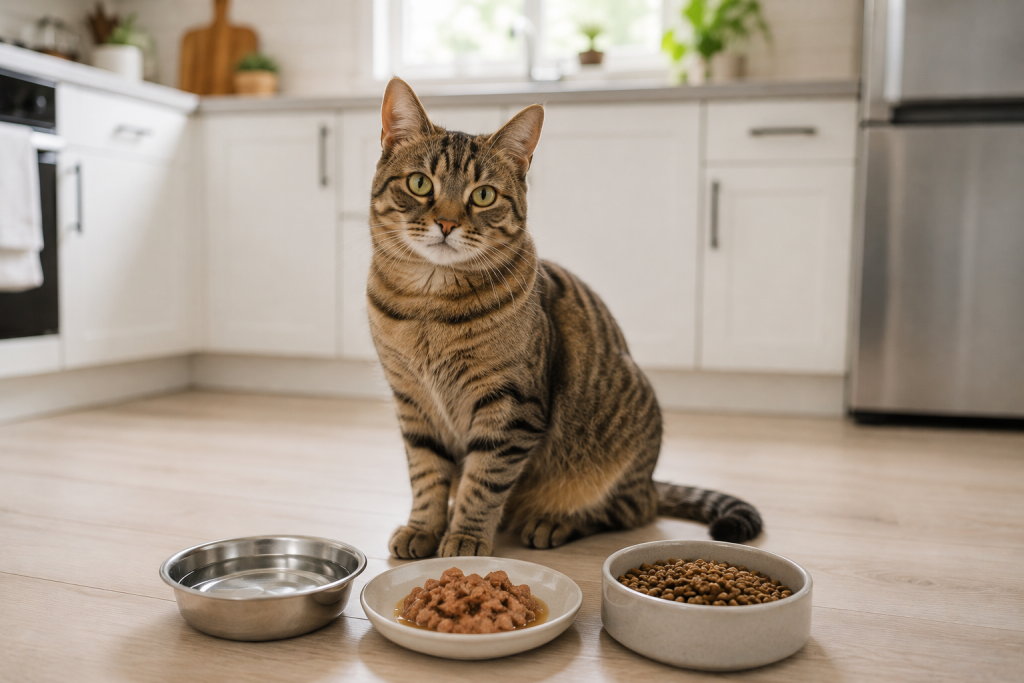
Cat nutrition is the foundation of healthy growth, body weight, muscle maintenance, energy, organ function, and long-term wellbeing. Cats have specialized nutritional requirements and should normally receive a complete and balanced diet formulated specifically for their species and life stage. AAFCO defines “complete” as containing all required nutrients and “balanced” as providing those nutrients in the correct proportions.
Cats are obligate carnivores and require nutrients that differ from those needed by dogs. Taurine is particularly important because cats cannot produce enough of it to meet their needs, and deficiency can contribute to serious heart and eye disease.
The right feeding plan also depends on the individual cat. Age, body condition, activity, health, reproductive status, and lifestyle all influence nutritional needs, which is why WSAVA recommends an individually tailored nutrition plan rather than one universal diet for every cat.
What Nutrients Do Cats Need?
Cats require protein, fat, vitamins, minerals, essential fatty acids, amino acids, and sufficient energy to maintain normal body functions.
Merck Veterinary Manual notes that cats need diets rich in high-quality fats and proteins along with specific amino acids such as taurine.
A food can contain ingredients that sound healthy while still failing to provide the correct nutritional balance. This is why the complete formulation matters more than focusing on one ingredient on the label.
Cats Are Obligate Carnivores
Cats evolved as hunters and have nutritional requirements closely connected to animal-based foods.
Unlike dogs, they cannot adapt as easily to diets lacking certain nutrients normally found in animal tissue. Taurine, arachidonic acid, preformed vitamin A, and specific amino acids are particularly important in feline nutrition.
Merck explains that cats require a meat-based protein source in a balanced diet to provide important amino acids and fatty acids required for feline metabolism.
This does not mean cats should simply be fed plain meat. Meat alone does not provide all nutrients in the correct proportions.
Why Taurine Is Essential
Taurine is one of the best-known feline nutritional requirements.
Cats cannot synthesize enough taurine on their own, so they must obtain it from their diet. Merck identifies taurine as an essential amino acid for cats and notes that deficiency can lead to dilated cardiomyopathy and central retinal degeneration.
Modern complete commercial cat foods are formulated with adequate taurine. This has dramatically reduced taurine-deficiency heart disease compared with the past.
Feeding nutritionally unbalanced homemade or vegetarian diets can increase the risk of deficiency.
What Does “Complete and Balanced” Mean?
One of the most important things to look for on a cat food label is the nutritional adequacy statement.
AAFCO states that complete foods contain all required nutrients, while balanced foods provide them in the correct ratios. Recognized life stages include growth, adult maintenance, gestation and lactation, and all life stages.
A kitten food is therefore not simply an adult food with different packaging.
Likewise, treats and complementary products are generally not intended to replace a complete feline diet.
How to Read a Cat Food Label
Start with the nutritional adequacy statement.
This tells you whether the product is intended to provide complete nutrition and which life stage it supports. AAFCO identifies this statement as one of the most important parts of the pet food label.
Then check calorie information, feeding directions, and the manufacturer.
Ingredient lists can provide useful information, but they do not tell you by themselves whether the overall diet is nutritionally appropriate.
Protein Is Especially Important for Cats
Protein provides amino acids used to build and maintain tissues, enzymes, hormones, muscles, and many other body structures.
Cats have relatively high dietary protein requirements compared with many other animals.
However, the goal is not simply to buy the food with the highest protein percentage on the shelf.
The quality of the complete formulation, digestibility, calorie balance, and suitability for the individual cat matter more than one number.
Fat Provides Concentrated Energy
Fat is a concentrated source of calories and supplies essential fatty acids.
It contributes to skin and coat health, food palatability, and energy density.
Cats that need to gain or maintain weight may benefit from appropriate energy density, while overweight cats require careful calorie control.
Fat itself is not inherently bad, but calorie intake must remain appropriate for the cat’s needs.
Do Cats Need Carbohydrates?
Cats do not have a specific dietary requirement for carbohydrates in the same way they require certain amino acids and fatty acids.
However, properly formulated cat foods can contain digestible carbohydrate ingredients while still providing complete nutrition.
The presence of rice, corn, wheat, potatoes, or similar ingredients does not automatically make a food unhealthy.
Judge the complete nutritional profile rather than one ingredient.
Grain-Free Does Not Automatically Mean Better
Grain-free diets are heavily marketed, but removing grains does not automatically improve nutrition.
A grain-free label says more about which ingredients are absent than whether the diet is complete, balanced, appropriate, or scientifically formulated.
Unless your veterinarian has identified a specific reason to avoid an ingredient, there is no universal requirement for healthy cats to eat grain-free food.
Nutritional adequacy should come before marketing terminology.
Wet Food vs. Dry Food
Both wet and dry cat foods can provide complete and balanced nutrition when properly formulated.
The major practical difference is moisture content. Canned foods contain much more water, while dry foods are more calorie-dense and convenient for storage, measuring, and food puzzles. Merck describes canned and dry foods as common forms of nutritionally complete commercial pet food.
Some cats eat exclusively wet food, some eat dry food, and others receive a combination.
There is no universal requirement for every healthy cat to eat one format exclusively.
Benefits of Wet Cat Food
Wet food contributes substantial dietary moisture.
This can be helpful for cats that naturally drink relatively little water.
Its softer texture may also be appealing to some cats with dental or appetite problems, although painful dental disease still requires veterinary care.
Wet food can be lower in calories per gram because of its water content, but portion size still matters.
Benefits of Dry Cat Food
Dry food is convenient, easy to measure, and useful for puzzle feeders.
It generally contains more calories per gram than wet food because much of the moisture has been removed.
This makes portion control particularly important.
Leaving a large bowl continuously available can allow some cats to consume substantially more calories than they need.
Can Cats Eat Wet and Dry Food Together?
Yes.
A combination of complete wet and dry food can work well for many cats.
The important issue is total calorie intake.
Do not give a full daily allowance of dry food and then add a full daily allowance of wet food unless the combined calories have been calculated appropriately.
Divide the total daily ration between the two formats.
Fresh Water Is Essential
Cats should always have access to fresh, clean water.
Even cats receiving wet food still need drinking water available.
Some cats prefer wide bowls, multiple water locations, or fountains.
Place water where the cat can drink without being disturbed by other animals and keep bowls clean.
A persistent increase in thirst can be medically important and should be discussed with a veterinarian.
How Much Should You Feed a Cat?
There is no universal portion size.
A cat’s needs depend on body weight, body condition, age, activity, reproductive status, health, and the calorie density of the food.
Feeding instructions on the package provide a starting point rather than an exact prescription.
WSAVA recommends evaluating nutrition individually and adjusting the plan according to the pet’s condition.
Monitor the cat rather than blindly following the same feeding amount for years.
Measure Food Consistently
Small errors can matter significantly in cats because their total daily calorie requirements are relatively modest.
Adding only a little extra food each day can gradually lead to substantial weight gain.
Measure dry food carefully or use a kitchen scale when precision matters.
For wet food, calculate how much of each can or pouch contributes to the total daily ration.
Body Condition Matters More Than Bowl Size
Two cats of the same body weight can have different ideal calorie requirements.
This is why body condition scoring is useful.
WSAVA’s feline body-condition system evaluates fat coverage, waist, ribs, and abdominal fat to determine whether a cat is below, at, or above ideal condition.
Ask your veterinarian to show you how your cat scores so you can monitor changes at home.
Obesity Is Common but Preventable
Indoor cats can gain weight gradually when calorie intake exceeds activity.
Free feeding, calorie-dense treats, multiple household members feeding the cat, and limited physical activity can all contribute.
Weight management should focus on measured food, appropriate enrichment, and regular body-condition monitoring.
Do not wait until obesity is severe before adjusting the routine.
Safe Weight Loss
Overweight cats should lose weight gradually under an appropriate nutritional plan.
Severe calorie restriction can be dangerous, particularly in cats.
The goal is controlled fat loss while preserving adequate protein, vitamins, minerals, and other nutrients.
Veterinary weight-management diets may be useful because they are specifically formulated to provide complete nutrition at reduced calorie intake.
Never Starve an Overweight Cat
Cats that stop eating are at risk of serious metabolic complications.
This is particularly concerning in overweight cats, which can develop hepatic lipidosis when food intake falls dramatically.
Do not attempt rapid weight loss by simply withholding food.
If an overweight cat suddenly refuses meals, contact your veterinarian rather than assuming missing several days of food will help with weight loss.
Feeding Kittens
Kittens require food formulated specifically for growth.
AAFCO recognizes growth as a separate nutritional life stage because growing animals require different nutrient concentrations from adults.
Young kittens also have small stomachs and high energy requirements.
They generally benefit from several meals throughout the day rather than relying on one large meal.
When Should Kittens Switch to Adult Food?
Most kittens transition toward adult-maintenance nutrition around the end of their first year, although individual development can vary.
Do not switch too early simply because the kitten appears physically large.
Growth diets are designed to support developing tissues, bones, organs, and energy requirements.
Your veterinarian can help determine when your kitten has reached an appropriate stage for transition.
Adult Cat Nutrition
Once growth is complete, most healthy cats need food formulated for adult maintenance.
The goal is to maintain healthy body weight, muscle condition, activity, and overall health.
Portions may need to change over time.
A young adult cat that runs through the house constantly may need more calories than the same cat several years later after becoming less active.
Senior Cat Nutrition
Older cats should be fed according to health and body condition rather than age alone.
Some senior cats gain weight because activity decreases, while others begin losing body weight and muscle.
Medical conditions such as kidney disease, hyperthyroidism, diabetes, or digestive disorders can also dramatically change nutritional needs.
Do not automatically place every older cat on a low-protein or low-calorie diet.
Senior Cats and Muscle Maintenance
Muscle loss can occur with aging and chronic illness.
A senior cat may look thinner over the spine, hips, or shoulders even when total body weight has not changed dramatically.
Adequate nutrition and appropriate protein intake are important for preserving lean tissue.
Veterinary assessment is useful when muscle loss becomes noticeable.
Feeding Frequency and Natural Cat Behavior
Cats naturally tend to eat multiple small meals rather than one or two very large meals.
FelineVMA’s feeding consensus recommends allowing normal feeding behaviors such as hunting, foraging, and consuming frequent small meals when practical.
This does not mean food must be freely available all day.
Measured portions can be divided into several small meals or delivered through timed and puzzle feeders.
Food Puzzles Can Improve Feeding Enrichment
Food does not always need to come from a bowl.
Puzzle feeders can encourage cats to search, manipulate objects, and work for part of their food.
This can increase activity and better reflect natural foraging behavior.
Use food from the cat’s measured daily ration instead of adding extra calories specifically for enrichment.
Multi-Cat Homes Need Separate Feeding Options
Cats often prefer to eat without competition.
Feline feeding guidance emphasizes that cats may benefit from eating in solitary locations, particularly in multi-pet households.
One cat may otherwise eat too quickly because another cat approaches, while a timid cat may eat too little.
Separate feeding areas also make it easier to know how much each individual cat consumes.
Free Feeding
Leaving dry food available all day works for some cats but can contribute to overeating in others.
It also makes appetite changes more difficult to detect.
If three cats share one continuously filled bowl, it can be nearly impossible to know whether one cat has stopped eating.
Measured meals or controlled portions make health monitoring and weight management easier.
Treats Should Stay Limited
Treats can be useful for bonding, training, and enrichment, but they should make up only a small part of daily calorie intake.
Current WSAVA guidance recommends keeping treats to no more than about 10% of a healthy cat’s daily calories.
AAFCO also notes that treats are generally not intended to provide complete and balanced nutrition.
The majority of calories should therefore come from the cat’s nutritionally complete primary food.
Human Food Should Remain Occasional
A small amount of an appropriate plain food may be safe for some cats, but human meals should not replace complete feline nutrition.
Prepared foods can contain excessive fat, salt, seasoning, onion, garlic, or other unsuitable ingredients.
Cats also need nutrients such as taurine that ordinary human meals may not provide consistently.
Use human foods as rare extras rather than the foundation of the diet.
Can Cats Drink Milk?
Adult cats do not need cow’s milk.
Many cats digest lactose poorly, which can lead to gastrointestinal upset.
Current WSAVA treat guidance lists milk and dairy products among foods to avoid because many cats are lactose intolerant.
Fresh water should remain the normal drink.
Raw Meat Diets
Raw feeding carries nutritional and food-safety concerns.
Raw animal products can contain harmful microorganisms, and a diet built from meat alone can be deficient or imbalanced.
FelineVMA educational guidance advises owners to avoid raw meat-based diets and to cook meat thoroughly when offering it.
If you want to feed a home-prepared diet, consult a veterinary nutrition specialist rather than improvising.
Homemade Cat Diets
Home-prepared feeding can be nutritionally adequate when professionally formulated.
However, homemade diets assembled from meat, fish, rice, vegetables, or supplements are easy to imbalance.
Merck warns that homemade diets are often deficient in essential vitamins and minerals and generally recommends nutritionally balanced commercial diets for ordinary feeding.
If a homemade diet is medically necessary or strongly preferred, follow a veterinary nutritionist’s recipe precisely.
Vegetarian or Vegan Diets
Cats have specialized nutritional requirements that make vegetarian or vegan feeding particularly difficult.
Taurine, specific amino acids, fatty acids, and other nutrients must be provided in appropriate amounts.
Merck notes that taurine-deficiency dilated cardiomyopathy can still occasionally occur in cats eating noncommercial diets such as vegetarian or poorly balanced home-prepared foods.
Do not attempt plant-based feeding without specialist veterinary nutritional oversight.
Fish Should Not Be the Entire Diet
Cats often enjoy fish, but plain fish alone is not nutritionally complete.
A commercial cat food containing fish can be balanced because other nutrients are added to create the complete formulation.
Feeding canned tuna or cooked fish as the main diet is different.
Human fish products should remain occasional extras unless incorporated into a professionally formulated diet.
Supplements Are Usually Not Automatically Necessary
A healthy cat eating a complete and balanced commercial diet generally should not need random vitamin or mineral supplements.
Adding nutrients unnecessarily can disrupt an already balanced formulation.
Supplements may have legitimate medical uses, but they should address a specific need.
Discuss supplements with your veterinarian before adding them routinely.
Taurine Supplements
Commercial complete feline diets should already contain appropriate taurine.
Adding extra taurine to a complete diet is generally unnecessary unless a veterinarian identifies a specific reason.
The better strategy is to ensure that the primary food itself is nutritionally appropriate.
Homemade feeding is where taurine and other nutrient deficiencies become a greater concern.
Omega-3 Fatty Acids and Other Supplements
Fish oils and other fatty-acid supplements may be used for certain medical conditions.
However, dose, calorie content, and product quality matter.
Supplements can also interact with medications or be inappropriate for some health conditions.
Ask your veterinarian before using them routinely.
Changing Cat Food
Cats can be sensitive to sudden food changes.
When there is no medical reason for an immediate switch, introduce the new food gradually by mixing increasing amounts with the old diet.
Cats can also develop strong preferences for particular textures, flavors, or shapes.
A gradual transition gives the digestive system and the cat’s feeding preferences time to adjust.
Do Not Let a Cat Refuse Food for Too Long During a Transition
A cat should not be forced into accepting a new food through prolonged starvation.
If the cat refuses the new diet completely, continue offering a safe familiar option while discussing the transition with your veterinarian.
Cats can develop serious complications when calorie intake falls dramatically.
This is particularly important for overweight cats.
Food Allergies
Food allergy can cause skin or gastrointestinal symptoms, but it should not be diagnosed simply by switching flavors.
A controlled elimination diet may be required to determine whether food ingredients are contributing.
Hydrolyzed or novel-protein veterinary diets are sometimes used for this purpose.
Follow the diet strictly because additional treats or foods can interfere with the trial.
Therapeutic Veterinary Diets
Prescription or therapeutic diets can be important parts of managing certain diseases.
Veterinarians may recommend specialized diets for kidney disease, urinary disorders, gastrointestinal disease, diabetes, obesity, allergies, or other conditions.
These foods deliberately alter nutrient levels to support management of a specific problem.
They are not automatically healthier for every cat.
Kidney Disease and Nutrition
Cats with chronic kidney disease may benefit from specifically formulated renal diets.
These diets differ from ordinary maintenance foods in several nutrient characteristics.
The nutritional strategy should be based on diagnosed disease rather than feeding a renal diet to a healthy senior cat simply as prevention.
Your veterinarian can determine whether and when a therapeutic diet is appropriate.
Urinary Health and Diet
Some cats with urinary disease may receive diets designed to influence urine characteristics or reduce the risk of certain crystals or stones.
Do not choose a urinary diet based only on marketing when your cat has urinary symptoms.
Different urinary problems require different management.
A veterinarian should determine the likely cause before selecting a therapeutic feeding plan.
Diabetes and Nutrition
Cats with diabetes require individualized nutritional and medical management.
Body weight, food composition, feeding schedule, and insulin treatment may all need to be coordinated.
Never dramatically change a diabetic cat’s diet or meal timing without veterinary advice because it may affect glucose management.
Nutrition During Pregnancy and Nursing
Pregnant and nursing cats have increased nutritional demands.
AAFCO recognizes gestation and lactation as a separate life stage from ordinary adult maintenance.
Queens should receive a complete diet designed to support these higher demands.
Veterinary monitoring can help maintain appropriate body condition throughout pregnancy and nursing.
Monitor Appetite
Appetite is an important health indicator.
A cat that normally eats enthusiastically but suddenly refuses food may have dental pain, nausea, stress, kidney disease, digestive disease, infection, or another health problem.
Measured feeding helps you detect changes earlier.
Persistent reduced appetite deserves veterinary attention.
Increased Appetite Can Also Matter
A cat eating much more than usual may have increased calorie needs, but persistent excessive hunger can also accompany medical conditions.
Hyperthyroidism and diabetes are examples of diseases that may affect appetite and body weight.
Pay particular attention when increased hunger occurs with weight loss, thirst changes, or increased urination.
Unexplained Weight Loss
Weight loss should not automatically be solved by simply adding more food.
Dental disease, thyroid disease, kidney disease, digestive disorders, cancer, diabetes, and other problems can affect weight.
A cat losing weight while eating normally or eating more than usual deserves veterinary evaluation.
Regular weighing helps identify the trend before it becomes visually obvious.
A Cat That Stops Eating Needs Attention
Cats are not animals that should simply be allowed to go several days without eating.
Reduced intake can become medically important, particularly when the cat is overweight or already ill.
Contact your veterinarian when your cat has stopped eating properly, especially if appetite loss continues or occurs with vomiting, lethargy, dehydration, pain, or weight loss.
Early intervention is safer than waiting until the cat becomes visibly weak.
Common Cat Nutrition Mistakes
Common mistakes include leaving unlimited calorie-dense food available, giving too many treats, using dog food as the primary diet, changing foods repeatedly, adding unnecessary supplements, and assuming homemade meat-based meals are automatically complete.
Another mistake is allowing marketing claims to become more important than nutritional adequacy.
The feeding plan should be based on the cat’s life stage, body condition, health, and response to the diet.
When to Ask Your Veterinarian About Nutrition
Professional nutritional guidance is particularly useful when your cat:
- Is overweight or underweight
- Is losing muscle
- Is a growing kitten
- Is pregnant or nursing
- Has kidney or urinary disease
- Has diabetes
- Has chronic vomiting or diarrhea
- Has suspected food allergies
- Needs a homemade diet
- Stops eating normally
- Loses weight unexpectedly
- Requires a therapeutic diet
WSAVA recommends individualized nutritional assessment because feeding needs depend on the whole animal rather than one general rule.
Building a Healthy Cat Nutrition Routine
Good cat nutrition begins with a complete and balanced food formulated for the appropriate feline life stage. AAFCO identifies growth, adult maintenance, gestation and lactation, and all life stages as recognized nutritional categories.
Cats also have species-specific nutritional requirements. Taurine is essential, and deficiency can contribute to serious heart and retinal disease, which is one reason cats should not be maintained on dog food or poorly formulated homemade diets.
Measure portions, monitor body condition, and keep treats to no more than about 10% of daily calories. Divide food into several smaller meals when practical, and consider puzzle feeding or other methods that allow normal hunting and foraging behaviors. FelineVMA specifically recommends feeding strategies that accommodate frequent small meals and solitary feeding preferences.
Both wet and dry foods can provide complete nutrition when properly formulated. Choose the format according to your cat’s health, preference, calorie needs, hydration, and daily routine rather than assuming one is always superior.
Avoid unbalanced homemade diets, raw feeding, unnecessary supplements, and prolonged food refusal during diet transitions. Therapeutic diets should be used for specific medical reasons under veterinary guidance.
Most importantly, monitor your cat rather than only the food label. Healthy nutrition should support stable body condition, appropriate muscle, normal digestion, good energy, and overall wellbeing.
When appetite, weight, thirst, digestion, or body condition changes significantly, discuss the feeding plan with your veterinarian. The best diet is the one that safely meets the nutritional needs of the individual cat.