
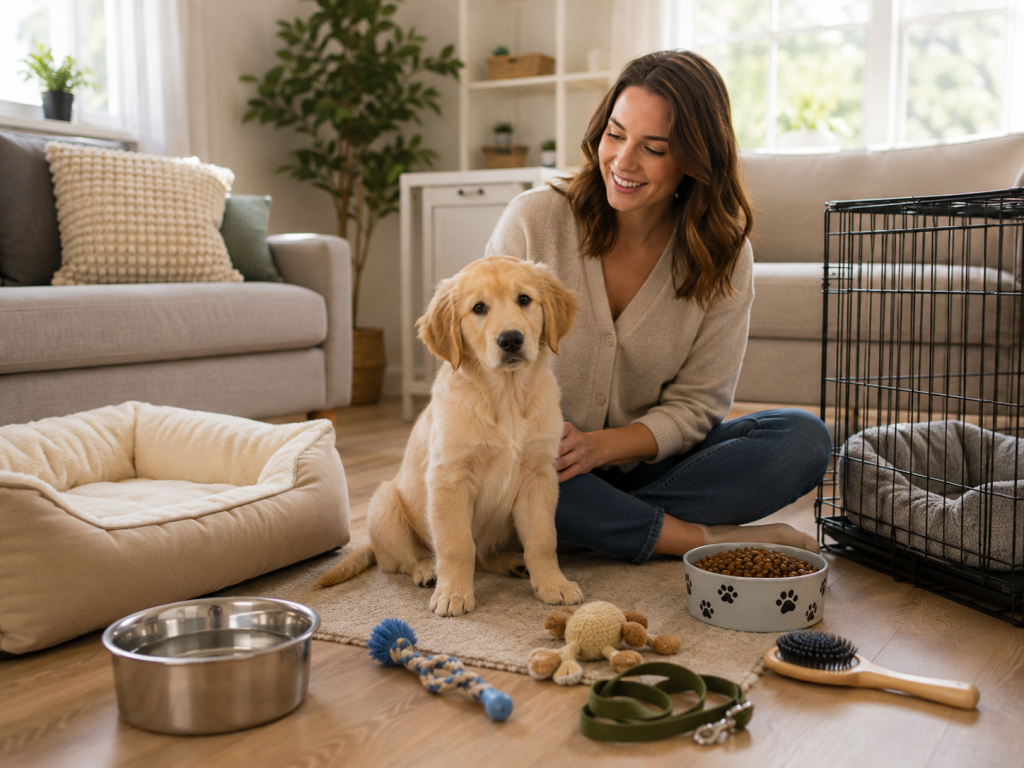
Puppy care essentials include proper nutrition, regular veterinary care, vaccinations, parasite prevention, house training, socialization, safe exercise, grooming, sleep, and a puppy-proofed home. Puppies grow quickly and depend heavily on their owners to create healthy routines during the first months of life. Their needs also change rapidly as they move from a very young puppy toward adolescence.
Good puppy care does not require making every day complicated. A predictable routine built around meals, bathroom breaks, sleep, play, short training sessions, and positive social experiences covers many of the most important needs. Veterinary visits then provide professional monitoring of growth, vaccination, parasite control, and overall development.
Understanding these essentials from the beginning can help prevent common problems and build the foundation for a healthy, confident adult dog.
Prepare Your Home Before the Puppy Arrives
Puppies explore their surroundings with their noses, paws, and especially their mouths.
Before bringing a puppy home, remove or secure medications, cleaning products, electrical cords, batteries, small objects, toxic foods, trash, and anything that could be swallowed. Shoes, socks, children’s toys, and other everyday objects can quickly become chewing targets.
Use baby gates or closed doors to limit access to unsafe areas.
Giving a young puppy unrestricted access to an entire house can make house training, supervision, and chewing management much more difficult.
Create a Comfortable Sleeping Area
Every puppy needs a quiet place to rest.
A comfortable bed, crate, or protected sleeping area gives the puppy somewhere predictable to relax away from constant household activity.
Place the resting area somewhere safe and comfortable rather than in a location where the puppy is repeatedly disturbed.
Children and other pets should also learn to leave the puppy alone when they are resting.
Sleep is an important part of physical and behavioral development, not simply downtime.
Schedule a Veterinary Visit
A veterinary examination should be one of the first priorities after bringing a puppy home.
Bring any available records showing previous vaccinations, deworming, medications, microchip information, or medical history. Your veterinarian can check general health, growth, body condition, teeth, heart, lungs, skin, eyes, ears, and other areas.
Puppies normally require several veterinary visits during their first months rather than one single appointment. Merck Veterinary Manual describes routine puppy care as including repeated veterinary visits, nutrition, preventive care, and monitoring throughout early development.
These appointments are also an opportunity to discuss feeding, socialization, behavior, grooming, and parasite prevention.
Keep Puppy Vaccinations on Schedule
Vaccination helps protect puppies against important infectious diseases.
AAHA divides canine vaccines into core vaccines recommended broadly and additional vaccines selected according to an individual dog’s lifestyle and exposure risks. The puppy vaccination schedule normally involves multiple appointments because reliable protection cannot be assumed after one early dose.
Your veterinarian will determine which vaccines your puppy needs and when they should be given.
Geographic location, travel, boarding, contact with other dogs, and local regulations can all influence the final vaccination plan.
Do Not Forget Parasite Prevention
Puppies can be exposed to intestinal worms, fleas, ticks, heartworm, and other parasites depending on where they live.
Your veterinarian may recommend stool testing, deworming, and preventive medication according to age, body weight, environment, and regional risk.
Do not assume that an indoor puppy cannot have parasites.
Young puppies can already carry intestinal parasites when they arrive in a new home, even if they appear completely healthy.
Only use parasite products appropriate for the puppy’s current age and weight.
Feed Food Designed for Puppy Growth
Growing puppies should receive nutritionally complete food formulated for growth.
Dogs require different nutrient concentrations at different stages of life, which is why puppy diets and adult-maintenance diets are not interchangeable.
Choose a reputable complete and balanced growth food rather than building meals from meat, rice, vegetables, or supplements without professional formulation.
Large and giant breeds deserve particular attention. Merck recommends appropriately formulated large-breed growth diets for puppies expected to reach approximately 32 kg, or 70 pounds, or more as adults.
Feed Puppies Several Times a Day
Young puppies need meals more frequently than adult dogs.
Merck’s puppy feeding schedule gives four meals per day from approximately 6 to 12 weeks, three meals between 3 and 6 months, and two meals between 6 and 12 months.
These are general guidelines rather than strict rules for every individual puppy.
Small breeds, medical conditions, food type, growth rate, and veterinary recommendations can affect the ideal feeding schedule.
Measure the total amount of food for the day and divide it between meals.
Measure Portions Carefully
Growing puppies need enough calories, but excessive weight gain is not beneficial.
Use the feeding guide on the puppy food as a starting point and then monitor body weight, growth, and body condition with your veterinarian.
Avoid filling the bowl repeatedly whenever the puppy appears hungry.
Food used during training also contributes calories. Using part of the puppy’s normal measured food allowance as training rewards can make calorie control easier.
Always Provide Fresh Water
Fresh, clean drinking water should normally be available throughout the day.
Wash the bowl regularly and place it somewhere the puppy can easily reach.
Water consumption changes with exercise, weather, food type, and body size.
Become familiar with how much your puppy normally drinks. A sudden major increase or decrease can provide useful health information.
Begin Potty Training Immediately
House training works best when a clear routine starts from the first day.
Take your puppy to the designated bathroom area after waking, eating, playing, drinking, and before sleeping.
Young puppies need bathroom opportunities much more frequently than adult dogs because bladder control is still developing.
Reward successful toileting immediately after the puppy finishes.
The reward helps make the correct location more valuable and easier to understand.
Do Not Punish Potty Accidents
Accidents are normal during puppy development.
Punishing the puppy after discovering urine or stool does not clearly explain what they should have done instead.
Clean the area thoroughly and improve supervision or the bathroom schedule.
If you catch the puppy beginning to eliminate indoors, calmly interrupt when possible and take them to the correct location.
House training depends more on prevention and repetition than punishment.
Consider Crate Training
A crate can provide a safe resting space and make household management easier when introduced properly.
Create positive associations by placing comfortable bedding, treats, meals, or safe toys inside.
Never use the crate as punishment.
The puppy should be able to stand, turn around, and lie comfortably. Young puppies also need frequent bathroom breaks and should not spend excessively long periods confined.
The goal is to create a safe space rather than simply a place to keep the puppy out of the way.
Socialization Is an Essential Part of Puppy Care
Socialization helps puppies learn that everyday people, environments, objects, sounds, and experiences are manageable.
AVMA recommends using praise, play, and treats to reward positive or neutral interactions while allowing the animal to move away when uncomfortable.
Introduce experiences gradually.
A puppy can encounter different people, safe surfaces, household sounds, gentle handling, car travel, and appropriate animals without being forced into overwhelming situations.
The quality of each experience matters more than checking off as many experiences as possible.
Socialization Should Be Safe, Not Delayed Completely
Owners sometimes believe a puppy must remain isolated until every vaccine is completed.
However, AAHA guidance notes that positive, structured exposure during sensitive developmental periods is important and that appropriately managed socialization does not necessarily need to wait until the entire vaccination series is finished. Exposure to sick animals should still be avoided and appropriate hygiene should be maintained.
Discuss safe local options with your veterinarian because infectious-disease risk varies by area.
Avoid high-risk environments where large numbers of unknown dogs gather until your veterinarian considers them appropriate.
Do Not Force a Fearful Puppy
A puppy that freezes, hides, tries to escape, or refuses food may be overwhelmed.
Move farther away from the trigger or reduce the intensity of the experience.
AVMA specifically recommends allowing pets to withdraw when they appear uncomfortable.
Forcing frightened puppies to remain close to intimidating people, animals, noises, or environments can create stronger negative associations.
Confidence grows when new experiences remain manageable.
Begin Reward-Based Training Early
Puppies can learn simple behaviors from an early age.
Start with their name, coming when called, sitting, waiting briefly, following you, and calmly accepting handling.
Keep sessions short and enjoyable.
Reward the puppy immediately when they perform the behavior you want.
Puppies have limited attention spans, so several short training sessions are generally easier than one long session.
Teach a Reliable Recall
Coming when called is one of the most useful skills a puppy can learn.
Start indoors or in another low-distraction environment.
Say the puppy’s name and recall cue, then reward enthusiastically when they reach you.
Avoid repeatedly calling the puppy for unpleasant experiences whenever possible.
The recall cue should predict something worthwhile, especially during early training.
Start Leash Training Gradually
A leash and collar or harness can feel unfamiliar at first.
Let the puppy become comfortable wearing the equipment indoors before expecting polished walking outdoors.
Reward staying near you and checking in voluntarily.
Young puppies will naturally stop to smell, investigate, and become distracted.
Loose-leash walking develops through consistent practice rather than pulling the puppy through every walk.
Provide Safe Chewing Options
Chewing is normal puppy behavior.
Young dogs investigate objects with their mouths, and chewing often becomes particularly noticeable during teething.
Provide several safe chew toys appropriate for your puppy’s size and chewing strength.
Rotate them to maintain interest.
Remove toys once they become damaged enough for pieces to break off and potentially be swallowed.
Redirect Puppy Biting
Mouthing and nipping are also common during puppy play.
If the puppy bites hands or clothing, redirect toward a suitable toy.
Avoid turning hands into wrestling toys if you do not want the adult dog to use teeth during play.
If the puppy becomes increasingly rough, they may need a short break or nap rather than more stimulation.
Overtired puppies can become much more difficult to settle.
Puppies Need Plenty of Rest
A puppy’s day should include repeated periods of sleep and quiet rest.
Constant entertainment can create an overtired puppy that struggles to control excitement.
Build naps into the daily routine.
Provide a calm sleeping area and avoid repeatedly waking the puppy simply because family members want to interact.
Rest should be balanced with play, training, socialization, and bathroom breaks.
Exercise Should Be Age-Appropriate
Puppies need physical activity, but more exercise is not always better.
Short walks, safe exploration, play, training, and gentle games can provide useful activity without requiring long repetitive running.
Growing bones and joints are still developing.
Large and giant breeds may require particular care around excessive repetitive high-impact activity.
Ask your veterinarian about appropriate exercise if your puppy has orthopedic concerns or belongs to a breed with specific developmental risks.
Mental Exercise Is Equally Important
Puppies also need opportunities to think.
Simple food puzzles, scent games, short training sessions, safe exploration, and appropriate chew activities can provide mental stimulation.
Use part of the puppy’s normal meal in enrichment toys rather than constantly adding extra treats.
Mental activity can help satisfy curiosity without simply trying to exhaust the puppy physically.
Start Grooming Before It Becomes Necessary
Even puppies with low-maintenance coats should learn that handling is normal.
Briefly touch the paws, ears, mouth, tail, and body while providing rewards.
Introduce brushing gradually.
Long, curly, dense, or continuously growing coats may require considerable maintenance later, so early practice is especially valuable for those puppies.
Positive handling also makes veterinary examinations and nail care easier.
Introduce Nail Care Slowly
Begin by touching the paws without clipping anything.
Once the puppy remains relaxed, briefly handle individual toes and introduce the nail clippers or grinder.
You do not need to trim every nail during the first session.
Reward calm behavior and stop before the puppy becomes overwhelmed.
If you are unsure how far a nail can safely be trimmed, ask a veterinary professional or groomer to demonstrate.
Begin Dental Care Early
Puppyhood is a good time to establish home dental habits.
Start with gentle mouth handling and gradually introduce a dog-specific toothbrush and toothpaste.
Never use human toothpaste unless your veterinarian specifically confirms the product is safe.
Daily or frequent tooth brushing is much easier when the dog has learned from puppyhood that mouth handling is ordinary.
Veterinary dental examinations will still remain important throughout life.
Teach Your Puppy to Be Alone
Puppies should gradually learn that short periods without their owners are safe.
Start with brief separations while the puppy is comfortable and has an appropriate activity or resting space.
Return before the puppy becomes highly distressed and gradually build duration.
Avoid creating a routine where the puppy is never alone for weeks and is then suddenly expected to tolerate many hours of separation.
Gradual practice can make later schedule changes easier.
Introduce Other Dogs Carefully
Socialization does not mean greeting every dog.
Choose calm, healthy, socially appropriate dogs when possible.
Avoid allowing older dogs to become repeatedly harassed by an overexcited puppy.
Both animals should have space to move away.
Watch body language and stop interactions when either dog appears uncomfortable.
Supervise Puppies Around Children
Puppies and children should not be expected to manage interactions alone.
Teach children not to chase, climb on, tightly hug, pull, or disturb a puppy while sleeping or eating.
Use toys for energetic play instead of hands.
Puppies may bite during excitement, while children may react unpredictably when frightened.
Active adult supervision protects both.
Microchip and Identification
Puppies can escape through open doors, damaged fences, or unfamiliar environments.
A microchip provides permanent identification, while an appropriate collar and identification tag can help someone contact you quickly.
Make sure the microchip is actually registered.
Update your contact details whenever your phone number or address changes.
Identification is most useful when the associated information is current.
Monitor Growth
Growth should be steady rather than simply as fast as possible.
Weigh your puppy periodically and discuss body condition during veterinary visits.
Rapid excessive weight gain can create unnecessary stress on developing joints, particularly in larger breeds.
A healthy puppy should be growing while maintaining an appropriate body condition for their individual development.
Watch Appetite and Energy
Most healthy puppies are curious and interested in food, although individual personalities differ.
A sudden loss of appetite, unusual weakness, or dramatic reduction in activity can be important.
Young puppies have less physiological reserve than healthy adults and can become unwell quickly.
Do not assume a puppy that suddenly sleeps all day is simply tired when other signs of illness are present.
Vomiting and Diarrhea Need Attention
Puppies may develop occasional digestive upset, but repeated symptoms deserve closer attention.
Parasites, dietary changes, infections, toxins, foreign-body ingestion, and other conditions can cause vomiting or diarrhea.
Contact your veterinarian when symptoms are persistent, severe, bloody, or accompanied by weakness, pain, dehydration, or appetite loss.
Puppies that have not completed their vaccination series can also be vulnerable to serious infectious gastrointestinal diseases.
Watch for Signs of a Foreign Body
Puppies frequently swallow things they should not.
Socks, pieces of toys, fabric, stones, string, and other objects can create intestinal obstruction.
Possible signs include repeated vomiting, appetite loss, abdominal discomfort, lethargy, or difficulty passing stool.
If you know your puppy swallowed a potentially dangerous object, contact your veterinarian rather than waiting for severe symptoms.
Know When Your Puppy Needs Urgent Care
Some symptoms justify immediate veterinary attention.
Seek urgent care for severe breathing difficulty, collapse, repeated seizures, serious trauma, suspected poisoning, severe weakness, repeated vomiting with inability to keep water down, a swollen painful abdomen, inability to urinate, or significant bleeding.
Young puppies can deteriorate rapidly.
When symptoms appear severe, early veterinary assessment is safer than waiting to see whether the puppy improves overnight.
A Simple Daily Puppy Care Routine
A practical daily routine might include measured meals, fresh water, frequent bathroom opportunities, short training sessions, age-appropriate exercise, socialization, chewing, mental enrichment, and several periods of uninterrupted sleep.
The exact timing can change from household to household.
What matters is consistency.
A predictable routine makes behavior easier to manage and also helps you notice changes in appetite, elimination, sleep, or energy.
Essential Puppy Supplies
A new puppy does not need dozens of complicated products.
The most useful basics usually include:
- Complete puppy food
- Food and water bowls
- Comfortable bed
- Appropriately sized crate if used
- Collar or harness
- Leash
- Identification tag
- Safe chew toys
- Training rewards
- Grooming brush
- Dog nail clippers
- Dog toothbrush and toothpaste
- Waste bags
- Baby gates when needed
Choose products according to your puppy’s current size rather than assuming they will fit throughout adulthood.
Building Healthy Habits From the Beginning
The most important puppy care essentials are consistency, prevention, and positive learning.
Feed a complete growth diet and provide meals frequently enough for your puppy’s age. Merck’s general schedule moves from four meals daily at 6–12 weeks to three meals at 3–6 months and two meals from 6–12 months.
Keep veterinary visits, vaccines, and parasite prevention current. AAHA’s canine vaccination guidance emphasizes a structured puppy vaccination series and individualized risk assessment for additional vaccines.
Begin house training and reward-based training immediately, while also giving your puppy positive exposure to the world. Socialization should be gradual, and puppies should be allowed to withdraw when they become uncomfortable rather than being forced through frightening situations.
Provide safe chewing, age-appropriate exercise, mental enrichment, grooming practice, and plenty of uninterrupted rest. Puppy-proof the home carefully because preventing accidents, poisoning, and foreign-body ingestion is far easier than treating them.
Most importantly, learn your puppy’s normal appetite, energy, bathroom habits, and behavior. When something changes significantly, veterinary advice can help determine whether the problem is simply part of development or a sign that your puppy needs medical care.