
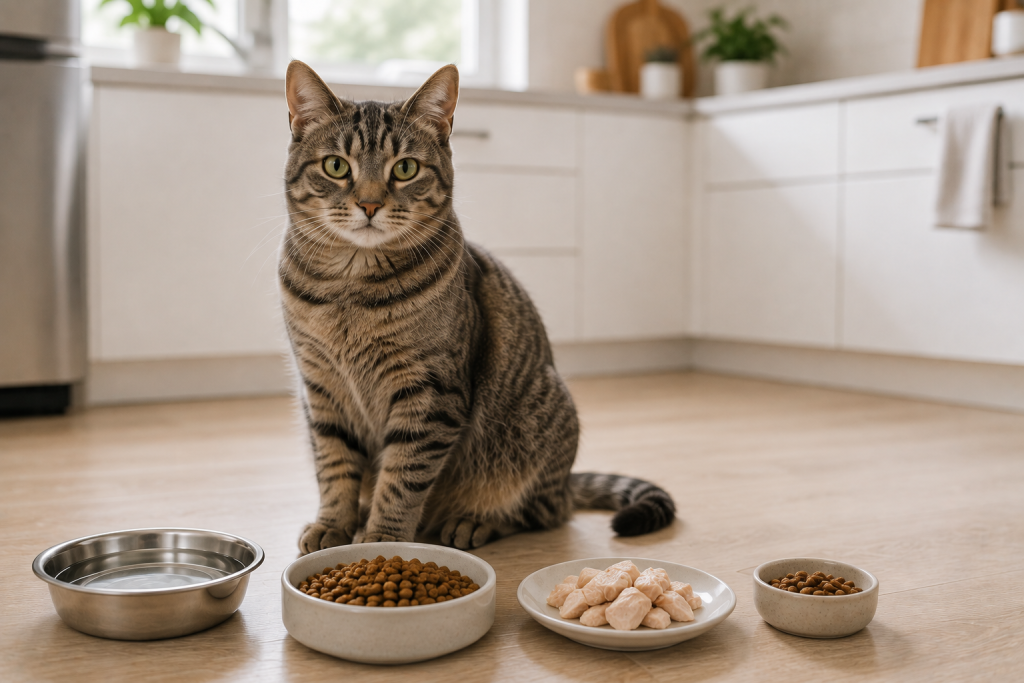
Healthy feeding habits for cats combine complete and balanced feline nutrition with measured portions, fresh water, appropriate meal frequency, limited treats, and careful choices about human foods. Cats have specialized nutritional needs, including nutrients such as taurine, so their main diet should be formulated specifically for cats rather than built around table scraps or dog food.
How a cat receives food also matters. Cats naturally tend to eat multiple small meals and often prefer to eat without competition from other animals. FelineVMA feeding guidance recommends creating feeding programs that support normal behaviors such as hunting, foraging, eating frequent small meals, and feeding in separate locations when several pets share a home.
Human foods can occasionally be offered in small amounts when they are safe, plain, and appropriate for the individual cat. However, extras should remain a small part of the overall diet because most treats and snacks are not nutritionally complete.
Why Feeding Habits Matter
Choosing a nutritionally appropriate food is only part of healthy feline feeding.
Portion size, meal frequency, competition with other pets, treats, and access to food can influence weight, appetite, and behavior. Leaving unlimited calorie-dense food available throughout the day may make it difficult to determine exactly how much a cat is eating.
Structured feeding also makes appetite changes easier to notice.
If you know that your cat normally finishes three small measured meals but suddenly leaves most of them untouched, the change is much clearer than when food is constantly available in a large shared bowl.
Feed a Complete and Balanced Main Diet
The majority of your cat’s calories should come from nutritionally complete feline food.
Complete and balanced commercial diets are formulated to provide adequate amounts of essential nutrients without harmful excesses. Cats also have nutritional requirements that differ from dogs and humans, including a dietary need for taurine.
Plain chicken or fish may appear nutritious, but neither is automatically a complete long-term feline diet by itself.
Human foods should therefore be treated as occasional additions rather than replacements for properly formulated cat food.
Cats Naturally Prefer Small Meals
Cats evolved to consume relatively small meals repeatedly rather than relying on one enormous meal.
FelineVMA feeding guidance encourages feeding strategies that allow frequent small meals and normal foraging behavior when practical.
You can divide the cat’s measured daily ration into several portions rather than feeding everything at once.
Automatic feeders can also be useful when owners are away during the day.
How Often Should Adult Cats Eat?
There is no exact meal schedule that every adult cat must follow.
Many cats do well with several small measured meals spread throughout the day.
The important factor is controlling the total daily amount rather than continually adding food every time the cat asks.
A cat receiving four small meals should normally receive portions of the same total daily calorie allowance rather than four full-sized meals.
Should Cats Have Food Available All Day?
Free feeding works for some cats, but it has disadvantages.
A cat with constant access to dry food may consume more calories than necessary. It can also become difficult to determine whether appetite has decreased.
This problem becomes even more significant when several cats eat from the same bowl.
Measured meals usually provide clearer control over calorie intake and make appetite easier to monitor.
Measure Food Instead of Guessing
Cats require relatively modest numbers of calories, so small daily overfeeding errors can accumulate over time.
Use the feeding guide on the cat food as a starting point and adjust according to body condition, body weight, activity, and veterinary guidance.
Measure dry food consistently rather than filling the bowl by eye.
For wet food, calculate how much of each can, tray, or pouch contributes to the total daily amount.
Treats Should Stay Limited
Treats are useful for training, medication, enrichment, and bonding, but they should remain a small part of the diet.
Merck recommends keeping treats below approximately 10% of total daily calorie intake because most treats are not complete and balanced.
This means even safe foods should not be offered without limits.
The remaining calories should come primarily from complete feline nutrition.
Can Cats Eat Human Food?
Some plain human foods can be safely offered to many healthy cats in very small amounts.
ASPCA lists small portions of unseasoned cooked meats such as chicken, turkey, beef, or pork as foods that can sometimes be shared with pets.
Preparation matters.
Food that is safe when plain can become unsuitable after adding onion, garlic, sauces, butter, salt, or other seasonings.
Plain Cooked Chicken
Small pieces of plain cooked chicken can be an appealing treat for many cats.
Remove bones, skin, sauces, and seasoning before sharing it.
ASPCA identifies small portions of lean cooked meat without bones or seasoning as suitable occasional treats.
Chicken should still remain an extra rather than replacing complete cat food.
Plain Cooked Turkey
Plain cooked turkey can also be offered in small amounts.
As with chicken, remove bones and avoid seasoned meat.
Holiday turkey can contain butter, gravy, garlic, onion, and other ingredients that make it very different from a small piece of plain cooked meat.
Never assume food is safe simply because the main ingredient is meat.
Plain Cooked Beef
Small amounts of plain cooked lean beef may also be suitable for many healthy cats.
Avoid heavily salted, processed, or seasoned beef.
Processed meats such as bacon or deli meat can contain large amounts of salt and fat, and ASPCA specifically recommends avoiding processed meats when sharing food with pets.
Keep portions small enough that they remain treats.
Can Cats Eat Fish?
Many cats enjoy fish, but fish should not automatically become the entire diet.
Commercial cat foods containing fish can be nutritionally complete because they include additional nutrients required by cats.
A piece of plain cooked fish is different.
It can occasionally be used as a small treat, but relying heavily on human fish products does not provide the same nutritional balance as complete cat food.
What About Tuna?
Cats often find tuna highly appealing.
A small amount of plain tuna can occasionally be used as a treat, but human canned tuna should not replace complete feline food.
A tuna-based commercial cat food can be nutritionally balanced because it has been formulated specifically for cats.
Human tuna does not provide the same guarantee of complete nutrition.
Can Cats Eat Eggs?
Plain fully cooked egg can be offered occasionally to many healthy cats.
Serve only a small amount without butter, oil, salt, onion, or garlic.
Raw eggs are different because raw animal products introduce food-safety concerns.
ASPCA advises avoiding raw or undercooked meat and eggs for pets because they can contain harmful bacteria.
Can Cats Eat Cheese?
A tiny amount of cheese may be tolerated by some cats, and ASPCA lists small quantities as a possible occasional snack.
However, many adult cats do not tolerate dairy particularly well.
Cheese can also be calorie-dense and high in fat or salt.
Use it sparingly rather than making it a routine part of the diet.
Can Cats Drink Milk?
Despite the traditional image of cats drinking bowls of milk, adult cats do not need cow’s milk.
Dairy products can cause digestive upset in animals that do not digest lactose efficiently. ASPCA lists milk and dairy among foods that can cause diarrhea or other digestive problems in pets.
Fresh water is the appropriate everyday drink.
Fresh Water Should Always Be Available
Cats need continuous access to clean drinking water.
Some cats prefer broad bowls, fountains, or water stations placed in several locations.
Water availability becomes particularly important in homes with several cats because one animal should not be able to control access to the only bowl.
Never intentionally restrict water because a cat appears to be drinking excessively.
A persistent increase in thirst should instead be discussed with a veterinarian.
Wet Food Can Contribute Moisture
Wet cat food contains substantially more moisture than dry food.
This means some cats eating wet diets obtain a significant part of their daily water intake through food.
However, they should still have fresh water available.
Cats eating dry food may rely more heavily on direct drinking.
Can Cats Eat Vegetables?
Cats do not require vegetables as the foundation of their diet.
They are obligate carnivores with specialized nutrient requirements, so vegetables should never replace complete feline nutrition.
Some individual cats may safely eat tiny amounts of certain plain vegetables, but many have little interest in them.
There is no need to force a cat to eat vegetables simply because they are considered healthy for humans.
Can Cats Eat Fruit?
Fruit is also unnecessary for feline nutrition.
Some fruits may be safe in tiny portions, but cats do not require them to obtain a balanced diet.
Fruit also contains calories and sugar.
When you want to give your cat an occasional food reward, a tiny piece of plain cooked meat is often more naturally appealing.
Foods Cats Should Never Eat
Several ordinary human foods can be dangerous to cats.
ASPCA warns against foods and ingredients including chocolate, coffee and caffeine, alcohol, onions, garlic, raw or undercooked animal products, and certain other human foods.
Because prepared meals may contain several ingredients, check the entire recipe rather than only the main food.
A piece of chicken covered in onion sauce is not equivalent to plain chicken.
Onions and Garlic
Onion and garlic can damage red blood cells and contribute to anemia in cats.
ASPCA specifically notes that onions and garlic can cause gastrointestinal problems and potentially anemia, with cats being particularly susceptible.
These ingredients may appear fresh, cooked, powdered, or incorporated into sauces.
Garlic powder and onion powder should therefore be considered when evaluating packaged or prepared foods.
Chocolate
Chocolate should not be given to cats.
Chocolate contains methylxanthines such as theobromine and caffeine, which can cause vomiting, diarrhea, excessive thirst, abnormal heart rhythm, tremors, seizures, and potentially death in pets.
Dark chocolate and baking chocolate generally contain higher concentrations than milk chocolate.
Any meaningful ingestion deserves veterinary or poison-control guidance.
Coffee and Caffeine
Coffee, coffee grounds, energy drinks, caffeine tablets, and similar products should remain inaccessible.
Caffeine can affect the nervous system and cardiovascular system and can cause serious poisoning.
Cats do not need to consume an entire cup of coffee for exposure to be concerning, especially when concentrated products are involved.
Keep mugs and coffee grounds away from curious pets.
Alcohol
Cats should never intentionally consume alcohol.
Alcoholic beverages and foods containing alcohol can cause significant toxicity.
Alcohol can also appear in desserts, sauces, fermented foods, and other products.
If a cat consumes alcohol, contact a veterinarian promptly rather than waiting for obvious symptoms.
Raw Meat
Cats are natural predators, but that does not make every raw-food feeding practice risk-free.
Raw meat can contain harmful microorganisms, and homemade raw diets may also fail to provide complete nutritional balance.
ASPCA identifies raw or undercooked meat as a potential food-safety risk for pets.
If you want to feed a home-prepared diet, veterinary nutritional formulation is safer than simply serving raw meat.
Raw Eggs
Raw eggs present similar concerns.
They can contain bacteria capable of causing illness in animals and people.
Cooking the egg removes some of those food-safety concerns.
Even cooked egg should remain a treat rather than replacing complete cat food.
Bones
Bones can create choking, dental, and gastrointestinal risks.
Cooked bones are particularly concerning because they may become brittle and break into sharp pieces.
ASPCA advises against feeding bones as ordinary pet treats.
Choose safe cat-appropriate enrichment and dental products instead.
Fatty Foods and Leftovers
Rich fatty leftovers may cause gastrointestinal upset and add substantial calories.
ASPCA recommends avoiding especially fatty foods as routine pet treats.
Processed meat, fried food, creamy sauces, and heavily seasoned leftovers are poor choices.
Cats do not need food from the human dinner table to have an enjoyable feeding routine.
Avoid Feeding Directly From Your Plate
Cats learn quickly when particular behaviors produce food.
If meowing, pawing, climbing onto the table, or stealing food repeatedly results in a reward, those behaviors may become more persistent.
If you want to give a safe treat, set aside a tiny amount and offer it separately.
This makes portion control easier and avoids reinforcing begging during meals.
Feeding Multiple Cats
Multi-cat feeding requires additional planning.
FelineVMA guidance recommends that each cat have individual food and water resources and that feeding stations be visually separated when possible.
One cat may otherwise eat too quickly because another animal approaches.
Another cat may avoid the food entirely because the feeding area feels unsafe.
Cats Often Prefer Eating Alone
Cats are social in some circumstances, but they evolved as solitary hunters.
Feline feeding guidance specifically recognizes solitary feeding as a normal feline preference.
Do not assume two cats enjoy eating side by side simply because they tolerate it.
Separate feeding locations can reduce tension and help you monitor individual appetite.
Food Puzzles Can Support Natural Feeding Behavior
Puzzle feeders can turn part of a meal into a searching and problem-solving activity.
FelineVMA recommends feeding methods that promote hunting and foraging behaviors when practical.
Start with easy puzzles so the cat learns how to access the food.
Use part of the normal daily ration instead of adding extra calories.
Scatter and Forage Feeding
Small portions of dry food can also be placed in several safe locations around the home for appropriate cats.
This encourages movement and searching.
FelineVMA includes forage feeding among strategies that can support natural feline feeding patterns.
Do not use this approach if it makes food intake impossible to monitor in a cat with medical problems.
Fast Eating
Some cats consume food extremely quickly.
Several smaller meals can help reduce the size of each feeding.
Puzzle feeders may also slow consumption while adding enrichment.
In multi-cat households, make sure fast eating is not caused by fear that another cat will steal the food.
Picky Eating
Cats can develop strong preferences for flavor, temperature, texture, and food format.
Some prefer pâté-style wet food, while others prefer chunks, dry kibble, or warmed food.
However, sudden food refusal is different from long-standing preference.
A cat that normally eats enthusiastically and suddenly becomes “picky” may be experiencing pain, nausea, stress, or illness.
Do Not Encourage Pickiness Accidentally
Constantly replacing food whenever a healthy cat hesitates can teach the cat that refusing one option produces something more desirable.
Maintain a consistent feeding routine when your veterinarian has confirmed that the cat is healthy.
At the same time, never use prolonged starvation to force a cat to eat an unwanted food.
Cats should not be allowed to stop eating for extended periods.
Changing Cat Food
When possible, transition gradually between foods.
Mix increasing amounts of the new diet with decreasing amounts of the old food over several days.
Some cats need longer because they are particularly sensitive to changes in texture or flavor.
Monitor appetite, vomiting, diarrhea, and stool quality throughout the transition.
Appetite Loss in Cats Is Important
A cat that stops eating deserves attention.
Dental disease, nausea, kidney disease, gastrointestinal disorders, infection, pain, stress, and many other conditions can reduce appetite.
Measured feeding makes changes easier to identify.
Do not simply wait several days hoping that hunger will eventually force the cat to eat.
Overweight Cats Should Not Be Starved
This is especially important for overweight cats.
Cats with severe reductions in food intake can develop hepatic lipidosis, a potentially serious liver condition.
Weight reduction should therefore be gradual and nutritionally controlled.
If an overweight cat suddenly refuses food, contact your veterinarian rather than treating the situation as an opportunity for rapid weight loss.
Increased Appetite Can Also Be Important
Persistent excessive hunger can also indicate a health problem.
For example, hyperthyroidism and diabetes can affect appetite, body weight, thirst, and urination.
A cat that eats substantially more while losing weight deserves veterinary evaluation.
Do not simply increase portions indefinitely without investigating the change.
Treats for Training
Food rewards can be useful for carrier training, grooming, medication routines, and other positive-reinforcement training.
FelineVMA identifies food treats as one possible reward, while acknowledging that some cats may prefer play, petting, or grooming.
Use very small pieces so repeated rewards do not add excessive calories.
Part of the cat’s normal food can also be reserved for training.
Homemade Cat Food
A homemade diet can meet feline nutritional requirements only when carefully formulated.
Merck warns that homemade cat diets are often deficient in essential vitamins and minerals and generally recommends balanced commercial diets for routine feeding.
Combining meat, fish, eggs, and vegetables based on intuition does not guarantee adequate taurine, calcium, vitamins, minerals, or other nutrients.
Owners committed to home preparation should work with a veterinary nutrition specialist.
Cats Should Not Live on Dog Food
A cat may occasionally steal food from a dog’s bowl without developing immediate nutritional disease.
Long-term feeding is different.
Cats require specific nutrients, including taurine, that are not necessarily provided in dog food at feline-appropriate levels.
The primary diet should therefore be formulated specifically for cats.
Feeding Kittens
Kittens require more calories and nutrients for growth than healthy adults.
Merck states that kittens need additional calories, protein, fat, vitamins, and minerals and should receive multiple daily meals of food formulated specifically for growth.
Meal frequency can gradually decrease as the kitten develops.
Growth nutrition should generally continue until approximately 9 to 12 months of age, depending on individual development.
Feeding Senior Cats
Senior cats should be fed according to health, body condition, muscle condition, and appetite rather than age alone.
Some become overweight as activity decreases, while others lose body weight or muscle and require greater nutritional support.
Medical conditions can also change the ideal diet.
A senior cat with kidney disease may need something very different from a healthy senior cat with no chronic illness.
Safe Foods Still Need Moderation
A food does not become unlimited simply because it is considered safe.
Plain cooked chicken, turkey, beef, egg, or another appropriate treat still contributes calories.
Large amounts can also displace complete feline food and reduce nutritional balance.
Keep extras small and preserve the main diet as the primary nutritional source.
When to Contact a Veterinarian
Talk with your veterinarian if your cat:
- Stops eating normally
- Loses weight unexpectedly
- Becomes much hungrier while losing weight
- Develops repeated vomiting
- Has persistent diarrhea
- Has difficulty chewing
- Drinks or urinates much more than usual
- Requires a homemade diet
- Is significantly overweight or underweight
- Has a chronic medical condition
- Eats a potentially toxic food
Sudden appetite changes are particularly important because feeding behavior often provides one of the earliest signs that something has changed.
What to Do If Your Cat Eats Something Toxic
If you know or suspect that your cat has consumed a toxic food, seek professional advice promptly.
Do not automatically induce vomiting or give home remedies unless a veterinarian or animal poison professional specifically instructs you to do so.
The correct response depends on the substance, amount, timing, body weight, and symptoms.
Keep the package or ingredient list available when contacting the veterinary team.
Building Healthy Feeding Habits for Cats
Good feeding habits and safe foods for cats begin with complete feline nutrition and controlled portions.
Cats have specialized nutrient requirements, including taurine, which is one reason their primary diet should be formulated specifically for cats rather than built from dog food or ordinary human meals.
Divide the measured daily food into several small meals when practical. FelineVMA feeding recommendations encourage frequent small meals, hunting and foraging opportunities, and separate feeding areas that reduce competition in multi-pet households.
Keep treats and human foods limited. Merck recommends that treats remain below about 10% of total calorie intake because most are not complete and balanced.
Plain cooked, unseasoned meat can occasionally be offered in small quantities, but foods containing onion, garlic, chocolate, caffeine, alcohol, or other dangerous ingredients should remain inaccessible. Raw animal products and bones also carry important safety risks.
Most importantly, monitor appetite closely. A cat that suddenly stops eating, begins losing weight, develops persistent excessive hunger, or changes normal drinking and elimination habits may need veterinary attention.
Healthy feeding is not about giving cats the largest possible variety of foods. It is about providing consistent, nutritionally appropriate meals while using safe extras carefully and recognizing when feeding behavior changes.