
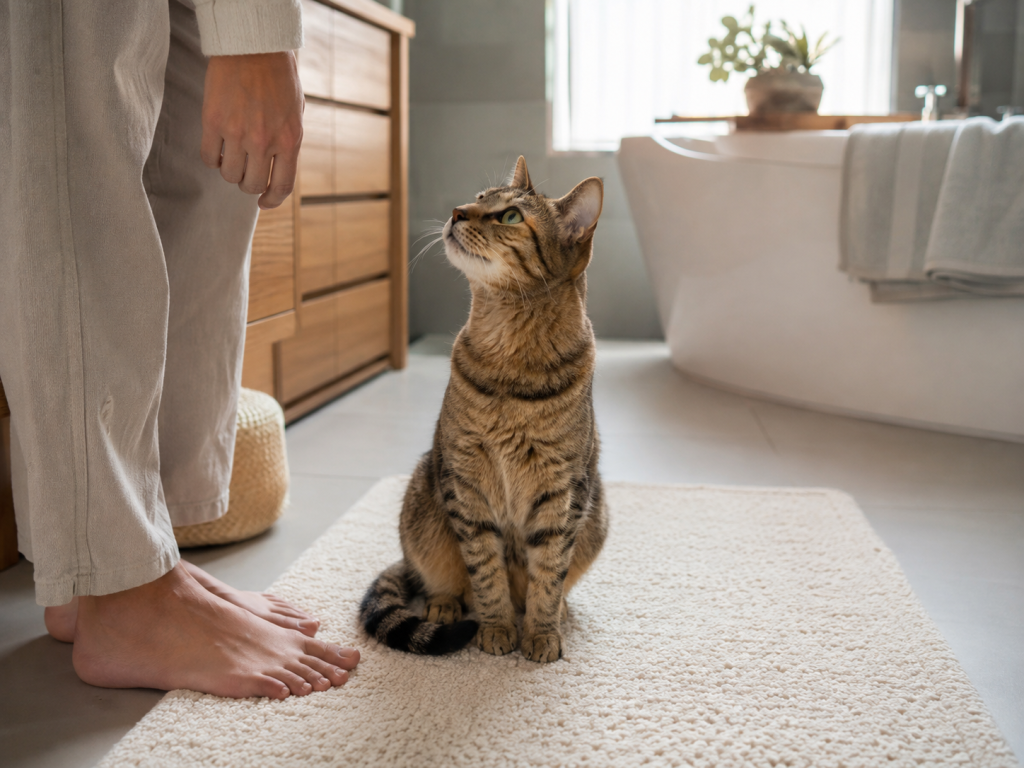
Why does my cat follow me into the bathroom? In most cases, your cat follows you because they are curious, enjoy your company, have learned your routine, or expect attention when you go there. The bathroom can also be an interesting place filled with unusual smells, running water, cool surfaces, and a closed door that suddenly makes your cat want access.
Cats often build predictable routines around the people they live with. They can recognize familiar voices, respond to household routines, and seek people out for companionship. Therefore, following you into the bathroom may simply be another part of the relationship your cat has developed with you.
If your cat has always followed you and otherwise behaves normally, there is usually little reason for concern. However, a sudden major increase in clinginess, especially alongside appetite, litter-box, sleep, or behavior changes, deserves closer attention.
Your Cat Is Curious About What You Are Doing
Cats are naturally interested in changes within their environment. When you suddenly walk into another room and close or partially close the door, your cat may want to investigate where you went and what is happening.
The bathroom is also different from many other rooms. Faucets make noise, water moves, toilet paper hangs from a roll, towels create soft places to sit, and cabinets contain unfamiliar smells. For a curious cat, there can be plenty to inspect.
Your behavior also matters. You may visit the bathroom several times each day, so your cat has many opportunities to notice the pattern. Eventually, following you can become almost automatic.
This does not necessarily mean your cat is worried whenever you leave the room. Sometimes the simplest explanation is that you moved somewhere interesting, and your cat decided to come along.
Your Cat May Simply Enjoy Being Near You
Cats are sometimes described as solitary animals, but domestic cats can form meaningful social relationships. Merck Veterinary Manual explains that cats regulate social interactions through behaviors such as maintaining distance, rubbing, grooming, and other affiliative signals.
Some cats express companionship by sitting directly on a person’s lap. Others prefer staying nearby while maintaining a little distance. Following you from the living room into the bathroom can be your cat’s version of staying socially connected.
VCA also notes that cats can recognize familiar voices, respond to routines, and seek their people out for companionship.
Therefore, your cat does not need to be constantly touching you to enjoy your company. Sitting beside the sink while you brush your teeth may be enough.
The Bathroom Has Become Part of Your Cat’s Routine
Cats can become very attached to predictable daily patterns. Feeding times, bedtime, morning activities, and the movements of household members can all become familiar cues.
If you go to the bathroom shortly after waking every morning, your cat may learn that this action predicts something else. Perhaps breakfast comes next, you open the blinds afterward, or you usually give the cat attention before leaving for work.
Over time, the bathroom trip itself becomes part of the sequence.
Your cat may therefore follow you not because the bathroom is important on its own, but because they have learned what usually happens before and after you go there. VCA notes that cats respond to familiar routines and can seek out their owners as part of regular social behavior.
This can explain why some cats seem almost perfectly synchronized with their owner’s daily schedule.
A Closed Bathroom Door Can Make It More Interesting
Some cats appear completely uninterested in the bathroom until you close the door. Suddenly, they scratch, meow, reach underneath, or wait directly outside.
Part of this reaction may come from losing access to a familiar area or person. Cats often prefer having control over their movements and access to important parts of their environment.
A door that is normally open but suddenly closes changes the environment. Your cat may simply want to investigate the change or restore access.
This does not mean your cat understands privacy and deliberately chooses to ignore it. Human concepts of bathroom privacy have little relevance to feline behavior.
From your cat’s perspective, you walked through a familiar doorway and then prevented them from following. That alone can make the room considerably more interesting.
Your Cat May Expect Attention
Think about what usually happens when your cat follows you into the bathroom. Do you talk to them, pet them, laugh, pick them up, or give them some other form of attention?
If so, your reaction may help maintain the behavior.
Cats can learn which behaviors produce desirable outcomes. Merck Veterinary Manual recommends reinforcement-based approaches when modifying feline behavior because behaviors that receive rewarding consequences can become more likely to occur again.
Your cat does not need to understand the situation in a complicated way. If following you repeatedly results in attention, the behavior can become worthwhile.
Even telling your cat to leave can sometimes provide the interaction they were seeking.
Running Water Can Attract Cats
Bathrooms contain another potentially interesting feature: water.
Some cats become fascinated when a faucet drips or when water moves around a sink or bathtub. The sound and movement can attract attention even if the cat has fresh drinking water elsewhere.
A cat may follow you because they have learned that bathroom visits occasionally produce running water. They might jump onto the sink and wait for you to turn on the faucet.
If your cat enjoys drinking from moving water, consider providing appropriate fresh water options elsewhere rather than routinely allowing them to drink from potentially dirty bathroom surfaces.
A sudden major increase in thirst is different from a cat simply enjoying a faucet. If your cat begins drinking much more than usual, discuss the change with your veterinarian.
The Bathroom Can Be Comfortable
Bathrooms can offer surprisingly appealing resting locations. Tile floors may feel cool during warm weather, while bath mats, towels, and laundry can provide soft surfaces.
Some bathrooms are also quieter than the rest of the house. If children, visitors, or other pets are active elsewhere, following you into a smaller room may give your cat a calmer environment for several minutes.
Your cat may even have a favorite spot there. Once a location becomes associated with comfort, cats often return to it repeatedly.
In this situation, you may simply happen to be visiting one of your cat’s preferred rooms.
Why Does My Cat Sit and Watch Me in the Bathroom?
Watching does not necessarily mean anything unusual. Your cat may be monitoring what you are doing because your movements are interesting or because they expect interaction.
Cats often observe their environment closely. A person moving between the toilet, sink, shower, and cabinets provides several changing sights, sounds, and smells.
Your cat may also have learned that watching you eventually results in attention.
Look at their body language. A relaxed cat sitting with neutral ears and loose muscles is likely experiencing something very different from a tense cat that appears unable to settle.
Calm observation is usually just that: observation.
Why Does My Cat Rub Against Me in the Bathroom?
Rubbing is a common social behavior in cats. Merck describes rubbing as one of the affiliative behaviors cats use during social interactions.
If your cat enters the bathroom and rubs against your legs, they may simply be greeting you or continuing a familiar social interaction.
Cats also use scent as part of communication, and rubbing helps transfer scent onto familiar people and objects. This can make rubbing both a social and scent-related behavior.
The important thing is the overall body language. A cat approaching voluntarily with relaxed muscles and remaining near you is generally showing a comfortable interaction.
Why Does My Cat Meow Outside the Bathroom Door?
A cat that meows outside a closed bathroom door may want access to you, the room, or something inside it.
The behavior can become especially persistent if opening the door usually follows the meowing. From the cat’s perspective, vocalizing may have successfully caused the door to open many times before.
Some naturally vocal cats also meow frequently during ordinary interactions. Therefore, consider what is normal for your individual cat rather than treating every meow as a sign of distress.
If the vocalization appears suddenly and becomes excessive in other situations too, pay attention to additional behavioral or physical changes.
A major change from your cat’s normal vocal behavior can sometimes deserve veterinary evaluation.
Why Does My Cat Follow Me Everywhere, Not Just the Bathroom?
If your cat follows you into every room, the bathroom may simply be one example of a broader social habit.
Some cats prefer staying near familiar people throughout much of the day. They may follow you into the kitchen, bedroom, office, and bathroom before settling nearby.
This can reflect companionship, routine, curiosity, expectations about food or play, or a combination of several factors. Cats can actively seek social interaction while still retaining control over how close they want to be.
Following is not automatically a sign of unhealthy dependence. The rest of your cat’s behavior matters.
A cat that follows you but can also eat, sleep, play, and relax independently may simply enjoy your company.
Is My Cat Protecting Me in the Bathroom?
It can be tempting to interpret the behavior as your cat standing guard while you are vulnerable. However, there is no need to assume that protection is the primary reason.
Curiosity, social contact, routine, and learned attention provide simpler explanations for most household cats.
Your cat may certainly remain alert while sitting nearby, but that does not prove they believe you need protection from a threat.
Avoid turning a charming behavior into a complicated story when ordinary feline behavior explains it well.
The fact that your cat voluntarily chooses to accompany you is meaningful enough without needing to interpret it as a deliberate security mission.
Does Following Me Mean My Cat Loves Me?
Following you can be one sign that your cat values social contact with you, but no single behavior can fully measure a cat-human bond.
Some affectionate cats follow their owners constantly. Others show attachment through rubbing, head contact, resting nearby, playing, slow blinking, or choosing to spend time in the same room.
VCA notes that cats may seek people out for companionship, while Merck describes rubbing and grooming among affiliative feline social behaviors.
Therefore, following you into the bathroom can fit within a larger pattern of trust and familiarity.
However, a cat that never follows you can still feel completely comfortable and secure around you.
Should You Let Your Cat Follow You Into the Bathroom?
In most cases, this is simply a personal choice. If the cat is calm, the bathroom is safe, and you do not mind the company, there is usually no behavioral reason you must stop them.
Make sure medications, cleaning chemicals, razors, dental floss, hair ties, and other potentially dangerous objects remain inaccessible. Cats can climb onto counters and investigate containers that appear safely out of reach.
You may also want to keep the toilet lid closed, especially if cleaning products have been used in the bowl.
If you prefer privacy, it is also perfectly reasonable to close the door. Your cat may complain initially, especially if they are accustomed to entering, but you do not need to allow access every time.
How Can You Stop Your Cat From Following You?
If the behavior bothers you, focus on changing the routine rather than punishing your cat.
Provide an appealing activity outside the bathroom before you enter. A comfortable resting place, puzzle feeder, appropriate toy, or window perch may give your cat something else to do.
If your cat meows or scratches because the door is closed, avoid unintentionally teaching them that persistent behavior always opens it. Reinforcement can influence whether behaviors continue.
Never frighten or physically punish your cat for following you. They are performing a normal behavior, not deliberately violating a human boundary.
Consistency will usually be more useful than punishment.
When Could Following You Be a Sign of a Problem?
A cat that has followed you for years and continues behaving normally is very different from an independent cat that suddenly refuses to leave your side.
Sudden behavioral changes deserve attention because illness, discomfort, environmental stress, or other problems can affect normal feline behavior. Merck notes that abnormal or excessive feline behaviors can be associated with issues such as anxiety, compulsive behavior, cognitive decline, or other behavioral and medical concerns.
Watch for additional changes such as loss of appetite, weight changes, unusual thirst, vomiting, litter-box problems, excessive vocalization, hiding, aggression, confusion, or reduced activity.
If several changes appear together, contact your veterinarian rather than assuming your cat has simply become more affectionate.
Why Your Cat Wants to Join Every Bathroom Trip
So, why does your cat follow you into the bathroom? For most cats, the answer is a combination of curiosity, companionship, routine, learned attention, and interest in the bathroom environment.
Cats can form social relationships with familiar people and may actively seek their company. They also respond strongly to predictable routines, which means something as ordinary as your daily bathroom trip can become part of your cat’s schedule.
The bathroom itself may add to the attraction. Closed doors, running water, cool floors, towels, new smells, and your undivided attention can make a small room surprisingly interesting.
If the behavior is normal for your cat and they remain relaxed and healthy, there is usually no reason to worry. Your cat may simply believe that whatever you are doing behind that bathroom door is important enough that they should be there too.