
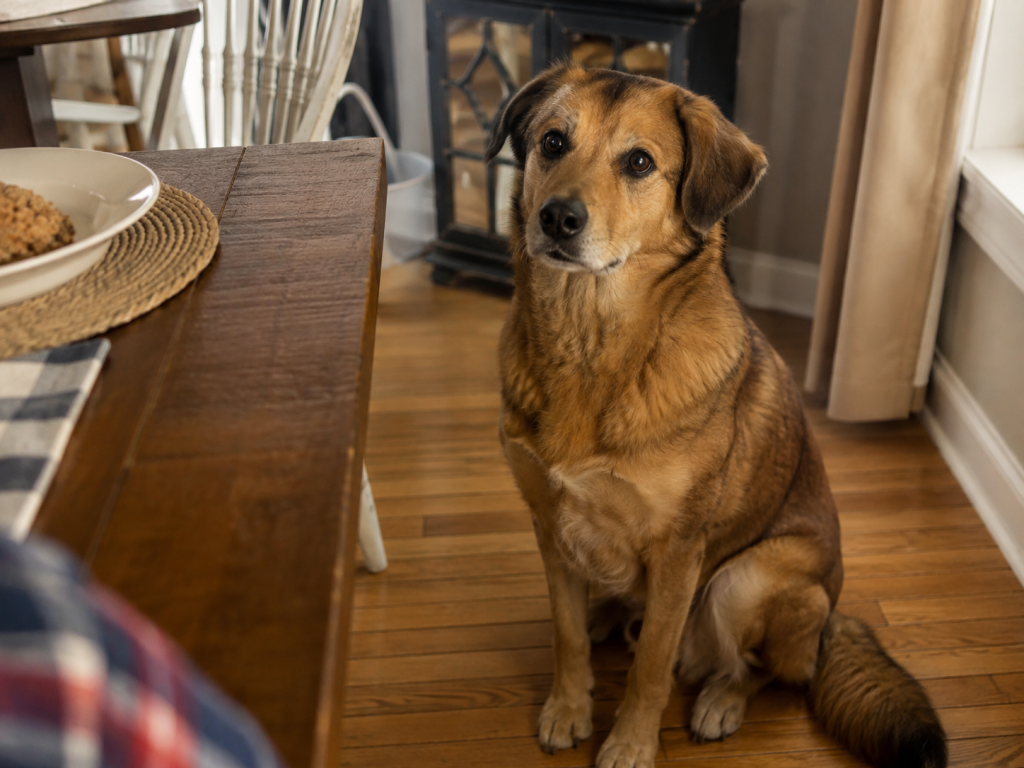
If you find yourself asking, “why does my dog stare at me while I eat,” the answer usually comes down to learned habit. Your dog has likely learned that food sometimes appears when they wait and watch closely. This behavior comes from simple learned association rather than genuine hunger or distress. In most cases, it is a normal, harmless habit rather than a sign of a problem.
That said, staring can range from a quick, hopeful glance to intense, persistent begging. Knowing the difference helps you respond in a way that keeps mealtimes relaxed for both of you.
This guide covers why the behavior happens, when it is worth adjusting, and which foods to keep off the menu if you do decide to share a bite now and then.
Why Dogs Stare at Their Owners During Meals
Several factors combine to create this familiar mealtime behavior. Most dogs show a mix of the following reasons rather than just one.
Learned Association with Food
If your dog has ever received food from your plate, even once, they likely remember it. Dogs are excellent at connecting actions with outcomes, so staring at you during meals becomes a learned strategy. Because the behavior occasionally works, it tends to stick around.
This is a straightforward example of reinforcement. If staring sometimes leads to a bite of chicken or a dropped crumb, your dog has no reason to stop trying. Even occasional rewards, given only once in a while, are often enough to keep the behavior firmly in place.
Dogs Are Wired to Watch Human Faces
Unlike most other animals, dogs pay close attention to human facial expressions and eye contact. This tendency likely developed over thousands of years of living alongside people. As a result, watching your face during a meal comes naturally, even without a specific food reward involved.
Some research on human-dog interaction suggests that mutual gaze between dogs and their owners may be linked to bonding hormones, similar to what happens between parents and infants. This does not mean every staring session is emotional. It simply shows how deeply dogs are tuned into human attention.
This is also why staring is not unique to mealtimes. Many dogs watch their owners closely throughout the day, and food simply happens to be one of the most reliable moments to catch your attention.
Hope and Anticipation
Dogs live largely in the present, and food is a powerful motivator. When they smell or see something appealing, watching closely is a natural response. This is especially true if your dog has learned that persistence sometimes pays off.
Strong-smelling or unfamiliar foods tend to draw more attention than bland, everyday meals. A dog who mostly ignores your salad may suddenly show intense interest in a slice of pizza, simply because it smells far more appealing.
Routine and Timing
Many dogs quickly learn the household schedule. If mealtimes reliably happen at certain times, your dog may start anticipating your meal simply because it is part of the daily pattern, regardless of whether food has ever been shared before.
Dogs are remarkably good at tracking routines, sometimes better than their owners realize. A dog positioned by the table minutes before dinner is often responding to a pattern they have memorized over weeks or months.
Is Staring While You Eat Normal Behavior?
Yes, in most cases. Watching an owner eat is one of the most common mealtime behaviors reported by dog owners, and it rarely indicates a deeper issue on its own. According to the American Kennel Club, staring is a natural way dogs communicate interest, attention, and anticipation toward their owners.
Most owners notice this behavior daily, and it typically stays consistent over time rather than escalating. A dog who simply watches, without added pressure, is behaving well within the normal range.
Signs that the behavior is simply normal curiosity include:
- Calm, relaxed body language while watching
- The dog eventually loses interest and settles down
- No pawing, barking, or physical pressure involved
- The behavior happens mainly around food, not constantly
Curious Staring vs. Begging Behavior
There is a meaningful difference between casual staring and active begging, even though both start from the same underlying instinct.
Curious staring typically looks like quiet observation. Your dog may sit or lie nearby, watch for a while, and then relax once nothing happens. Begging, on the other hand, often escalates. It can include whining, pawing at your leg, resting a head on your lap, or repeatedly approaching your plate.
Neither behavior is inherently “bad.” However, begging tends to become more persistent over time if it continues to be rewarded, even occasionally. For this reason, consistency from everyone in the household matters more than most owners expect.
A useful way to tell the two apart is to notice what happens when you simply ignore the behavior. A curious dog usually loses interest fairly quickly, while a dog in full begging mode often escalates until it gets a reaction.
Why You Shouldn’t Feed Your Dog From the Table
Even though a hopeful stare can be hard to resist, regularly feeding your dog from your plate creates a few practical problems.
First, it reinforces the exact behavior you may eventually want to reduce. Second, many common human foods are unsafe for dogs, even in small amounts. According to the ASPCA, foods such as onions, garlic, grapes, raisins, chocolate, and anything containing xylitol can be toxic to dogs.
Foods commonly found on the dinner table that pose risks include:
- Onions and garlic, which can damage red blood cells
- Grapes and raisins, linked to kidney injury in some dogs
- Chocolate, which contains compounds dogs cannot process safely
- Foods sweetened with xylitol, a sugar substitute toxic to dogs
- Fatty or fried foods, which can trigger digestive upset or pancreatitis
Even foods that are not toxic can cause stomach upset if they are rich, seasoned, or unfamiliar to your dog’s regular diet. If you want to share food safely, plain, dog-appropriate treats offered separately from your plate are a much better option.
Portion size matters too. Even a small amount of a rich or fatty food can affect a small dog far more than a large breed. It helps to think in proportion to your dog’s size, rather than assuming a “small bite” is automatically harmless.
When Staring Crosses Into Pushy or Demanding Behavior
Occasionally, staring develops into something more insistent. This usually happens gradually, often because the behavior has been rewarded inconsistently over time.
Watch for these signs of escalating demand behavior:
- Barking or whining that increases if ignored
- Pawing, nudging, or jumping toward your plate
- Refusing to settle even after being redirected
- Guarding behavior, such as stiffening or growling near food
Mild attention-seeking is common and manageable. However, if guarding behavior appears, meaning your dog reacts defensively when someone approaches food, this deserves extra caution. Resource guarding can escalate if it is left unaddressed.
It also helps to notice whether the intensity is new. A dog who has always been mildly food-focused is different from a dog whose behavior suddenly becomes more demanding. A sudden shift often has an identifiable trigger worth investigating.
How to Stop Your Dog From Staring at You While You Eat
If mealtime staring bothers you, or if it has turned into more persistent begging, a few consistent strategies usually help.
- Avoid feeding from the table, even occasionally, since inconsistency slows progress
- Feed your dog before your own mealtime so they are less food-motivated
- Teach a reliable “place” or “settle” command for mealtimes
- Reward calm behavior away from the table instead of at your feet
- Ask every household member to follow the same rules consistently
- Redirect your dog with a puzzle toy or chew during meals
- Keep training sessions short and positive, rather than scolding your dog for staring
These strategies work gradually rather than instantly. Most dogs adjust within a few weeks once the new pattern becomes consistent and predictable. Progress often looks like shorter staring sessions before your dog settles, rather than the behavior disappearing all at once.
Does Age or Breed Affect This Behavior?
Staring behavior can vary somewhat based on a dog’s age, training history, and individual personality.
Puppies
Puppies often stare simply out of curiosity and general interest in everything happening around them. Consistent, gentle training early on makes it easier to establish healthy mealtime habits before begging becomes a strong pattern.
Adult Dogs
Adult dogs typically show more deliberate, learned staring behavior, especially if they have previously received food from the table. Established habits usually take a bit longer to change, but they respond well to consistency.
Breed Tendencies
Food-motivated breeds, including many retrievers, beagles, and working breeds, may show more persistent staring simply because they are highly motivated by food rewards in general. This is a personality trait, not evidence of poor training.
Senior dogs sometimes become more focused on food-related routines, partly because meals offer predictable structure. If an older dog’s staring suddenly intensifies alongside other changes, it is worth mentioning at their next veterinary visit.
When to Be Concerned
In most situations, staring during meals is completely normal. However, a few patterns are worth mentioning to a veterinarian.
Consider seeking guidance if you notice:
- Sudden, intense focus on food that seems unusual for your dog
- Noticeable weight loss or increased hunger alongside the staring
- Guarding behavior that involves growling or snapping
- Signs of anxiety, such as pacing or restlessness tied to mealtimes
These patterns are uncommon, but they can occasionally point to an underlying medical issue or a behavior concern that benefits from professional support rather than home management alone. A veterinarian can help determine whether the change relates to appetite, discomfort, or anxiety.
Frequently Asked Questions
Is it bad to give my dog a little bit of my food?
Occasional, dog-safe food is generally fine, but consistency matters more than the amount. Regularly feeding from your plate reinforces staring and begging, and it increases the risk of your dog eating something unsafe.
Why does my dog stare at me even when there’s no food nearby?
Some dogs stare simply out of habit or general attentiveness, especially toward a favorite person. This is usually harmless and reflects attachment rather than hunger.
Should I ignore my dog while they stare?
Calmly redirecting your dog, rather than reacting with attention, usually works better than fully ignoring the behavior. Consistency in your response matters more than whether you technically “give in.”
Can training really stop the staring?
Yes. Most dogs adjust well to new mealtime routines within a few weeks, especially when every household member follows the same consistent approach.
Why does my dog only stare at certain family members?
Dogs quickly learn who is more likely to share food. If one household member has fed them from the table before, a dog will often direct more attention toward that person specifically.
Is it okay to let my dog watch me eat without giving in?
Yes, as long as the behavior stays calm and your dog can settle afterward. Watching quietly is very different from persistent begging, and it does not need to be discouraged on its own.
Key Takeaway
So, why does my dog stare at me while I eat? Mostly out of learned habit, hopeful anticipation, and natural attentiveness to human behavior. This is typically a normal, low-stakes behavior rather than a cause for concern.
If staring turns into pushy or defensive behavior around food, a little consistency, or occasionally a veterinarian’s guidance, usually resolves it. Most of the time, that hopeful gaze simply means your dog enjoys being near you at mealtime, food or not.