
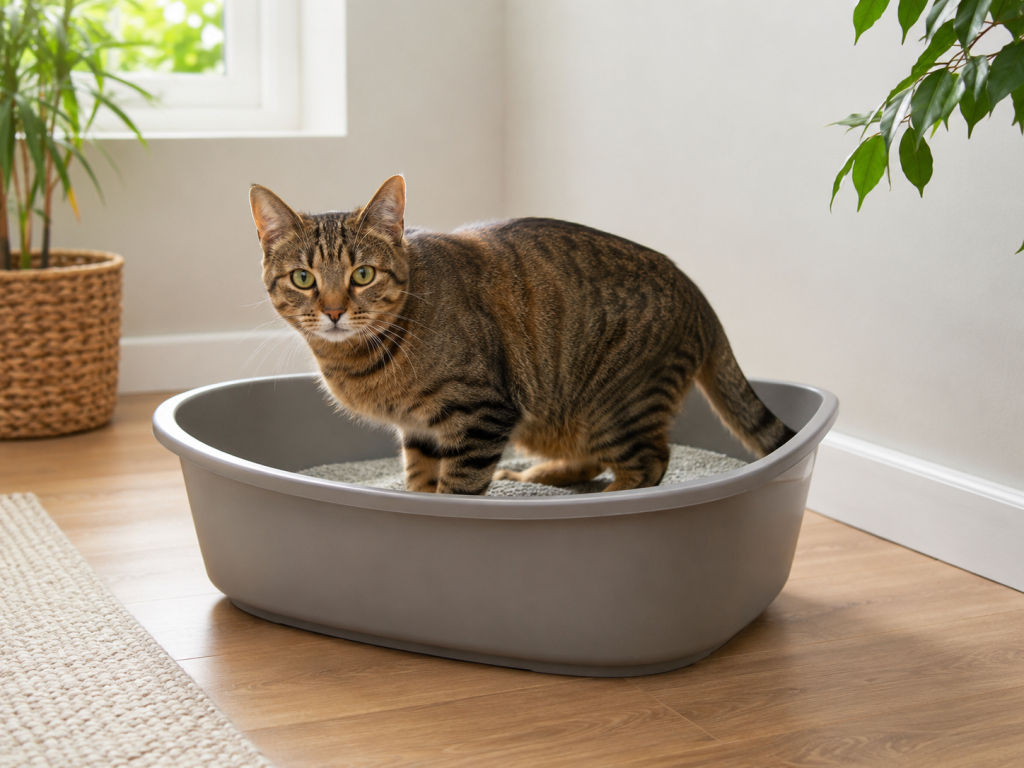
Healthy litter box habits are an important part of both feline behavior and physical health. Cats generally prefer a clean, accessible, comfortable place to urinate and defecate, and problems often develop when the litter box no longer meets those needs or when a medical condition makes elimination painful. FelineVMA guidance recommends evaluating both the litter box setup and the cat’s wider environmental needs whenever house-soiling develops.
A cat suddenly urinating or defecating outside the box is not necessarily being stubborn or deliberately misbehaving. Urinary disease, constipation, pain, stress, litter preferences, box location, competition with another cat, and negative experiences around elimination can all contribute.
Understanding normal litter box behavior makes it easier to recognize when a change is environmental, behavioral, or potentially medical.
What Normal Litter Box Habits Look Like
A healthy cat should normally be able to enter the litter box comfortably, eliminate without obvious distress, cover waste according to individual preference, and leave the box normally.
Individual frequency varies depending on diet, water intake, age, health, and other factors. The most useful approach is therefore to learn what is normal for your own cat.
Changes matter more than one universal number.
If your cat suddenly begins visiting the box repeatedly, straining, vocalizing, producing very small amounts of urine, or eliminating somewhere else, pay attention rather than assuming the cat has developed a bad habit. Lower urinary tract disorders commonly cause frequent urination, straining, blood in the urine, and urination outside the litter box.
How Many Litter Boxes Do Cats Need?
Providing multiple litter boxes can be especially useful in homes with more than one cat.
Cats may not consider several boxes placed directly beside each other to be truly separate resources. Spread boxes through different areas of the home so one cat cannot easily control access to all of them.
This becomes particularly important when there is subtle conflict between cats.
A cat may avoid a litter box not because the box itself is unpleasant, but because reaching it requires passing another cat that frequently stares, chases, or blocks access.
Feline house-soiling guidelines emphasize optimizing the litter box environment and meeting broader environmental needs rather than treating elimination as an isolated behavior.
Choose a Large Enough Litter Box
Cats need enough room to enter, turn around, dig, and position themselves comfortably.
A box that was adequate for a kitten may become too small once the cat reaches adulthood.
Large cats may require storage-style trays or oversized litter boxes rather than standard commercial boxes.
Senior cats and cats with mobility problems may need a lower entrance so they do not have to climb over a high wall.
Watch how your cat uses the box. If much of the body remains outside while eliminating or the cat appears cramped, a larger box may be more comfortable.
Covered vs. Uncovered Litter Boxes
Some cats tolerate covered boxes well, while others prefer open boxes.
Covered boxes can contain litter and odor from the owner’s perspective, but they may also restrict visibility, trap smells, or make a cat feel less able to escape if another pet approaches.
An open box allows the cat to monitor the surrounding environment more easily.
If your cat currently has litter box problems, offering different box styles can help identify a preference rather than assuming one design is universally superior.
What Type of Litter Do Cats Prefer?
Cats can develop strong preferences for litter texture and odor.
Many cats prefer fine, soft substrates that are comfortable beneath the paws. Strong perfumes or sudden changes in litter type can discourage some cats from using a familiar box.
If your cat is reliably using a particular litter, there is usually no reason to keep changing it.
When a change is necessary, mixing the new litter gradually with the old one may be easier than replacing everything overnight.
Avoid Strong Fragrances
A litter that smells pleasantly perfumed to a person may smell overwhelming to a cat.
Cats have a far more sensitive sense of smell than humans.
Strongly scented litter, deodorizing powders, cleaning products, or air fresheners around the box may make the area less attractive.
Cleanliness is more useful than trying to hide odor with heavy fragrance.
Where Should You Put the Litter Box?
Choose a location that is quiet, accessible, and reasonably private without being difficult to reach.
Avoid trapping the cat in areas where loud appliances suddenly activate or where other pets can easily corner them.
A box beside a noisy washing machine, for example, may become unpleasant if the cat is repeatedly startled while eliminating.
The cat should also have a clear route into and away from the box.
Do Not Place Every Box in One Room
Several boxes in one small area may not provide enough choice.
If something frightens the cat in that room or another cat blocks the doorway, every box becomes inaccessible at once.
Spread resources throughout the home when possible.
Multi-level homes can particularly benefit from litter boxes on more than one floor, especially when kittens or senior cats are present.
How Often Should You Scoop a Litter Box?
Frequent removal of urine and feces helps keep the box attractive.
Cats may avoid heavily soiled boxes, especially when alternative surfaces are available elsewhere in the home.
Daily cleaning also allows you to monitor urine clumps and stool more closely. Cornell notes that daily litter box cleaning is useful not only for hygiene but also in helping control certain intestinal parasites.
The exact cleaning routine depends on litter type and the number of cats using the box.
Wash the Box Regularly
In addition to scooping, litter boxes occasionally need a more complete clean.
Empty the litter, wash the box with a mild product that does not leave a powerful fragrance, rinse thoroughly, dry it, and refill it with clean litter.
Avoid harsh scents whenever possible.
If the plastic becomes deeply scratched and begins retaining odor, replacing the box may eventually be helpful.
Why Is My Cat Peeing Outside the Litter Box?
Urination outside the box has many possible causes.
A cat may dislike the litter, box, location, cleanliness, or access route. Stress and social conflict can also contribute.
Medical causes are equally important.
Cornell explains that urinary tract inflammation can make urination painful and urgent, which may cause a cat to eliminate outside the litter box and potentially associate the box with discomfort.
This is why a sudden change deserves medical consideration before assuming the problem is purely behavioral.
Why Is My Cat Pooping Outside the Box?
Defecating outside the litter box can also have behavioral or medical causes.
Constipation, diarrhea, pain, mobility problems, or a negative experience while defecating can affect box use.
A cat that finds the box difficult to enter may choose a nearby floor instead.
Senior cats with arthritis may particularly struggle with high-sided boxes or stairs leading to a distant litter area.
Persistent changes deserve veterinary evaluation.
Litter Box Avoidance vs. Urine Marking
Urine marking and ordinary urination outside the box are not necessarily the same behavior.
A cat eliminating on horizontal surfaces such as beds, rugs, or floors may be choosing a different toileting location or substrate. Merck describes this as undesirable toileting and notes that cats can develop strong location or surface preferences.
Urine marking often involves smaller amounts of urine used as scent communication.
Understanding which behavior is occurring helps identify the likely cause.
Why Do Cats Spray?
Urine spraying can be associated with social communication, territorial changes, stress, unfamiliar cats, or conflict within the home.
A cat may spray after seeing an outdoor cat through a window or after the arrival of another pet.
Do not immediately punish the behavior.
First consider the social and environmental changes surrounding it.
Medical urinary problems should also be ruled out when a cat’s elimination pattern changes.
Never Punish Litter Box Accidents
Punishment does not solve the reason the cat stopped using the box.
Yelling, rubbing the cat’s face in urine, spraying water, or physically carrying the cat to the litter box can increase stress.
The cat may begin avoiding you without becoming any more comfortable with the litter box.
Instead, investigate medical causes, improve the litter box setup, remove environmental stressors, and clean accident areas thoroughly.
Clean Accident Areas Properly
Cats can return to areas that continue smelling like urine or feces.
Clean soiled areas thoroughly using a pet-safe product designed to remove organic odor rather than simply masking it.
Avoid cleaners with very strong fragrances that may create another unpleasant scent.
Block access temporarily when practical while you work on restoring normal litter box habits.
Litter Box Problems Can Be Caused by Pain
Pain can affect whether and how a cat uses the box.
Arthritis may make climbing into a high-sided box difficult. Urinary disease can make urination painful, and gastrointestinal disorders can make defecation uncomfortable.
A cat can then begin associating the litter box with the unpleasant experience.
Changing the box may help with accessibility, but medical pain itself still needs appropriate treatment.
Urinary Problems Can Look Like Constipation
Owners sometimes mistake urinary straining for difficulty passing stool.
Cornell notes that cats with bladder or urethral problems may spend extended periods straining in the litter box, which can be mistaken for constipation.
This distinction is extremely important because urinary obstruction can be life-threatening.
If you are unsure whether your cat is producing urine, check the litter carefully and seek veterinary guidance.
Urinary Obstruction Is an Emergency
A cat repeatedly entering the litter box but producing little or no urine requires immediate attention.
Urethral obstruction occurs particularly in male cats because their urethra is longer and narrower. Merck classifies urinary obstruction as a medical emergency requiring immediate veterinary treatment.
Cornell similarly describes urethral obstruction as an absolute emergency. Affected cats may repeatedly attempt to urinate while producing little or no urine and become progressively distressed.
Do not wait until the next day to see whether the cat improves.
Signs of Feline Lower Urinary Tract Disease
Lower urinary tract problems can cause several noticeable litter box changes.
Common signs include frequent trips to the box, straining, blood in the urine, discomfort, vocalization, and urinating outside the litter box.
A cat may also lick the genital area more frequently.
These signs do not identify one specific disease by themselves.
Bladder inflammation, urinary stones, infection, urethral plugs, and other disorders can produce similar symptoms, which is why veterinary diagnosis is important.
Constipation Can Change Litter Box Behavior
Cats with constipation may strain, pass small amounts of hard dry stool, or spend longer than normal in the litter box.
Chronic constipation can have several causes, including obstruction or problems affecting normal colon function.
A constipated cat may eventually avoid the box if defecation repeatedly becomes painful.
Persistent straining, appetite loss, vomiting, abdominal discomfort, or inability to pass stool deserves veterinary attention.
Diarrhea Can Cause Accidents
A cat with diarrhea may not always reach the litter box in time.
Sudden urgency can lead to accidents near the box or elsewhere in the home.
Persistent diarrhea can have dietary, parasitic, inflammatory, infectious, or other medical causes.
Do not assume every stool accident is behavioral when the consistency of the stool has also changed.
Senior Cats May Need Different Litter Boxes
A litter setup that worked for ten years may become difficult as a cat ages.
Arthritis, weakness, vision changes, and other age-related problems can make stairs, high-sided boxes, or distant toileting areas harder to use.
Provide at least one easily accessible box with a lower entry if mobility declines.
Place resources near the parts of the home your senior cat uses most often.
Kittens Need Easy Access
Young kittens also benefit from low, accessible litter boxes.
A very high-sided box can be difficult for a small kitten to enter.
Place the box close enough that the kitten can reach it quickly after meals, play, or sleep.
As the kitten grows, you can gradually transition to larger boxes.
Multi-Cat Homes Need Extra Planning
Households with several cats can experience litter box problems even when the boxes themselves appear clean and suitable.
One cat may guard a doorway, stare at another cat, chase them after leaving the box, or quietly control access to resources.
Feline house-soiling guidelines emphasize evaluating the whole environment rather than focusing only on the elimination site.
Provide several separated litter areas and make sure cats can approach and leave without being trapped.
Stress Can Affect Litter Box Habits
Cats are sensitive to environmental changes.
Moving house, construction, unfamiliar visitors, a new baby, another cat, schedule changes, or conflict can all increase stress.
Some cats respond by hiding, eating differently, grooming excessively, or changing elimination patterns.
Maintaining predictable routines and providing hiding areas, vertical space, separated resources, and safe resting locations can help reduce environmental pressure.
Do Not Change Everything at Once
When solving a litter box problem, changing the box, litter, location, food, cleaning routine, and household setup simultaneously makes it difficult to know what helped.
Start by ruling out medical causes.
Then make thoughtful changes while monitoring the response.
In some cases, offering several different litter box options at the same time can help identify what the cat prefers.
Watch Urine Clump Size and Frequency
Clumping litter makes it easier to notice changes in urination.
Larger or more frequent clumps may suggest increased urine production, while repeated visits producing tiny amounts can indicate lower urinary tract discomfort.
You do not need to measure every clump precisely.
Instead, become familiar with your cat’s typical pattern and notice major changes.
Watch Stool Appearance
The litter box also provides useful digestive information.
Notice whether stool becomes consistently harder, softer, smaller, larger, unusually dark, or contains obvious blood.
A single unusual stool may occasionally occur without serious disease, but persistent changes deserve attention.
The litter box can therefore function as a simple daily health-monitoring tool.
If Your Cat Suddenly Stops Using the Litter Box
A sudden change should prompt several questions.
Has the litter changed? Has the box moved? Is it dirty? Has another cat begun using the same area? Did something frightening happen nearby?
Then consider health.
Cornell emphasizes that any medical condition interfering with normal urination or defecation can contribute to house-soiling.
If there is no obvious environmental explanation or the change persists, arrange veterinary evaluation.
When to Contact a Veterinarian
Contact your veterinarian when litter box problems appear suddenly, persist, or occur with physical symptoms.
Important signs include:
- Repeated straining
- Blood in urine or stool
- Frequent trips to the litter box
- Crying while urinating or defecating
- Urinating outside the box suddenly
- Persistent constipation
- Persistent diarrhea
- Vomiting
- Appetite loss
- Increased thirst
- Weight loss
- Pain or reduced mobility
Because behavioral and medical causes often overlap, veterinary assessment can prevent a painful condition from being mistaken for disobedience.
When Litter Box Problems Are an Emergency
Seek immediate veterinary care when your cat repeatedly attempts to urinate but produces little or no urine.
This is especially urgent in male cats.
Other emergency signs include collapse, severe weakness, repeated vomiting with inability to pass urine, rapidly increasing distress, or a painful abdomen.
Urinary obstruction can become life-threatening and should never be managed by waiting at home.
Building Healthy Litter Box Habits
Good litter box habits in cats start with making toileting easy, clean, comfortable, and safe.
Provide large, accessible litter boxes in quiet locations and offer more than one option when several cats share a home. Keep boxes clean and pay attention to individual litter and box preferences. FelineVMA house-soiling guidelines specifically recommend optimizing the litter box and addressing the cat’s broader environmental needs whenever problems occur.
Do not punish accidents. Cats that eliminate outside the box may be responding to discomfort, substrate preferences, location preferences, environmental stress, or medical disease rather than deliberately breaking a household rule.
Use the litter box as a health-monitoring tool as well. Changes in urine frequency, urine volume, stool consistency, straining, or vocalization can provide important clues about urinary and digestive health.
Most importantly, recognize urinary emergencies. A cat repeatedly trying to urinate while producing little or no urine needs immediate veterinary attention because urethral obstruction can be life-threatening.
A well-designed litter box setup supports more than household cleanliness. It helps protect feline comfort, reduces stress, and gives owners valuable information about their cat’s everyday health.
KEYPHRASE: litter box habits and problems in cats
SEO TITLE: Litter Box Habits & Problems in Cats: Complete Guide
SLUG: litter-box-habits-problems-cats
META DESCRIPTION: Learn about litter box habits and problems in cats, including setup, cleaning, accidents, spraying, urinary issues, constipation, and warning signs.