
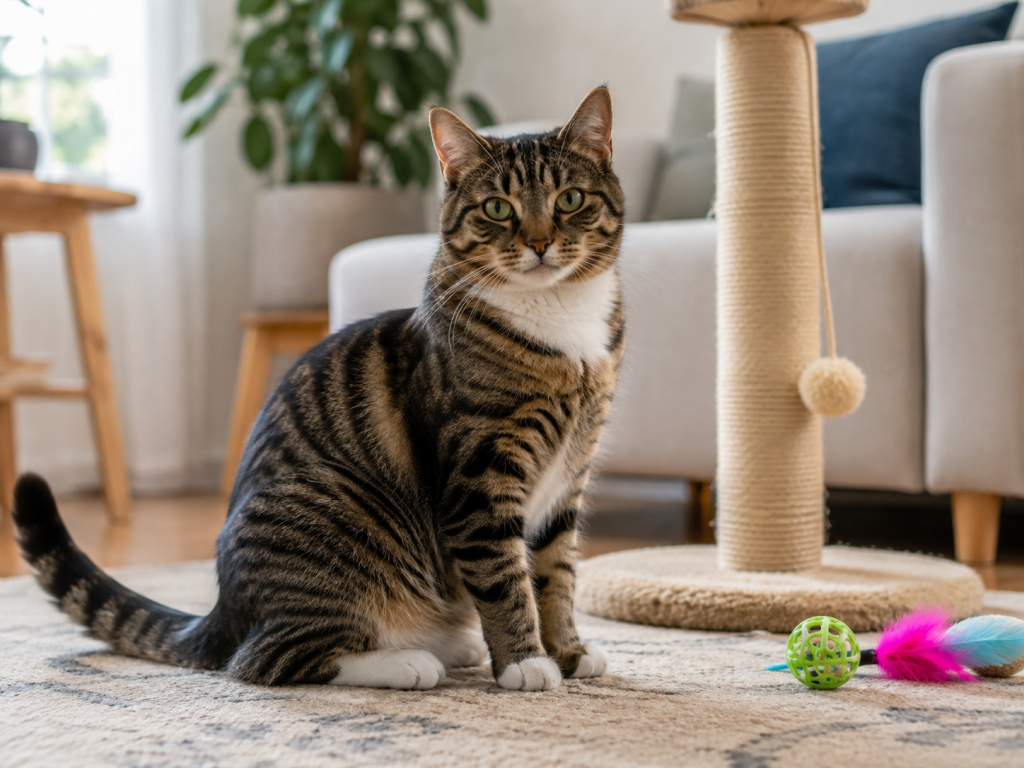
Cat behavior is shaped by genetics, early experiences, learning, health, social relationships, and the environment in which a cat lives. Cats communicate through posture, facial expressions, ear and tail position, vocalizations, scent marking, scratching, movement, and changes in everyday routines. Understanding these signals can help owners recognize whether a cat feels relaxed, playful, curious, fearful, frustrated, overstimulated, or physically uncomfortable.
Many behaviors that people consider strange are completely normal for cats. Scratching, climbing, stalking toys, hiding, rubbing against objects, and seeking elevated spaces all reflect natural feline needs. Problems often arise when cats do not have appropriate ways to express these behaviors or when their environment causes persistent stress.
Learning what normal behavior looks like for your individual cat also makes it easier to recognize sudden changes that may indicate pain or illness.
Understanding Cat Body Language
Cats communicate constantly through their bodies.
A relaxed cat typically has a loose posture, neutral or forward-facing ears, soft facial muscles, and eyes that appear comfortable rather than intensely focused. The cat may lie on its side, sit with the paws tucked comfortably underneath the body, groom normally, stretch, or move through the environment without hesitation.
A tense cat may crouch, flatten the ears, widen the eyes, tuck the tail, freeze, or attempt to retreat. Fear can also produce dilated pupils, flattened whiskers, and a tightly held body posture.
Always interpret several signals together rather than relying on one body part.
What Does a Cat’s Tail Mean?
The tail can provide useful information about a cat’s emotional state.
A cat approaching with the tail held upright may be displaying friendly social behavior. A loosely resting tail often accompanies relaxation, while a tail held tightly around the body can appear during uncertainty or fear.
Rapid tail flicking or strong swishing commonly indicates increasing arousal. During petting, this can be an early sign that the cat is becoming overstimulated.
Do not interpret cat tail movement using dog rules. A strongly wagging dog and a strongly swishing cat can be experiencing very different emotional states.
Why Does My Cat Hold Its Tail Up?
An upright tail is commonly seen when cats approach familiar people or socially compatible cats.
It can be part of a friendly greeting and may accompany rubbing, purring, or walking directly toward you.
Some cats curve the tip of the tail slightly while approaching.
As always, look at the rest of the body. An upright tail on a relaxed cat is different from a rigid tail with raised hair during intense arousal.
What Does a Puffed-Up Tail Mean?
A dramatically enlarged tail occurs when the hairs stand upright.
This reaction, known as piloerection, can make the cat appear larger. It commonly occurs during fear, defensive aggression, or intense excitement.
Cornell describes raised hair, an arched back, and other posture changes as possible components of feline aggression or defensive behavior.
If your cat suddenly becomes puffed up around another animal, give both animals additional space instead of forcing interaction.
Cat Ear Positions
Cats can rotate their ears extensively, making them particularly useful indicators of attention and emotion.
Forward-facing ears often accompany curiosity or relaxation. Ears rotated outward or sideways may indicate increasing uncertainty.
Flattened ears are more concerning. Cats experiencing fear or defensive aggression may hold their ears backward or close to the head.
When ears begin flattening during petting or handling, consider stopping before the cat feels the need to escalate.
Understanding Your Cat’s Eyes
Cat pupils naturally change with light levels, but emotion also affects them.
Wide pupils can appear during play, excitement, fear, or intense arousal. Narrow pupils may occur in bright light or during strong concentration.
The eyes should therefore never be interpreted alone.
A cat with enlarged pupils while chasing a toy may simply be highly engaged. The same pupils combined with flattened ears, crouching, and attempts to escape suggest fear.
Why Do Cats Slow Blink?
Many cats partially close their eyes or slowly blink during relaxed interactions.
This behavior often occurs when the cat feels safe enough to reduce visual vigilance around another individual.
Owners can respond by remaining relaxed and avoiding intense staring.
A cat does not need to maintain constant eye contact to show affection or trust.
Why Do Cats Stare?
Cats stare for several possible reasons.
They may be watching movement, waiting for food, tracking another animal, or attempting to understand what someone is doing.
A fixed stare between unfamiliar or socially tense cats can also contribute to conflict.
In multi-cat homes, repeated staring combined with blocking pathways or resources may indicate tension even when no obvious fight occurs.
Why Do Cats Meow?
Adult domestic cats often use meowing extensively when interacting with humans.
A cat may meow to greet you, request food, ask for access to another room, seek attention, or respond to a familiar routine. Merck notes that cats use several vocal signals and may produce louder sounds when upset or urgently seeking something.
Owners often learn to distinguish individual vocal patterns over time.
A sudden major increase in vocalization, however, can also occur with stress, pain, sensory decline, or medical disease.
What Does Purring Mean?
Purring is commonly associated with relaxation and social contact.
Cats frequently purr while resting beside familiar people, being gently stroked, or nursing kittens.
However, purring should not be treated as proof that a cat is healthy or completely comfortable. Cats can also purr while stressed or physically unwell.
Look at the complete picture, including posture, appetite, movement, and behavior.
Why Do Cats Hiss?
Hissing is usually a request for more distance.
A cat may hiss when frightened, cornered, surprised, painful, or threatened by another animal or person.
Merck describes hissing among defensive behaviors cats may use when attempting to increase distance from a perceived threat.
Do not punish a cat for hissing.
The hiss is valuable information that the current interaction has exceeded the cat’s comfort level.
Why Do Cats Growl?
Growling can also communicate discomfort or conflict.
Cats may growl around another animal, while guarding a resource, during painful handling, or when they believe escape is difficult.
Increase distance and identify what triggered the behavior.
Repeated growling in previously tolerated situations can warrant veterinary attention, especially if touching or movement appears painful.
Why Do Cats Chirp and Chatter?
Some cats produce chirping, chattering, or rapid jaw movements while watching birds or other prey through a window.
This is generally associated with predatory arousal.
The cat may be intensely focused even though the prey is inaccessible.
This behavior is usually normal and does not mean the cat is distressed.
Providing interactive play can give indoor cats appropriate opportunities to express parts of the hunting sequence.
Why Do Cats Scratch Furniture?
Scratching is normal feline behavior.
Cats scratch to maintain their claws, stretch their bodies, and leave visual and scent signals.
Trying to eliminate scratching completely ignores an important behavioral need.
Instead, provide acceptable scratching surfaces in locations your cat is likely to use. Feline behavior guidance recommends meeting normal instinctive needs in appropriate locations rather than relying on punishment.
Different cats may prefer vertical posts, horizontal cardboard, or different textures.
Why Do Cats Knead?
Kneading involves rhythmically pushing the front paws against a soft surface.
This behavior begins during kittenhood when kittens knead around the mother’s mammary glands while nursing.
Many adult cats continue kneading on blankets, beds, or people when relaxed.
Some may purr at the same time.
Kneading is usually normal unless it suddenly becomes excessive alongside other unusual behavior.
Why Do Cats Rub Against People?
Cats may rub their cheeks, head, or body against familiar people and household objects.
Merck notes that cats use rubbing both socially and as a form of scent marking because scent glands are present around the face.
A cat rubbing against your legs may therefore be combining social contact with scent communication.
This is a normal part of feline interaction.
Why Does My Cat Head-Butt Me?
Gentle head rubbing or bunting is another common social behavior.
Cats may push the forehead or cheek against familiar people and other cats.
This behavior can accompany purring, tail-up greetings, and relaxed body language.
Not every cat uses bunting equally, so its absence does not mean the cat lacks attachment.
Why Do Cats Follow Their Owners?
Many cats follow familiar people around the home.
They may expect food, play, access to a room, social interaction, or simply enjoy being nearby.
Some cats remain within a few feet of their owners without wanting to be held.
Following becomes more noteworthy when the pattern changes dramatically, such as a normally independent cat suddenly becoming extremely clingy.
Changes like this can occur during stress or illness.
Why Do Cats Sleep Near Their Owners?
Sleeping near a familiar person may reflect warmth, security, comfort, and social preference.
Cats choose sleeping locations carefully because sleep reduces awareness of the surrounding environment.
A cat that repeatedly sleeps on the bed, beside your legs, or near your head may simply consider the area comfortable and safe.
Individual preferences differ, and cats may change sleeping locations according to temperature or household activity.
Why Do Cats Hide?
Hiding is a normal feline coping strategy.
Cats may retreat to enclosed or elevated spaces to sleep, avoid noise, escape unwanted contact, or feel safer in unfamiliar situations.
Environmental guidelines emphasize the importance of providing safe, secure places where cats can withdraw.
Normal hiding should be distinguished from a sudden major change.
A social cat that suddenly remains hidden for most of the day may be frightened, painful, or sick.
Why Do Cats Sit in Boxes?
Boxes provide enclosed boundaries and visual protection.
They can function as sleeping areas, hiding places, observation points, or play objects.
Providing cardboard boxes is an inexpensive way to increase environmental choice for many indoor cats.
Make sure boxes are free from staples, tape loops, sharp materials, or anything the cat could swallow.
Why Do Cats Climb?
Cats naturally use vertical space.
Climbing provides observation points, additional territory, escape routes, and opportunities to rest away from disturbances.
Environmental guidelines recognize elevated locations as important components of feline-friendly spaces.
Cat trees, shelves, stable furniture, and window perches can help meet this need.
Vertical territory becomes especially valuable when several cats share a home.
Why Do Cats Knock Things Over?
Cats investigate objects with their paws and are highly responsive to movement.
A small object pushed toward the edge of a table may become interesting precisely because it moves when touched.
Some cats may also discover that knocking objects down reliably produces human attention.
Remove fragile or dangerous objects rather than repeatedly punishing exploratory behavior.
Provide appropriate toys that the cat can safely manipulate instead.
Why Do Cats Have Zoomies?
Sudden bursts of running around the home are common.
Cats may sprint after resting, after using the litter box, during play, or when they have accumulated energy.
Young cats and kittens often display particularly intense activity bursts.
Normal zoomies involve coordinated movement and usually end quickly.
Collapse, loss of balance, severe breathing difficulty, or signs of pain are not normal zoomies.
Cat Play Resembles Hunting
Play often includes stalking, crouching, chasing, pouncing, grabbing, and kicking.
These movements resemble elements of predatory behavior.
Merck notes that feline play can include stalking, swatting, and biting and may persist into adulthood.
Use interactive toys rather than encouraging kittens to attack hands or feet.
Teaching appropriate play targets early can reduce painful play attacks later.
Why Does My Cat Attack My Feet?
Moving feet beneath blankets or walking past a hiding cat can trigger chasing and pouncing.
From the cat’s perspective, the movement may resemble prey.
Young cats with insufficient appropriate play may direct more hunting-style behavior toward people.
Increase interactive play and redirect attacks toward toys.
Avoid encouraging aggressive hand or foot games during kittenhood.
Why Do Cats Bite During Play?
Play biting is normal, especially in kittens.
Young cats learn through wrestling, stalking, pouncing, and biting.
Problems can develop when owners repeatedly use bare hands as toys.
Cornell and Merck both recognize play and predatory behavior as potential sources of aggression toward people.
Use wand toys, balls, and other safe interactive objects instead.
Why Does My Cat Bite During Petting?
A cat may enjoy petting and then suddenly reach a point where continued touch becomes uncomfortable.
Early signs can include tail flicking, skin twitching, turning the head toward your hand, ears rotating backward, or increased body tension.
Stop before the cat feels the need to bite.
Petting tolerance differs significantly between individuals.
Respecting those limits can prevent repeated conflict.
Cats Can Become Overstimulated
Overstimulation occurs when interaction becomes more intense than the cat wants.
Petting is a common example, but energetic play or handling can also produce increasing arousal.
A cat may go from relaxed to tail swishing, skin twitching, staring at the hand, grabbing, or biting.
Learn your cat’s early signals and end interaction while they are still comfortable.
Aggression Is Communication
Aggression is not a personality diagnosis.
Cats may behave aggressively because of fear, pain, frustration, territorial conflict, play, resource competition, or redirected arousal.
Cornell emphasizes that feline aggression has several potential causes and recommends determining the underlying motivation before treatment.
Repeated or severe aggression deserves professional evaluation.
Sudden aggression should also raise the possibility of a medical problem.
Fearful Cat Behavior
A frightened cat may crouch, hide, freeze, flatten the ears, widen the pupils, tuck the tail, hiss, growl, or attempt to escape.
Cornell describes dilated pupils, flattened ears, flattened whiskers, and a closely held or tucked tail among signs of fear.
The safest response is usually to reduce pressure.
Allow the cat to retreat instead of continuing to approach.
Do Not Corner a Frightened Cat
Cats often prefer escape over confrontation.
If escape is blocked, defensive behavior can escalate into hissing, swatting, scratching, or biting.
Providing hiding areas and routes away from unwanted interaction can reduce conflict.
Do not reach into a hiding location simply to force social contact.
Let the cat recover before attempting interaction again.
Why Do Cats Suddenly Attack Another Cat?
Conflict can arise because of territorial tension, competition for resources, fear, or redirected aggression.
For example, an indoor cat that sees an unfamiliar cat outside may become intensely aroused and then attack another household cat nearby.
Merck includes redirected aggression among recognized feline behavior problems.
Separate cats safely when serious conflict occurs and allow time for arousal to decrease.
Do not immediately force them back together.
Resource Competition in Multi-Cat Homes
Cats sharing a home may compete without obvious fighting.
One cat may block another from reaching food, water, litter boxes, doorways, resting areas, or preferred people.
Subtle staring, chasing, avoidance, and changes in room use can reveal tension.
Environmental guidelines recommend providing multiple separated resources so cats do not need to compete for essential needs.
More resources can reduce conflict even when the cats appear to tolerate each other.
Cats Use Scent to Communicate
Feline communication is not limited to what humans can see or hear.
Cats use scent from glands around the face and body and may communicate through rubbing, scratching, and urine marking.
Because humans cannot detect many feline scent signals, some behaviors can appear mysterious.
Avoid removing every familiar scent from the environment at once when cleaning because familiar smells can contribute to environmental stability.
Why Do Cats Spray Urine?
Urine marking differs from simply emptying the bladder.
A marking cat often deposits a relatively small amount of urine on a vertical surface while standing.
Stress, social conflict, territorial changes, and the presence of unfamiliar cats can contribute to marking.
However, urinary disease can also cause inappropriate urination.
Any sudden change in elimination should be medically evaluated before assuming it is purely behavioral.
Why Is My Cat Avoiding the Litter Box?
Litter box avoidance has many potential causes.
The box may be dirty, too small, difficult to access, located somewhere stressful, or filled with litter the cat dislikes.
Conflict with another pet can also make the route to the box feel unsafe.
Medical problems such as urinary disease, gastrointestinal disorders, or pain can produce similar changes.
Punishing the cat rarely solves the underlying cause.
Cat Stress Can Be Subtle
Cats do not always show obvious distress.
Environmental guidelines specifically note that cats can experience stress without displaying dramatic visible signs.
A stressed cat may hide more, play less, eat differently, become more vigilant, overgroom, avoid certain rooms, or change litter box habits.
Subtle changes deserve attention, particularly when they persist.
Environmental Needs Affect Behavior
Many feline behavior problems improve when the environment better supports normal behavior.
Cats need safe locations, separated resources, opportunities for play and predatory behavior, positive human interaction, scratching areas, and control over social contact. These principles form the foundation of feline environmental-needs guidance.
Environmental enrichment is therefore not optional entertainment.
It is part of maintaining behavioral wellbeing.
Reward Desired Behavior
Cats can learn through consequences just as other animals do.
If meowing produces food every time, the cat may meow more frequently around feeding times.
If scratching the sofa produces immediate attention, attention itself may reinforce the behavior.
Reward behaviors you want instead.
Provide scratching posts, reward use of them, and redirect inappropriate behavior toward acceptable alternatives. FelineVMA guidance specifically recommends redirection and positive reinforcement rather than physical discipline.
Avoid Physical Punishment
Punishment can increase fear and damage trust.
Yelling, spraying water, hitting, or physically intimidating a cat does not explain what behavior should replace the unwanted action.
It may instead teach the cat to avoid the person delivering the punishment.
Current feline behavior guidance recommends avoiding reprimands and physical discipline and focusing on meeting environmental needs, redirecting behavior, and rewarding appropriate choices.
Cats Can Be Trained
Cats can learn cues and routines through positive reinforcement.
Food rewards, play, or access to preferred activities can reinforce behaviors such as entering a carrier, coming when called, sitting on a mat, or accepting grooming.
Short sessions generally work best.
Training can also improve confidence and make veterinary or grooming procedures easier.
Carrier Training
Many cats associate carriers only with stressful trips.
Leaving the carrier open in the home can help make it part of the normal environment.
Place bedding or occasional treats inside and allow the cat to enter voluntarily.
A familiar carrier can reduce some of the difficulty associated with transportation and veterinary visits.
Changes in Routine Can Affect Cats
Cats often notice household changes quickly.
Moving home, changing work schedules, introducing another animal, rearranging important resources, or bringing home a baby can alter behavior.
Maintaining familiar feeding, play, resting, and litter box routines can help during transitions.
Provide additional hiding and elevated areas when the environment becomes temporarily busier.
Senior Cat Behavior Can Change
Older cats may become less active, sleep differently, vocalize more, or interact differently with people.
Sensory decline, pain, chronic disease, and cognitive changes can all affect behavior.
Cornell notes that senior cats can require adjustments to their environment and increased attention to age-related changes.
Do not automatically assume confusion, house-soiling, or nighttime vocalization is simply normal aging.
Medical Problems Can Change Cat Behavior
Sudden behavior changes can result from physical illness.
Merck lists pain, sensory dysfunction, neurological disease, endocrine disease, and other conditions among potential causes of aggression, vocalization, house-soiling, altered sleep, confusion, and repetitive behavior.
A cat that suddenly becomes aggressive when touched may be painful.
A cat that starts vocalizing at night may have a medical or age-related problem.
Veterinary evaluation is particularly important when changes are sudden or severe.
Excessive Grooming Can Signal a Problem
Cats normally spend substantial time grooming.
However, repeated licking of one area until hair becomes thin or skin becomes irritated is different.
Pain, itching, parasites, allergies, skin disease, and stress can all contribute.
Cornell includes excessive licking among common feline behavioral concerns, but medical causes should always be considered.
Reduced Grooming Can Also Matter
A cat that suddenly stops grooming may be experiencing pain, obesity, dental disease, weakness, or another health problem.
Senior cats with arthritis may struggle to reach parts of the body that were previously easy to groom.
Look for greasy fur, mats, dandruff, or an uncharacteristically untidy coat.
A major decline in normal grooming deserves attention.
When Should You Seek Veterinary Help?
Contact your veterinarian when behavior changes suddenly, becomes severe, or appears alongside physical symptoms.
Important changes include:
- Sudden aggression
- Persistent hiding
- Major appetite changes
- New litter box problems
- Excessive vocalization
- Repetitive pacing or unusual activity
- Excessive grooming
- Reduced grooming
- Confusion
- Reduced jumping or movement
- New sensitivity to touch
- Major sleep changes
Medical causes of behavioral signs can include pain, sensory changes, neurological disorders, and endocrine disease.
When to Seek Behavioral Help
Professional behavioral support can be valuable when fear, aggression, inter-cat conflict, inappropriate elimination, or destructive behavior seriously affects quality of life.
A veterinarian should usually be involved first, particularly when the behavior is new.
Once medical causes have been considered, a qualified feline behavior professional can help modify the environment and create a structured behavior plan.
Avoid approaches built around frightening or physically punishing the cat.
Understanding Your Cat Instead of Fighting Normal Behavior
Good cat behavior does not mean having a cat that never scratches, climbs, hides, meows, hunts toys, or becomes excited.
Many behaviors that frustrate owners are normal feline behaviors being expressed in an inconvenient place or situation.
Provide scratching posts instead of attempting to eliminate scratching. Provide climbing space instead of repeatedly removing the cat from every elevated surface. Use interactive toys instead of allowing predatory play to target hands and feet.
Environmental guidelines emphasize that meeting normal feline needs can reduce stress and prevent many behavior problems.
Learn what your individual cat looks like when relaxed, excited, frightened, and uncomfortable. Pay attention to posture, ears, eyes, tail position, movement, vocalization, and changes in normal routines.
Most importantly, take sudden behavior changes seriously. Aggression, hiding, litter box changes, vocalization, altered sleep, reduced grooming, or unusual social behavior can sometimes be the first signs of pain or disease.
Understanding why a cat behaves a certain way makes it much easier to provide appropriate care, reduce stress, and build a safer and more trusting relationship.