
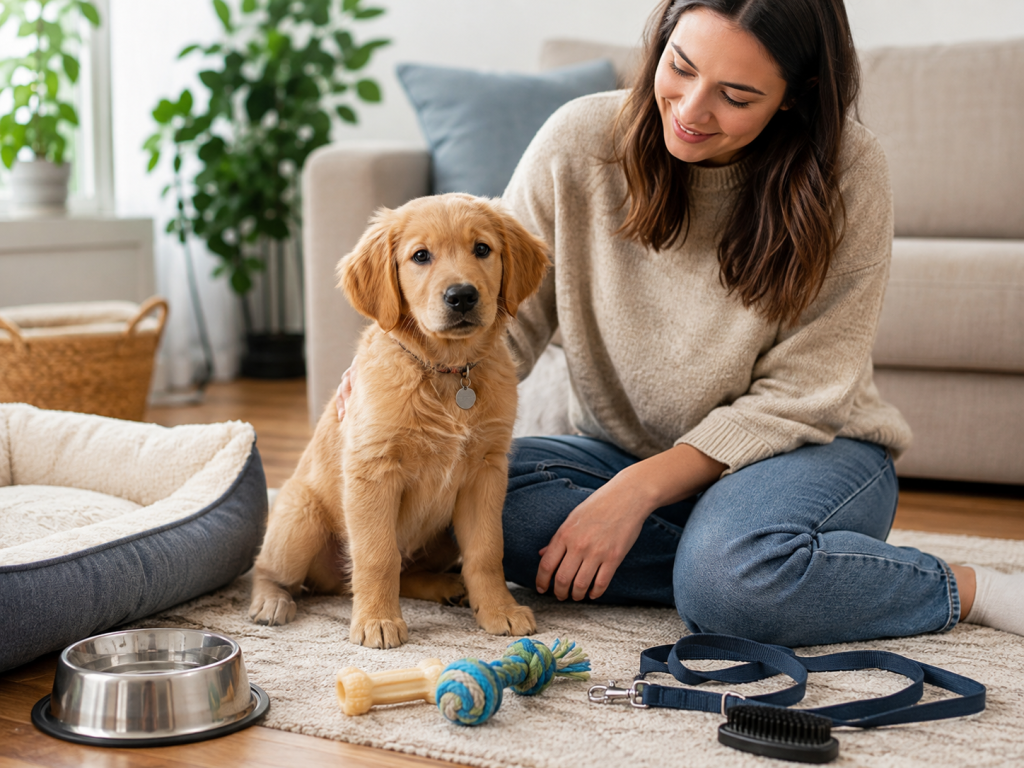
Good puppy care means providing the right nutrition, veterinary care, vaccinations, parasite prevention, training, socialization, exercise, sleep, grooming, and a safe home environment during the first year of life. Puppies grow quickly and need considerably more supervision than adult dogs. Merck Veterinary Manual notes that puppy care includes regular veterinary visits, appropriate feeding, socialization, and training.
The early months are especially important because habits formed during puppyhood can influence behavior and health for years. Puppies also have developing immune systems and require a structured vaccination schedule, while their nutritional needs are higher than those of adult dogs.
The best puppy routine is predictable but flexible. Feed appropriately, provide frequent bathroom breaks, create positive experiences with people and environments, allow plenty of sleep, and monitor closely for signs of illness or discomfort.
Bringing a Puppy Home
The first few days in a new home can be overwhelming for a puppy.
They are suddenly surrounded by unfamiliar smells, people, sounds, rooms, and routines. Give your puppy a calm starting area rather than immediately allowing unrestricted access to the entire home.
Set up a comfortable bed or crate, food and water, safe toys, and easy access to the designated bathroom area. Remove electrical cords, medications, cleaning products, small swallowable objects, toxic foods, and anything else the puppy might chew.
Young puppies learn through exploration, and much of that exploration happens with their mouths.
Schedule a Veterinary Visit Early
A new puppy should receive veterinary care soon after arriving home, particularly when previous medical records are incomplete.
Merck recommends puppy veterinary visits approximately every three to four weeks until around four months of age. These appointments help monitor growth, administer vaccines, review parasite prevention, and identify developmental or medical concerns early.
Bring any vaccination, deworming, microchip, medication, or feeding records provided by the breeder, shelter, rescue, or previous caregiver.
The first appointments are also useful for discussing nutrition, house training, socialization, grooming, dental care, exercise, and future reproductive decisions.
Puppy Vaccinations
Vaccination is an important part of preventive puppy care.
AAHA recommends that puppies receive at least three doses of the core combination vaccine against distemper, adenovirus, and parvovirus between approximately 6 and 16 weeks of age, with doses spaced two to four weeks apart.
Additional vaccines may be recommended according to geographic location, lifestyle, exposure risk, and local regulations.
Rabies vaccination is also required according to regional law and veterinary recommendations.
Follow your veterinarian’s complete schedule rather than assuming your puppy is protected after one early vaccine.
Why Puppies Need Several Vaccine Appointments
Puppies receive antibodies from their mothers, but those antibodies gradually decline.
While maternal antibodies can provide useful early protection, they can also interfere with vaccination. Because the timing of that decline differs between puppies, several vaccine doses are given during the early months.
Merck notes that core puppy vaccines are generally administered every two to four weeks until the puppy is at least 16 to 20 weeks old.
Skipping later doses can therefore leave gaps in protection.
Parasite Prevention
Puppies can be affected by fleas, ticks, intestinal worms, heartworm, and other parasites depending on where they live and their lifestyle.
Parasite prevention should be individualized according to age, weight, geographic risk, travel, and health.
Veterinarians may recommend stool testing and deworming during puppy visits.
Never use random parasite products simply because another dog in the household uses them. Age and weight restrictions matter, particularly in very young puppies.
Feed a Complete Puppy Diet
Puppies need food specifically formulated to support growth.
Their calorie needs relative to body size are higher than those of adults. Merck estimates that healthy puppies younger than four months may require roughly three times resting energy requirements, while older puppies may require around twice resting energy requirements. These are estimates rather than exact prescriptions for every puppy.
Choose food labeled complete and balanced for growth.
Large and giant breeds may need formulas specifically designed to support controlled development, so discuss breed-specific nutritional needs with your veterinarian.
How Often Should You Feed a Puppy?
Meal frequency usually decreases as a puppy grows.
Merck provides the following general schedule: puppies 6 to 12 weeks old are commonly fed four meals daily, puppies 3 to 6 months old receive three meals, and puppies 6 to 12 months old are generally fed twice daily.
This schedule is a useful starting point, not an absolute rule.
Individual puppies may need adjustments based on size, food type, body condition, health, and veterinary guidance.
Measure Food Instead of Free-Pouring
Puppies need enough energy to grow, but overfeeding is not beneficial.
Measure the total daily ration and divide it into meals. Avoid repeatedly topping up the bowl simply because the puppy appears hungry.
Rapid excessive growth can be particularly problematic in large-breed puppies.
Regular weigh-ins and veterinary body-condition checks help confirm that growth is progressing appropriately.
Fresh Water Should Always Be Available
Once a puppy is weaned, fresh drinking water should normally be available throughout the day.
Keep the bowl clean and easy to reach.
Water intake can increase with exercise, warm weather, dry food, or certain health conditions.
Become familiar with what is normal for your puppy. A sudden dramatic change in thirst can deserve veterinary attention.
Potty Training Starts Immediately
House training should begin from the first day.
Young puppies need frequent opportunities to eliminate because bladder control is still developing. Take the puppy to the designated area after waking, eating, drinking, playing, and before bedtime.
Reward successful toileting immediately.
Do not punish accidents. Yelling or rubbing the puppy’s nose in waste does not teach where they should go and may create fear around elimination.
Consistency and supervision are much more effective.
Use a Predictable Potty Schedule
Routine makes house training easier.
A young puppy may need bathroom breaks every few hours and more frequently after exciting activities or meals.
Watch for sniffing, circling, suddenly leaving play, or moving toward a familiar elimination area.
When you notice those signals, take the puppy outside promptly.
As the puppy matures, bladder control gradually improves and the intervals can lengthen.
Crate Training Can Be Useful
A properly introduced crate can provide a secure resting area and help with household management.
The crate should never be used as punishment.
Introduce it gradually with treats, meals, toys, and comfortable bedding so the puppy learns that the space is safe.
The crate must also be large enough for the puppy to stand, turn around, and lie comfortably.
Young puppies still need frequent bathroom opportunities and should not be confined for excessive periods.
Puppies Need Socialization
Socialization helps puppies develop confidence around ordinary life.
Positive experiences with people, environments, sounds, surfaces, handling, transportation, and appropriate animals can reduce the likelihood of future fear. AVMA recommends using praise, play, and treats to reinforce positive or neutral responses while allowing puppies to withdraw when they become uncomfortable.
Socialization is not about forcing a puppy into every possible situation.
The goal is to make new experiences safe, controlled, and positive.
Do Not Overwhelm a Puppy
A frightened puppy does not become confident simply by being forced to remain near something scary.
Allow the puppy to observe new people or environments from a comfortable distance. Pair calm exploration with food, play, and praise.
If the puppy hides, freezes, refuses treats, or repeatedly tries to escape, reduce the intensity.
Good socialization builds confidence rather than testing how much fear the puppy can tolerate.
Puppy Classes Can Help
Well-run puppy classes can provide structured training and social learning.
They also teach owners how to reinforce desirable behavior, manage common puppy problems, and understand body language.
Ask your veterinarian when participation is appropriate based on vaccination status and local infectious-disease risk.
Choose classes that use reward-based methods rather than intimidation or painful corrections.
Start Training Early
Puppies can begin learning simple behaviors soon after arriving home.
Teach name recognition, attention, sitting, coming when called, walking with you, settling, and handling gradually.
Keep sessions short and rewarding.
A few minutes of successful training several times a day is often more productive than one long session during which the puppy becomes distracted or tired.
Reward the Behavior You Want
Dogs repeat behaviors that produce useful outcomes.
Reward calm sitting instead of jumping, attention instead of pulling, appropriate chewing instead of furniture destruction, and toileting in the correct location.
Food is convenient for training, but rewards can also include toys, play, praise, access to sniffing, or another activity the puppy enjoys.
Training becomes easier when you show the puppy what works rather than focusing only on mistakes.
Puppy Biting Is Normal
Puppies commonly bite and mouth hands, clothing, and objects.
AKC describes nipping as normal puppy behavior, especially during teething.
Do not encourage wrestling with bare hands if you do not want an adult dog to use teeth during play.
Redirect biting toward suitable toys and stop interactions briefly when play becomes too rough.
Consistency across all family members makes learning faster.
Teething and Chewing
Puppies lose their baby teeth and develop adult teeth during the first months.
Chewing can become especially intense during this period. AKC notes that teething commonly increases the desire to chew as puppies deal with sore gums and developing teeth.
Provide several safe chew options with different textures.
Remove damaged toys before pieces can be swallowed, and keep shoes, electrical cords, children’s toys, medication, and household waste inaccessible.
Do Not Give Unsafe Chews
Not every hard object is safe simply because it is marketed for dogs.
Extremely hard chews can damage teeth, while pieces of toys or bones may create choking or gastrointestinal risks.
Select products appropriate for your puppy’s size and chewing style.
Supervise new chews until you know how your puppy uses them.
If a large piece is swallowed, contact your veterinarian for advice.
Puppies Need Plenty of Sleep
Young puppies spend a large portion of the day sleeping.
AKC notes that some young puppies may sleep approximately 16 to 18 hours each day and recommends providing several quiet nap periods.
An overtired puppy can become more excitable, bite harder, struggle to focus, and appear difficult to settle.
Make sure your puppy has a quiet resting place where children and other pets leave them alone.
Normal sleep should still be distinguished from unusual lethargy or weakness.
Exercise Should Match Development
Puppies need physical activity, but they should not simply follow an adult dog’s exercise routine.
Short play sessions, safe exploration, training, and age-appropriate walks provide useful movement and stimulation. AKC emphasizes balancing physical exercise with mental activity for healthy puppy development.
Avoid forcing young puppies through excessive repetitive running or intense exercise simply to make them tired.
Breed size, age, joint development, vaccination status, environment, and health all affect what is appropriate.
Mental Exercise Is Important Too
A tired puppy does not always need more running.
Training, scent games, food puzzles, exploration, and chewing can provide meaningful mental stimulation.
Scatter part of the puppy’s measured meal in a safe area or use a simple puzzle feeder.
Make challenges easy initially and gradually increase difficulty.
Mental enrichment can help satisfy natural curiosity without requiring constant high-impact exercise.
Introduce Leash Walking Gradually
Start by allowing the puppy to become comfortable wearing a lightweight collar or harness.
Then introduce the leash in a quiet environment before expecting calm walking around major distractions.
Reward the puppy for staying near you and for responding to attention cues.
Do not expect perfect leash walking immediately. Puppies are processing unfamiliar smells, people, sounds, and movement at the same time.
Practice Being Alone
Puppies also need to learn that short periods without constant human contact are safe.
Begin with very brief separations while the puppy has a comfortable resting area or appropriate chew. Gradually increase duration according to how well the puppy copes.
AKC recommends teaching alone time gradually instead of suddenly expecting a puppy to tolerate long absences.
A puppy that panics, screams continuously, injures themselves, or cannot settle may require a slower plan or professional guidance.
Grooming Should Begin Early
Puppyhood is an ideal time to create positive grooming habits.
Briefly brush the coat, handle paws, look at the ears, touch the mouth, and practice calm restraint while rewarding cooperation.
The amount of actual brushing required depends on coat type.
Long, curly, thick, or continuously growing coats usually need much more maintenance than short coats.
Early positive practice can make lifelong grooming substantially easier.
Introduce Nail Trimming Carefully
Start by touching and gently holding the paws.
When the puppy is comfortable, introduce the nail clippers or grinder without immediately trimming every nail.
Reward calm behavior and begin with one or two nails if necessary.
Avoid cutting into the quick.
If you are unsure how to trim safely, ask your veterinary team or professional groomer to demonstrate.
Start Dental Care Young
Adult dental health can benefit from habits introduced during puppyhood.
Begin with gentle facial and mouth handling. Later, introduce a dog-specific toothbrush and toothpaste gradually.
Never use human toothpaste without veterinary confirmation that it is safe for dogs.
Veterinary dental examinations should still remain part of preventive care even when home brushing is excellent.
Keep the Home Puppy-Proofed
Puppies can reach more places every week as they grow.
Secure medication, chocolate, grapes, raisins, onions, xylitol-containing products, cleaning chemicals, batteries, electrical cords, string, socks, small toys, and trash.
Use baby gates or closed doors to block unsafe areas when you cannot supervise.
Check garden plants and household plants for toxicity as well.
Prevention is far easier than treating poisoning or intestinal obstruction.
Introduce New Dogs Carefully
A puppy does not automatically need to greet every dog they see.
Choose calm, healthy, appropriately social dogs for early interactions.
Avoid overwhelming the puppy with uncontrolled groups of unfamiliar animals.
Positive experiences matter more than the total number of dogs they meet.
If another dog is clearly uncomfortable, give both animals space rather than making the older dog tolerate unlimited puppy behavior.
Introduce Puppies to Children Safely
Children should learn how to interact respectfully with puppies.
Do not allow chasing, tight hugging, climbing on the dog, pulling ears or tails, or disturbing the puppy while eating or sleeping.
Supervision is especially important because puppies can become excited and use their teeth during play.
Teach children to let the puppy approach voluntarily and to use toys rather than hands during energetic games.
Adolescence Changes Behavior
Puppyhood gradually develops into adolescence.
Merck notes that canine adolescence often begins around sexual maturity at approximately 6 to 9 months, although giant breeds may mature later. Increased independence and confidence can occur during this period.
A puppy that previously followed every cue may suddenly become more distracted.
Continue training rather than assuming previous lessons have disappeared.
Adolescence is a normal developmental stage, but consistent routines remain important.
Spaying and Neutering
The ideal timing of spaying or neutering is not identical for every dog.
Breed, expected adult size, health, lifestyle, sex, and reproductive risk can all influence the decision.
Discuss timing with your veterinarian rather than choosing an age based only on a general rule.
This conversation should happen during puppyhood so you can make an informed decision before reproductive maturity.
Microchipping and Identification
Even puppies intended to remain indoors or in fenced areas can become lost.
Microchipping provides permanent identification, while collars and identification tags can make reunification faster when appropriate.
Register the microchip and keep your contact details current.
A microchip that still contains an old phone number is much less useful when your dog is found.
Monitor Growth and Body Condition
Puppies should grow steadily, but rapid weight gain is not automatically desirable.
Your veterinarian can track body weight and body condition during routine puppy visits.
Look at overall development rather than comparing your puppy with another dog of the same age.
Breed size, genetics, sex, nutrition, and individual development all influence growth rate.
Watch Your Puppy’s Appetite
Puppies usually have reliable appetites because growth requires substantial energy.
A sudden refusal to eat can therefore be important.
Stress can temporarily reduce appetite, particularly after moving home, but vomiting, diarrhea, weakness, pain, or persistent food refusal deserves veterinary attention.
Young puppies have fewer energy reserves than healthy adults and can deteriorate more quickly when illness affects food intake.
Diarrhea in Puppies
A single soft stool can occur after stress or dietary change.
Persistent diarrhea is more concerning because puppies can become dehydrated and may have parasites, infections, dietary problems, or other illnesses.
Contact your veterinarian when diarrhea is severe, repeatedly occurs, contains blood, or appears with vomiting, weakness, poor appetite, or weight loss.
Do not repeatedly change food without understanding the cause.
Vomiting in Puppies
Repeated vomiting should not be ignored.
Puppies frequently chew and swallow inappropriate objects, making gastrointestinal foreign bodies an important concern.
Veterinary attention is especially important when vomiting occurs with abdominal pain, lethargy, refusal to eat, diarrhea, or inability to keep water down.
Do not induce vomiting at home unless a veterinarian or animal poison professional specifically tells you to do so.
Coughing and Sneezing
Occasional isolated sneezing can occur with irritation, but persistent respiratory symptoms deserve attention.
Coughing, nasal discharge, eye discharge, breathing difficulty, fever, reduced appetite, or lethargy may indicate respiratory illness.
Puppies that have not completed vaccination can be especially vulnerable to infectious disease.
Keep vaccination appointments current and contact your veterinarian when symptoms become persistent or severe.
Watch for Parasite Signs
A swollen abdomen, diarrhea, poor coat condition, weight problems, visible worms, excessive scratching, or fleas can indicate parasite problems.
However, some infected puppies show few obvious signs.
This is why routine deworming, stool testing, and preventive veterinary care are important.
Do not assume that a normal-looking puppy cannot have parasites.
When a Puppy Needs Urgent Veterinary Care
Some symptoms should not wait for a routine appointment.
Seek urgent veterinary attention if your puppy has:
- Difficulty breathing
- Collapse or severe weakness
- Repeated seizures
- Severe or repeated vomiting
- Bloody diarrhea with weakness
- Major trauma
- Suspected poisoning
- A swollen painful abdomen
- Inability to urinate
- Severe dehydration
- Ingestion of a dangerous foreign object
- Extreme lethargy or unresponsiveness
Young puppies can become seriously ill quickly, so early professional advice is appropriate when symptoms appear severe.
Build a Daily Puppy Routine
A simple routine helps a puppy understand everyday life.
Provide regular measured meals, bathroom trips, short training sessions, play, exercise, socialization, chew time, and plenty of sleep.
Include calm periods rather than keeping the puppy constantly stimulated.
Regularity makes house training easier and helps owners notice appetite, elimination, or behavior changes more quickly.
Common Puppy Care Mistakes
One common mistake is giving a puppy too much freedom too soon.
Unsupervised access to the entire home creates more opportunities for house-training accidents, dangerous chewing, and unwanted habits.
Another mistake is expecting the puppy to behave like an adult immediately. Bladder control, impulse control, social skills, and training all take time.
Owners may also provide too much intense activity while overlooking sleep and mental enrichment.
Finally, delaying veterinary care because a puppy “looks healthy” can allow preventable problems to progress.
Building a Healthy Foundation for Adulthood
Good puppy care combines health care, nutrition, training, socialization, enrichment, safety, and patience.
Schedule veterinary visits regularly during the early months. Merck recommends appointments roughly every three to four weeks during the initial puppy period, while AAHA vaccination guidelines call for a series of core vaccines through approximately 16 weeks of age.
Feed a complete growth diet and adjust meal frequency as your puppy matures. Merck recommends four daily meals from approximately 6 to 12 weeks, three meals from 3 to 6 months, and two meals between 6 and 12 months.
Use positive training and give your puppy safe opportunities to experience people, environments, handling, and appropriate animals. AVMA recommends rewarding positive or neutral engagement while allowing puppies to withdraw when they feel uncomfortable.
Provide appropriate physical activity, mental stimulation, chewing outlets, grooming practice, and plenty of sleep. Young puppies may sleep 16 to 18 hours per day, so rest is an important part of healthy development rather than wasted time.
Most importantly, learn what normal looks like for your puppy. Appetite, energy, stool, urination, breathing, movement, and behavior can all provide early clues when something changes.
The first year requires a lot of work, but consistent puppy care creates the foundation for a healthier, more confident, and better-adjusted adult dog.