
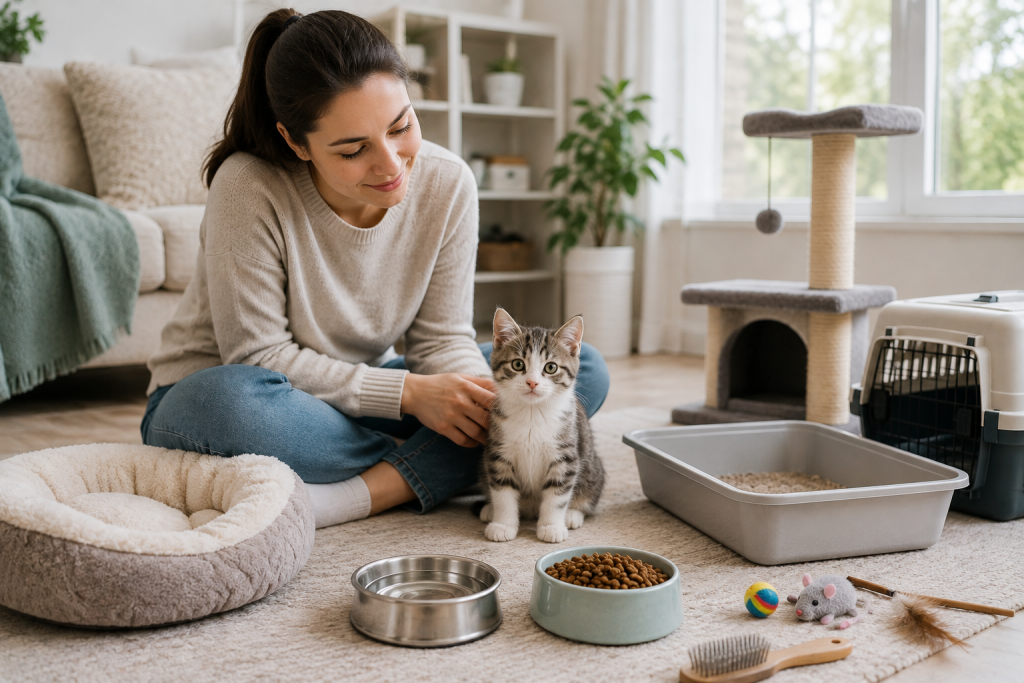
Kitten care involves much more than providing food, water, and a litter box. Growing kittens need appropriate nutrition, repeated veterinary care, vaccinations, parasite prevention, socialization, play, grooming, safe exploration, and plenty of rest. Merck Veterinary Manual includes nutrition, vaccination, parasite control, dental care, grooming, social interaction, and household safety among the key parts of routine kitten care.
The first months are especially important because kittens are developing physically while also learning how to interact with people, other animals, and their environment. Early positive handling and human contact can influence later confidence and social behavior.
A good routine should therefore support both physical health and emotional development while giving the kitten safe opportunities to explore and learn.
Bringing a Kitten Home
A new home can be overwhelming for a young kitten because everything is unfamiliar.
Begin with a quiet, secure area containing food, fresh water, a comfortable bed, hiding places, toys, scratching surfaces, and an easily accessible litter box. Expanding access to the rest of the home gradually can make supervision easier and help the kitten adjust.
The environment should also be kitten-proofed. Small objects, medication, cleaning products, electrical cords, toxic plants, thread, string, and other swallowable items should be kept inaccessible.
Kittens are naturally curious, and prevention is much easier than treating poisoning, injury, or intestinal obstruction.
Schedule a Veterinary Visit Early
Veterinary care should begin early in kittenhood.
Merck recommends repeated early veterinary visits for vaccinations, parasite control, nutrition assessment, dental care, grooming advice, and general health monitoring.
Bring any medical records provided by the breeder, shelter, rescue organization, or previous caregiver. These may include vaccination dates, deworming history, microchip information, previous illness, or medications.
Your veterinarian can also help establish an individualized feeding, vaccination, and parasite-prevention plan.
Kitten Vaccinations
Kittens require a vaccination series rather than one single injection.
Merck’s preventive-care guidance states that the core FPV-FCV-FHV-1 vaccine series commonly begins around 6–8 weeks of age and is repeated every 3–4 weeks until approximately 16–20 weeks.
Additional vaccines may be recommended according to lifestyle, geographic location, exposure to other cats, and local disease risk.
Follow the schedule recommended by your veterinarian rather than assuming that one early vaccination provides complete protection.
Parasite Prevention
Kittens can develop both internal and external parasites.
Roundworms, hookworms, tapeworms, fleas, ticks, protozoa, and other parasites can affect cats, and some may be passed from the mother to her kittens.
Veterinary visits may include stool testing, deworming, and recommendations for flea, tick, or other parasite prevention.
Only use products confirmed as safe for kittens of the correct age and body weight.
Feed a Complete Kitten Diet
Growing kittens need food formulated specifically for growth.
Their nutritional requirements differ from those of healthy adult cats, so a complete and balanced kitten food should normally form the foundation of the diet. WSAVA recommends tailoring nutrition to the individual animal’s life stage, body condition, health, and lifestyle.
Do not rely on plain meat, tuna, cow’s milk, or homemade combinations as the primary diet unless a veterinary nutrition specialist has formulated them appropriately.
Growing kittens need consistent access to adequate energy and nutrients to support development.
Feed Several Small Meals
Young kittens generally do better with multiple small meals rather than one large daily feeding.
Their stomachs are relatively small while their energy demands for growth are high. Dividing the daily ration into several portions can make intake easier to manage and gives owners more opportunities to notice appetite changes.
As the kitten approaches adulthood, meal frequency can gradually decrease.
The total daily amount should still be measured so repeated small meals do not accidentally become overfeeding.
Fresh Water Should Always Be Available
Kittens should have easy access to fresh, clean water.
Place the bowl somewhere quiet and separate from dirty litter areas. Some cats prefer wide bowls or multiple drinking locations.
Even kittens eating wet food should still have water available.
Changes in drinking can provide useful health information, particularly when they occur alongside appetite, urination, or activity changes.
Litter Training Usually Starts Naturally
Most kittens have a natural tendency to dig and eliminate in a loose substrate.
Provide a clean, low-sided litter box that the kitten can enter easily. Place it somewhere quiet, accessible, and separate from food and water.
After meals, naps, or energetic play, gently placing the kitten near the litter box can help reinforce its location.
Avoid punishment for accidents. Instead, clean the area thoroughly and make the correct litter box easier to access.
Use a Kitten-Friendly Litter Box
A box designed for an adult cat may be difficult for a very small kitten to enter.
Choose a low entry while the kitten is young, then increase the box size as the cat grows.
Keep the litter box clean because many cats are sensitive to heavily soiled toileting areas.
If the kitten suddenly stops using a previously accepted litter box, consider both environmental and medical causes.
Socialization Is Essential
Early socialization has a major influence on how kittens respond to people.
Merck reports that kittens handled by people during approximately 2–7 weeks of age tend to be friendlier and less aggressive toward people than kittens without comparable handling.
Positive experiences can include gentle handling, different household sounds, carriers, grooming, visitors, safe surfaces, and appropriate interaction with other animals.
The goal is not maximum exposure. Experiences should remain manageable and positive.
Do Not Overwhelm a Frightened Kitten
A kitten that hides, freezes, struggles, or repeatedly attempts to escape may be overwhelmed.
Reduce the intensity of the situation instead of forcing continued interaction.
Early socialization should help the kitten associate people and everyday experiences with safety.
Repeated frightening experiences can have the opposite effect and contribute to long-term fear.
Human Contact Matters
Kittens learn social skills from their mother and littermates, but human interaction also matters.
Merck notes that kittens generally need human contact during the early developmental period to become comfortable companion animals.
Use calm handling, play, treats, and gentle interaction.
Allow the kitten to approach voluntarily whenever possible rather than constantly picking them up.
Play Is Part of Healthy Development
Play helps kittens develop coordination, physical fitness, hunting skills, and social behavior.
Merck notes that kitten play changes over development, with social play such as wrestling and biting gradually shifting toward more predatory-style stalking and pouncing around 12–14 weeks.
Provide interactive toys that encourage chasing, stalking, and pouncing.
Short sessions several times a day can be more effective than leaving the kitten to entertain themselves indefinitely.
Do Not Use Hands as Toys
Kittens frequently bite and grab during play.
Using bare hands or feet as toys can teach them that human skin is an acceptable target. Feline behavior guidance specifically recommends avoiding hand and foot play with kittens.
Use wand toys, soft toys, balls, and other appropriate objects instead.
Redirect biting toward a toy rather than punishing normal play behavior.
Scratching Is Normal
Kittens begin learning where and how to scratch early in life.
Provide stable scratching posts or horizontal scratching surfaces near areas where the kitten spends time.
Scratching supports normal claw maintenance, stretching, and scent communication.
Making appropriate scratching surfaces convenient is more useful than repeatedly correcting the kitten for using furniture.
Kittens Need Plenty of Sleep
Young kittens sleep frequently because growth and development require substantial rest.
Provide several quiet resting places where the kitten can sleep without repeated interruption.
Energetic play followed by deep sleep is common.
However, unusual weakness, inability to wake normally, persistent hiding, or dramatic reduction in activity should not automatically be interpreted as ordinary kitten sleep.
Create a Predictable Daily Routine
Kittens often adapt well when everyday resources are predictable.
Regular meal times, litter box cleaning, play sessions, rest, and social interaction create a stable routine.
Predictability does not mean the household must operate at exactly the same minute every day.
The goal is to make food, water, toileting, rest, and interaction reliably available.
Introduce the Carrier Early
Do not allow the carrier to appear only immediately before a veterinary visit.
Leave it open in the home with comfortable bedding when practical.
Place treats or toys inside so the kitten can explore voluntarily.
A familiar carrier can make future transportation less stressful.
Start Grooming Young
Early grooming practice can make lifelong coat and nail care easier.
Gently brush the kitten, handle the paws, look at the ears, and briefly touch around the mouth.
Merck includes grooming as part of routine kitten health care.
Keep sessions short and positive.
Long-haired kittens may require more frequent brushing as their coat develops.
Nail Care
Kittens naturally use scratching surfaces to maintain their claws, but occasional trimming may still be useful.
Introduce paw handling before nail trimming becomes necessary.
Press each paw gently, reward calm behavior, and gradually introduce the nail clippers.
Avoid cutting into the quick.
If you are uncertain how much nail can safely be removed, ask a veterinarian or groomer to demonstrate.
Begin Dental Habits Early
Dental care is easier when a cat learns early that mouth handling is normal.
Start by gently touching the face and lips for short periods.
Later, introduce a cat-specific toothbrush and toothpaste gradually.
Merck includes proper dental care among the preventive needs addressed during kitten development.
Never use human toothpaste unless a veterinarian has specifically confirmed that a product is safe for cats.
Introduce Other Cats Gradually
A resident cat may not immediately welcome a new kitten.
Begin with separate resources and controlled introductions rather than placing the animals together and hoping they resolve everything themselves.
Allow scent exchange and gradual visual contact before unrestricted interaction when necessary.
Both cats should have escape routes, resting areas, food, water, and litter boxes that cannot easily be monopolized by the other animal.
Introducing a Kitten to a Dog
Dog-kitten introductions require careful supervision.
Keep the dog controlled initially and give the kitten elevated escape routes or protected areas.
Do not allow chasing, even when the dog appears playful.
The goal is calm coexistence rather than immediate close interaction.
Kitten-Proof Electrical Cords
Chewing cords can cause serious injury.
Cover or remove accessible cables, unplug unnecessary equipment, and provide appropriate toys instead.
Do not rely on verbal correction alone because kittens may investigate again when unsupervised.
Regularly inspect the home as the kitten becomes larger and more capable of reaching new areas.
Be Careful With String and Thread
String-like objects are especially attractive to many kittens.
Thread, yarn, ribbon, dental floss, elastic bands, and similar materials can be dangerous if swallowed.
Store them securely when they are not being used.
Interactive string toys should be put away after supervised play rather than left available indefinitely.
Check Houseplants
Some common plants are toxic to cats.
Identify plants before allowing a kitten access to them.
Do not assume that a kitten will naturally avoid something dangerous.
Young animals may bite leaves simply because they are exploring the environment.
Human Foods and Medications Should Be Secured
Medication should never be left where a kitten can reach it.
Human foods can also present risks because ingredients that are harmless to people may be dangerous to cats.
Keep medication, supplements, cleaning chemicals, and food waste in secure cabinets or containers.
A closed trash can can prevent many avoidable exposures.
Microchip and Identification
Even indoor kittens can escape through doors or windows.
Microchipping provides permanent identification and can improve the chance of reunification if the cat becomes lost.
Make sure the microchip is registered with current contact information.
A properly fitted breakaway collar with identification may also be appropriate for some cats.
Spaying and Neutering
Discuss reproductive care with your veterinarian during kittenhood.
Timing can depend on health, development, household circumstances, and veterinary recommendations.
Planning early helps prevent accidental breeding and ensures you understand the procedure before the kitten approaches sexual maturity.
Do not wait until behavioral or reproductive changes have already become established before having the conversation.
Monitor Growth
Kittens should gain weight and develop steadily.
Weighing the kitten periodically can help identify whether growth is progressing appropriately.
A kitten that fails to gain weight, loses weight, or becomes noticeably thinner should be evaluated.
WSAVA recommends nutritional assessment according to individual growth, body condition, and health rather than assuming one feeding amount fits every kitten.
Monitor Appetite
Healthy growing kittens usually show consistent interest in food.
A sudden reduction in appetite is therefore worth noticing.
Stress from moving to a new home can temporarily alter eating, but persistent food refusal can occur with infection, gastrointestinal disease, parasites, pain, or other illness.
Young kittens can deteriorate more quickly than healthy adults, so prolonged poor intake should be discussed with a veterinarian.
Vomiting and Diarrhea
Digestive problems are common reasons kittens require veterinary attention.
Diet changes, parasites, infections, inappropriate food, and swallowed objects can all contribute.
Repeated vomiting, persistent diarrhea, blood, dehydration, weakness, or poor appetite should prompt veterinary advice.
Because kittens are small, fluid loss can become important more quickly than in a healthy adult cat.
Watch for Respiratory Symptoms
Sneezing occasionally can occur without serious disease, but persistent sneezing, nasal discharge, eye discharge, coughing, reduced appetite, or breathing difficulty deserve attention.
Vaccination helps protect against several important feline infectious diseases, which is one reason kittens receive repeated vaccine doses during the early months.
Keep sick kittens separated from other cats when directed by a veterinarian.
Difficulty breathing should be treated as urgent.
Monitor the Litter Box
The litter box provides valuable health information.
Watch for diarrhea, constipation, blood, repeated straining, unusually frequent urination, or crying during elimination.
A kitten repeatedly trying to urinate while producing little or no urine requires prompt veterinary assessment.
Sudden litter box changes should not automatically be treated as bad behavior.
Signs of Parasites
Parasites do not always produce obvious symptoms, but possible signs include diarrhea, vomiting, poor coat quality, a swollen abdomen, visible worms, itching, or poor growth.
Roundworms, hookworms, tapeworms, fleas, ticks, and protozoal parasites can all affect cats.
Routine veterinary parasite prevention is important even when the kitten appears healthy.
When Does a Kitten Need Urgent Veterinary Care?
Seek prompt or emergency veterinary care if your kitten develops severe breathing difficulty, collapse, repeated seizures, serious trauma, suspected poisoning, uncontrolled bleeding, or extreme weakness.
Repeated vomiting, severe diarrhea with weakness, inability to keep water down, a painful swollen abdomen, inability to urinate, or suspected ingestion of a dangerous object can also require urgent attention.
Young kittens can become seriously ill quickly.
When symptoms appear severe or rapidly worsen, professional assessment is safer than waiting for the kitten to recover on their own.
Helping a Kitten Develop Into a Confident Cat
Good kitten care combines physical healthcare with positive early experiences.
Provide complete growth nutrition and an individualized feeding plan appropriate for the kitten’s age and condition. WSAVA recommends tailoring nutrition according to life stage, health, body condition, and individual requirements.
Keep veterinary visits, vaccination, and parasite prevention current. Merck’s preventive guidance places the core kitten vaccination series from approximately 6–8 weeks through 16–20 weeks, depending on the individual schedule.
Socialization is equally important. Early positive handling can influence friendliness and confidence, and kittens normally benefit from human contact during their early development.
Provide play, scratching opportunities, safe exploration, grooming practice, an accessible litter box, comfortable hiding areas, and plenty of rest. Avoid using hands and feet as toys so predatory play remains directed toward appropriate objects.
Most importantly, learn your kitten’s normal appetite, energy, stool, urination, breathing, movement, and behavior. Changes in those patterns can provide early warning that something needs veterinary attention.
Thoughtful kitten care during the first months creates the foundation for a healthier, more confident, and better-adjusted adult cat.