
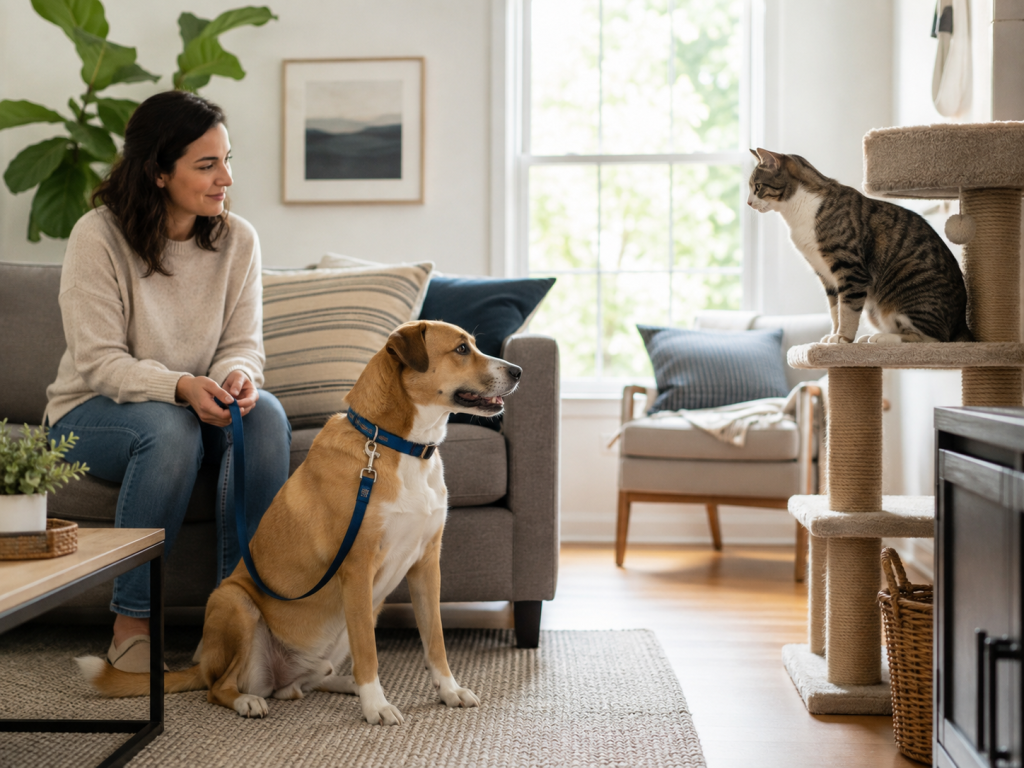
Learning how to introduce a new pet to a home with another pet starts with one rule: do not rush the first meeting. The safest approach is usually to give the newcomer a separate area, introduce scent and presence gradually, supervise early interactions, and allow both animals to control how quickly they become comfortable.
The exact process depends on the animals involved. Introducing two dogs is different from introducing two cats, while a dog-to-cat introduction requires additional management because chasing can create a serious safety problem. Individual temperament, age, health, previous experience, and fear levels matter more than simply assuming two animals should get along because they belong to a particular species.
A successful introduction does not require the pets to become best friends immediately. The first goal is much simpler: both animals should be able to remain safe and reasonably relaxed in the same household.
Prepare the Home Before the New Pet Arrives
Set up the environment before bringing the new animal through the door. The newcomer should have access to their own food, water, sleeping area, toys, and other essential resources.
For a new cat, this usually means preparing a separate room containing food, water, hiding places, scratching surfaces, resting areas, and a litter box. FelineVMA guidance recommends initially separating a new cat from resident cats and allowing gradual introductions rather than immediate unrestricted contact.
Dogs can also benefit from having a designated resting area where they are not constantly approached by the resident pet.
Removing competition before it begins makes the transition easier. Each pet should have somewhere to rest, eat, and retreat without being forced to interact.
Do Not Force an Immediate Face-to-Face Meeting
Bringing the new animal directly into the resident pet’s space and expecting them to “work it out” can create unnecessary conflict.
Animals often need time to process unfamiliar smells, sounds, movement, and changes in territory. Cats in particular can experience tension when a new cat suddenly appears in their environment. FelineVMA’s intercat guidelines recommend a gradual introduction process designed to prevent fear and conflict rather than forcing contact.
A poor first meeting does not guarantee the relationship will fail, but avoiding an overwhelming introduction gives both animals a better starting point.
Think in terms of stages rather than one dramatic meeting.
Let the New Pet Settle First
A newly adopted animal is already dealing with a major change. New smells, people, noises, routines, and surroundings can make even a confident pet more cautious than usual.
ASPCA recommends allowing a pet to adjust initially to a smaller “home base” rather than immediately giving unrestricted access to the entire home.
For a cat, this separate room may remain useful for several days or longer. For a dog, a quieter first day with limited visitors and reduced excitement can make adjustment easier. AKC similarly recommends minimizing stimulation when a new puppy first arrives home.
Allow the newcomer to eat, rest, explore, and begin learning the household routine before expecting complex social interactions.
Start With Scent When Introducing Cats
For cat-to-cat introductions, scent can be introduced before direct visual contact.
Cats gather substantial information about other animals through smell. Bedding, blankets, or other safe items carrying each cat’s scent can be exchanged between areas.
The goal is to make the other cat’s presence less novel before the animals are placed face to face.
FelineVMA’s step-by-step cat introduction guidance begins with separation and gradual exposure rather than immediately putting unfamiliar cats together.
You can also allow each cat to investigate areas the other has used at different times, provided they do not meet unexpectedly.
Feed Cats on Opposite Sides of a Barrier
Once both cats are comfortable with the initial separation, positive experiences can happen while they are aware of each other’s presence.
Food, treats, or play can be offered at comfortable distances on opposite sides of a closed door or another secure barrier. If either cat becomes too tense to eat, increase the distance.
The point is not to force proximity. The point is to allow the presence of the other cat to predict something neutral or positive.
Progress gradually. A cat that still hisses at the door may simply need more time before visual contact begins.
Introduce Visual Contact Gradually
When both cats appear reasonably comfortable with scent and nearby presence, controlled visual access can begin.
A secure screen, tall gate arrangement, slightly opened door, or other safe barrier can allow the cats to see each other without unrestricted physical access.
Keep early sessions brief and positive.
Watch their entire body rather than focusing only on hissing. A cat that looks briefly and then eats, plays, or walks away is coping differently from one that remains frozen, crouched, staring, or attempting to attack the barrier.
Do not punish hissing. It is communication and tells you that the cat may need more distance.
Give Cats Separate Resources
Even cats that eventually tolerate each other should not have to compete for every essential resource.
Provide multiple food and water locations, resting areas, hiding places, scratching surfaces, and litter boxes. Feline behavior guidance emphasizes distributing resources to reduce competition and tension between cats.
Litter boxes deserve particular attention. If one cat can block access to the only box, the other animal may begin avoiding it.
Separate resources allow cats to share a home without needing to share every activity.
Never Make Cats “Fight It Out”
Allowing two cats to physically fight in the hope that they will establish a hierarchy is not a reliable introduction strategy.
ASPCA specifically advises against allowing household cats to fight it out because conflict can worsen rather than resolve the relationship.
If a serious fight occurs, separate the cats safely and return to an earlier stage of the introduction.
Do not put your hands between actively fighting animals. Use distance, barriers, or another safe method to separate them without placing yourself at risk.
A major conflict may mean the introduction progressed too quickly.
Introducing One Dog to Another Dog
Dog-to-dog introductions often work best when the first meeting happens outside the resident dog’s home.
AKC recommends introducing dogs in neutral territory rather than bringing the new dog straight through the front door. A calm parallel walk can allow both dogs to become aware of each other while continuing to move instead of being forced into prolonged face-to-face contact.
Have one responsible adult handle each dog. Keep the leashes secure but avoid creating unnecessary tension by pulling the dogs tightly toward each other.
Allow them to investigate gradually while watching body language.
Use Neutral Territory for Dog Meetings
A quiet outdoor space neither dog strongly considers their own can reduce some of the pressure surrounding the introduction.
Walking in the same direction with space between the dogs can be easier than immediately allowing direct greetings.
If both animals remain relaxed, the distance can gradually decrease.
Avoid crowded dog parks for an important first meeting. Too many unfamiliar animals can make it difficult to understand how the two dogs actually respond to each other.
The first introduction should be controlled enough that you can increase distance whenever necessary.
Watch Dog Body Language Carefully
Relaxed dogs generally move with loose bodies and can disengage from each other voluntarily.
Concern increases when you see persistent freezing, intense staring, stiff posture, repeated lunging, escalating growling, or attempts to attack.
A brief correction or desire for space does not automatically mean the animals can never live together. Adult dogs may become irritated by energetic puppies, especially when the puppy repeatedly jumps on them or ignores attempts to disengage. AKC notes that adult dogs should not be expected to tolerate unlimited puppy behavior.
Give both animals opportunities to rest separately.
Remove High-Value Items at First
Food bowls, bones, chews, favorite toys, and other valuable resources can create conflict during early dog introductions.
Do not scatter highly desirable items around the room and then leave unfamiliar dogs to negotiate ownership.
Feed separately initially. Provide toys during controlled interactions only when you already understand how both dogs behave around resources.
As the relationship becomes predictable, household management can gradually become more flexible.
Some dogs may still need lifelong separation around particular high-value items, and that is acceptable if it keeps everyone safe.
Introducing a Dog to a Cat Requires Extra Control
Dog-to-cat introductions should be especially careful because even playful chasing can be frightening or dangerous for the cat.
Begin with physical separation. The cat needs a secure area containing essential resources and places the dog cannot reach.
When visual introductions begin, keep the dog under control with a leash or another secure management system. The cat should never be held in someone’s arms and forced close to the dog.
The cat must have freedom to move away.
Elevated surfaces, cat trees, shelves, or protected rooms can provide important escape options.
Do Not Allow the Dog to Chase the Cat
Chasing can quickly damage an introduction.
Even if the dog appears playful, the cat may experience the interaction as threatening. Repeated chasing can teach the cat that entering shared rooms is unsafe.
Reward calm dog behavior around the cat. If the dog notices the cat and then looks back toward you, relaxes, or disengages, reinforce that behavior.
If the dog becomes intensely fixated, lunges, ignores attempts to redirect attention, or repeatedly tries to pursue the cat, increase distance.
Do not rely on the cat to teach the dog a lesson.
Give the Cat Vertical Escape Routes
Cats often feel more secure when they can move vertically and observe from above.
Feline environmental guidance recommends providing safe areas where cats can retreat and feel protected.
A cat tree, shelf system, or furniture arrangement can give the cat ways to move through shared spaces without passing directly beside the dog.
Escape routes should never lead to dead ends where the cat can become trapped.
The goal is to let the cat decide whether to approach, observe, or leave.
Keep Early Sessions Short
Long introductions are not automatically more productive.
Five calm minutes may be more useful than 30 minutes that end with one animal becoming overwhelmed.
Finish sessions while both pets are still coping well. Then separate them and allow everyone to relax.
Several successful short sessions can gradually build familiarity.
If either animal becomes increasingly tense, return to a greater distance or earlier stage rather than trying to push through discomfort.
Do Not Punish Growling or Hissing
Growling and hissing provide information.
A dog growling may be communicating discomfort or asking for distance. A cat hissing is also warning that the interaction feels too close or threatening.
Punishing these signals can suppress warnings without resolving the underlying emotion.
Instead, increase distance and adjust the introduction.
The goal is not to create silent animals. It is to create animals that feel safe enough that warnings become unnecessary.
Keep the Resident Pet’s Routine Predictable
A new pet changes the household, but avoid changing everything the resident animal values at the same time.
Keep normal meals, walks, play sessions, sleep routines, and individual attention as consistent as practical.
The resident pet should not learn that the newcomer’s arrival means losing every enjoyable part of daily life.
Spend time with each animal separately as well as together.
This can be especially important when a new puppy requires large amounts of attention and an older dog still needs undisturbed rest.
Do Not Force Them to Share Beds or Bowls
Pets living in the same household do not need to share everything.
Separate food bowls are usually easier to manage. Dogs may also need separate beds, crates, or resting areas.
Cats should have multiple resources rather than one shared station. ASPCA specifically recommends separating resources such as food bowls, beds, and litter boxes when conflict occurs between cats.
Giving pets individual resources reduces unnecessary opportunities for tension.
If they later choose to sleep together voluntarily, that is different from forcing them into the same small space.
Supervise Until the Relationship Is Predictable
Do not leave new pets alone together simply because the first meeting went well.
Friendly behavior during one short session does not prove the animals will behave safely when food appears, excitement increases, or no person is present.
Continue supervising and using barriers or separate rooms whenever you cannot watch them.
Gradually increase freedom only after repeated calm interactions.
For dog-to-cat homes, supervision should continue until you are confident the dog will not chase, corner, or injure the cat.
How Long Should a Pet Introduction Take?
There is no universal timeline.
Some animals become comfortable within several days. Others need weeks or longer.
Cat introductions in particular may need to progress slowly. FelineVMA’s guidance treats introduction as a multi-stage process and recommends moving forward according to the cats’ responses rather than according to a fixed deadline.
Going slowly for two weeks is usually better than creating a severe conflict on day two that then requires months to repair.
Let behavior determine the pace.
Signs the Introduction Is Going Well
Progress can be subtle.
The animals may begin eating normally while the other is nearby, resting in the same room, briefly sniffing each other and walking away, or engaging in relaxed play.
Cats may stop staring and begin performing ordinary behaviors such as grooming or sleeping in the other’s presence.
Dogs may show loose bodies and be able to disengage easily.
They do not need to cuddle for the introduction to be successful.
Peaceful coexistence is a perfectly good outcome.
Signs You Need to Slow Down
Repeated chasing, intense staring, hiding, refusing food, guarding doorways, persistent growling, lunging, fighting, litter box problems, or one animal refusing to enter shared areas can indicate that the current stage is too difficult.
Feline tension may be subtle and can include blocking access to resources or spaces rather than obvious fighting. FelineVMA’s intercat tension guidelines specifically emphasize recognizing these less dramatic signs.
Return to greater separation and rebuild gradually.
If fear or aggression becomes severe, professional guidance can prevent repeated negative experiences.
Consider Health Before Introductions
A recent veterinary examination is a sensible step before adding another animal, particularly when the pet’s medical history is uncertain.
FelineVMA specifically recommends recent veterinary examinations and good health before introducing a new cat to resident cats.
Health matters behaviorally too. An animal experiencing pain may have less tolerance for an energetic new companion.
Vaccination and parasite considerations can also be important when animals from different backgrounds begin sharing a home.
Discuss individual health risks with your veterinarian.
Puppies and Kittens Need Extra Management
Young animals often have far more energy than adult or senior pets.
A puppy may repeatedly jump on an older dog that simply wants to sleep. A kitten may constantly chase an adult cat that wants more distance.
Do not make the resident animal responsible for teaching the newcomer every boundary.
Give the younger pet appropriate play, training, and rest separately. AKC specifically advises owners not to rely on an adult dog to entertain or train a new puppy.
Protecting the older animal’s rest can prevent irritation from escalating into conflict.
Introducing a New Pet to a Senior Animal
Senior pets may need additional consideration.
Pain, arthritis, hearing loss, reduced vision, or lower tolerance for activity can make a highly energetic newcomer difficult to live with.
Create areas the younger animal cannot constantly invade. A senior dog may need uninterrupted beds and quiet time, while an older cat may benefit from easily accessible elevated or protected resting areas.
Watch for changes in appetite, sleep, mobility, hiding, or social behavior.
If your senior pet’s behavior changes dramatically after the introduction, discuss the situation with your veterinarian rather than assuming they are simply jealous.
When Should You Get Professional Help?
Some introductions require more support than ordinary household management can provide.
Seek qualified veterinary or behavior help if the pets repeatedly fight, one animal is injured, fear is increasing, a dog shows intense predatory fixation toward a cat, or one pet can no longer comfortably access essential resources.
Professional help is also useful when repeated attempts at gradual introduction make little progress.
Do not continue recreating dangerous interactions in the hope that the animals will eventually become accustomed to each other.
Safety comes before speed.
Helping Two Pets Learn to Share a Home
Learning how to introduce a new pet to a home with another pet is mostly about controlling the environment and allowing familiarity to develop gradually.
Start with separation rather than an immediate face-to-face meeting. Give each pet their own resources and safe resting areas. With cats, begin with scent and controlled visual exposure before direct contact. FelineVMA recommends a gradual, step-by-step process for introducing new cats and reducing intercat tension.
When introducing two dogs, consider a calm first meeting on neutral territory and use controlled walks before bringing the new dog into the resident dog’s home.
For dogs and cats, keep the dog controlled and make sure the cat always has escape routes and protected areas. Never allow repeated chasing to become the normal pattern.
Most importantly, judge success by safety and comfort rather than friendship. Some pets eventually play and sleep together. Others simply learn to share the home peacefully while maintaining their own space.
Both outcomes can be successful. A patient introduction gives the animals time to build that relationship without forcing them into interactions before they are ready.