
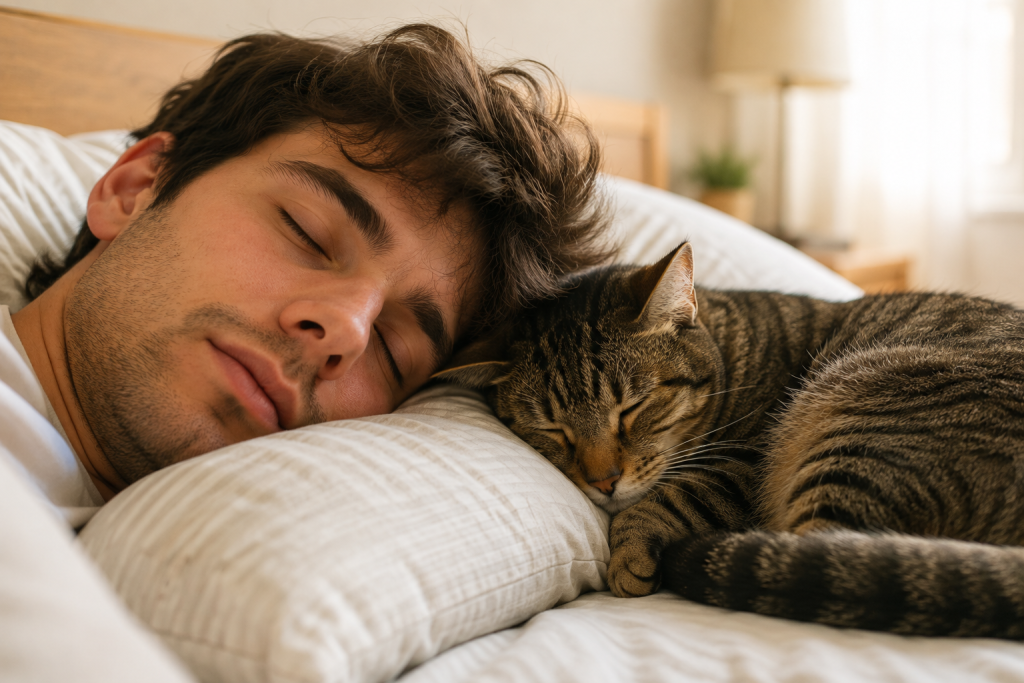
Why does my cat sleep next to my head? In most cases, your cat chooses this spot because it is warm, familiar, comfortable, and close to someone they trust. Your pillow and hair also carry your scent, which may make the area feel especially familiar and secure. Cats often prefer warm sleeping places and can find comfort in familiar scents.
For many cats, sleeping beside your head also becomes part of a nightly routine. You are relatively still while sleeping, the pillow is soft, and your cat can remain close without being underneath your arms or legs. If this has always been normal behavior for your cat and they otherwise seem healthy, there is usually no reason to worry.
Your Head Is a Warm Place to Sleep
Cats naturally seek comfortable sleeping locations, and warmth can be an important part of that choice. International Cat Care notes that cats often prefer warm places to sleep, while VCA also describes warmth and comfort as factors that influence feline sleeping positions.
Your head gives off body heat throughout the night, while your pillow helps retain some of that warmth. This can make the area beside your face more appealing than a cooler section at the bottom of the bed.
You may notice this behavior more often during colder months. A cat that sleeps farther away during summer might suddenly move toward your pillow when nighttime temperatures drop.
However, warmth is usually only one part of the explanation. Your cat may also be choosing your head because the area smells familiar and allows them to stay close to you.
Your Scent May Help Your Cat Feel Secure
Smell plays an important role in a cat’s environment. International Cat Care explains that familiar scents can contribute to a cat’s sense of safety, while VCA notes that a person’s scent can become a source of security for a kitten as they settle into a new home.
Your pillow, hair, and bedding contain a strong concentration of your normal scent. For a cat that has a close relationship with you, sleeping beside these familiar smells may create a comfortable and predictable resting area.
Cats also use scent when communicating socially. Merck Veterinary Manual notes that cats rub their faces against people and objects, depositing scent from facial glands in the process.
If your cat often rubs their face against your pillow before settling down, scent may be playing an important role in why that spot feels familiar.
Sleeping Near Your Head Can Show Trust
Sleep puts a cat in a less alert position than when they are awake and actively observing their surroundings. As a result, cats often choose sleeping locations where they feel comfortable and reasonably secure.
VCA explains that cats can prefer snug sleeping areas because they provide warmth and security. A cat that chooses to fall asleep directly beside your face is therefore showing that they are comfortable resting very close to you.
This does not mean that sleeping next to your head is the only sign of trust. Some cats show comfort by sleeping at the foot of the bed, on a nearby chair, or even across the room.
What matters is that your cat chooses the location voluntarily. A cat repeatedly returning to sleep beside you is showing that the area has become a safe and familiar part of their environment.
Your Cat May Simply Want Companionship
Cats can enjoy social contact without constantly demanding attention. Some cats want to sit directly on their owners, while others prefer being close enough to share space without being touched.
VCA notes that many cats enjoy being near people for both warmth and companionship, even when they are not interested in being petted continuously. This helps explain why a cat may sleep beside your head rather than directly on your chest.
Your pillow allows your cat to stay extremely close without carrying your body weight or being moved every time you reposition your arms.
For some cats, that balance of closeness and personal space makes the top of the bed an ideal sleeping location.
Why Does My Cat Sleep Above My Head on the Pillow?
Some cats do not simply sleep beside their owner’s head. They climb onto the pillow itself or settle directly above the headboard area.
The pillow offers several attractive features at once. It is soft, elevated slightly above the mattress, warm, and strongly scented with a familiar person.
Cats often appreciate elevated resting areas because they can provide a better view of the environment. International Cat Care notes that many cats enjoy sleeping in higher locations, including beds, sofas, and windowsills.
Although a pillow is not particularly high, it may still feel more protected than the open center of the bed. Your cat can settle against the headboard or wall while keeping the rest of the room visible.
Why Does My Cat Sleep Next to My Face?
Your face combines familiar scent, warmth, and proximity. It is also one of the areas of your body that tends to remain relatively still compared with your legs.
If your cat sleeps near your feet, they may be moved whenever you kick, turn, or change sleeping position. Your head and pillow often move much less dramatically.
This can make the area more predictable during the night.
Some cats may also learn that being beside your face gets a response. If waking up next to your cat usually results in petting, talking, or attention, the location can become even more rewarding.
Your Cat May Have Learned the Habit
Cats are excellent at developing routines. If your cat slept beside your head once and found the location warm, quiet, and comfortable, they may return the following night.
Repeated behavior can turn a convenient sleeping place into a strong habit. Eventually, your cat may head straight to the pillow as soon as you get into bed.
Your own behavior can strengthen that routine. If you make space for the cat, pet them, or speak softly whenever they arrive, the experience becomes even more positive.
This is why some cats seem to have assigned sleeping positions within the household. One may always sleep beside your head while another chooses your partner’s feet.
Why Does My Cat Sleep Next to My Head and Purr?
Purring often occurs during comfortable social interactions. Merck Veterinary Manual describes purring as one way cats communicate and notes that cats also use rubbing during friendly interactions.
A cat that climbs beside your head, relaxes their muscles, closes their eyes, and begins purring is presenting an overall picture consistent with comfort.
However, purring should never be interpreted by itself. Cats can purr in different situations, including when they are not completely comfortable.
Look at the rest of the body. Soft facial muscles, neutral ears, comfortable breathing, normal appetite, and normal daily behavior provide much more useful context.
Why Does My Cat Rub Its Face Against My Head?
Facial rubbing is a normal part of feline social and scent communication. Cats have scent glands around the face and can deposit these scents when they rub against familiar people and objects.
Merck Veterinary Manual explains that cats rub their faces against things as part of scent marking and may also rub against people during friendly interactions.
VCA similarly describes head-butting as a behavior associated with trust and bonding, noting that cats deposit pheromones from facial glands during the interaction.
Therefore, if your cat rubs against your forehead or hair before sleeping beside you, the behavior may combine social contact with scent communication.
Why Does My Cat Sleep in My Hair?
Some cats specifically position themselves against their owner’s hair. Again, scent is likely one practical reason.
Hair can retain familiar odors, especially from your normal skin, bedding, and household environment. It is also soft and warm, making it potentially comfortable to rest against.
Long hair may even provide a texture that some cats enjoy kneading or lying beside.
However, discourage your cat from chewing or swallowing hair. Long strands can create digestive problems if swallowed, so redirect hair-chewing toward an appropriate toy or activity.
Why Does My Cat Sleep by My Head Instead of My Feet?
Your feet and legs usually move much more during sleep than your head. A cat resting near them may be pushed, kicked, or disturbed accidentally when you roll over.
The top of the bed can therefore offer a more stable sleeping environment.
Your head also provides warmth and strong familiar scent. Combined with a soft pillow, these features can make the area particularly appealing.
Individual experience matters too. If your cat has repeatedly slept near your head without being disturbed, they have learned that it is a reliable location.
Another cat may prefer your feet because that area gives them more space. Neither choice indicates a stronger or weaker bond.
Does My Cat Sleep Near My Head Because They Love Me?
Sleeping very close to you can certainly fit into a broader pattern of trust and social attachment. Cats may show friendly relationships through rubbing, purring, resting nearby, grooming, and voluntarily seeking contact.
However, it is better not to assign one exact human emotion to a single feline behavior. Your cat may sleep near your head because they enjoy your company while also appreciating the warmth and softness of your pillow.
Several motivations can exist at the same time.
A cat does not need to sleep on you to have a strong bond either. Some affectionate cats prefer sleeping nearby and interacting more actively when everyone is awake.
Why Does My Cat Sleep Next to My Head Every Night?
A nightly pattern usually suggests that the location has become part of your cat’s routine. Cats often return to resting places where they have previously felt safe and comfortable.
Your bedtime itself may act as a cue. When you turn off the lights, get under the blankets, or place your phone on the nightstand, your cat may recognize that a familiar nighttime routine is beginning.
Soon afterward, they take their usual position.
This kind of predictable routine can be reassuring for cats. Familiar smells, locations, and household patterns can contribute to their sense of security.
Unless the behavior creates a problem for you, there is usually no reason to discourage it.
Why Has My Cat Suddenly Started Sleeping Next to My Head?
A new sleeping preference can have a simple explanation. The weather may have become colder, another sleeping area may have changed, or your cat may simply have discovered that your pillow is comfortable.
Changes within the household can also influence where cats choose to rest. New pets, visitors, furniture changes, or unusual noise may make a familiar person’s bed more attractive.
However, sudden behavior changes deserve more attention when they appear with other symptoms. VCA advises owners to monitor changes in activity, sociability, appetite, grooming, litter-box habits, and other normal behaviors because cats can behave differently when they are ill.
If your normally independent cat suddenly becomes extremely clingy and also eats less, hides, vocalizes unusually, loses weight, or behaves differently during the day, contact your veterinarian.
Do Senior Cats Sleep Closer to Their Owners?
Some senior cats may seek warmer or easier-to-access resting places as their physical needs change. International Cat Care notes that older cats may have difficulty reaching previous sleeping locations and may need easier access to comfortable beds.
An older cat may therefore choose your bed more frequently if jumping onto a high cat tree or windowsill has become difficult.
Warmth can also become particularly appealing. A soft bed and familiar person may offer a comfortable combination.
However, a major change in sleeping location can also accompany pain or illness. VCA notes that aging cats experiencing pain may change their grooming, mobility, jumping, social behavior, or normal routines.
Do not automatically dismiss behavioral changes as normal aging.
Is It Safe for My Cat to Sleep Next to My Head?
For most healthy adults, allowing a healthy cat to sleep beside the head is primarily a matter of comfort and preference.
Make sure your cat always has room to move away and is not trapped beneath bedding. You should also be able to sleep and breathe comfortably without the animal blocking your face.
If allergies, asthma, disrupted sleep, or another health issue makes sharing the pillow uncomfortable, encouraging another sleeping location is reasonable.
Babies and very young children require different safety precautions and should not sleep unsupervised with pets.
Your own sleep quality matters too. A charming habit is not beneficial if your cat repeatedly wakes you throughout the night and leaves you exhausted.
How Can I Encourage My Cat to Sleep Somewhere Else?
If you want your pillow back, offer your cat an attractive alternative rather than repeatedly pushing them away.
Place a comfortable cat bed or soft blanket near the top of the bed, on a bedside surface that is safe, or in another warm location. International Cat Care recommends giving cats warm, secure sleeping options and familiar-smelling bedding.
You can place an item carrying familiar household scent in the new sleeping area. Allow your cat to investigate voluntarily and reward calm use of the space.
Consistency is important. If you allow the cat onto your pillow every second night, it will be more difficult to establish a different routine.
Avoid punishment. Sleeping next to you is normal behavior, not something your cat is doing to annoy you.
When Should You Be Concerned About Sleeping Behavior?
The sleeping location itself is rarely the main concern. Instead, watch for a significant change in your cat’s overall behavior.
Contact your veterinarian if your cat suddenly sleeps much more than usual or becomes unusually clingy while also showing appetite loss, weight changes, vomiting, litter-box problems, difficulty jumping, altered grooming, unusual vocalization, or reduced activity.
VCA notes that cats often hide signs of illness and that changes in normal activity, appetite, sociability, grooming, breathing, and litter-box behavior can provide important clues.
Older cats deserve particular observation because medical conditions and pain can affect behavior more frequently with age. Merck Veterinary Manual notes that underlying physical conditions become increasingly important when evaluating behavioral changes in older cats.
A familiar sleeping habit in an otherwise healthy cat is usually reassuring. A dramatic unexplained change deserves a different response.
Why Your Cat Chooses the Pillow Beside You
So, why does your cat sleep next to your head? Most likely, the area combines several things your cat values at once: warmth, a familiar scent, comfort, security, and close social contact.
Your pillow can be particularly attractive because it is soft and strongly associated with you. Cats often prefer warm sleeping areas, and familiar scents can contribute to a sense of safety.
Sleeping beside your head may also allow your cat to stay close while avoiding the movement of your arms and legs. Once the behavior becomes part of the nightly routine, your cat may return to the same spot almost automatically.
If your cat has always slept there and behaves normally, there is usually nothing to worry about. It may simply be the place where warmth, comfort, familiarity, and companionship come together perfectly.