
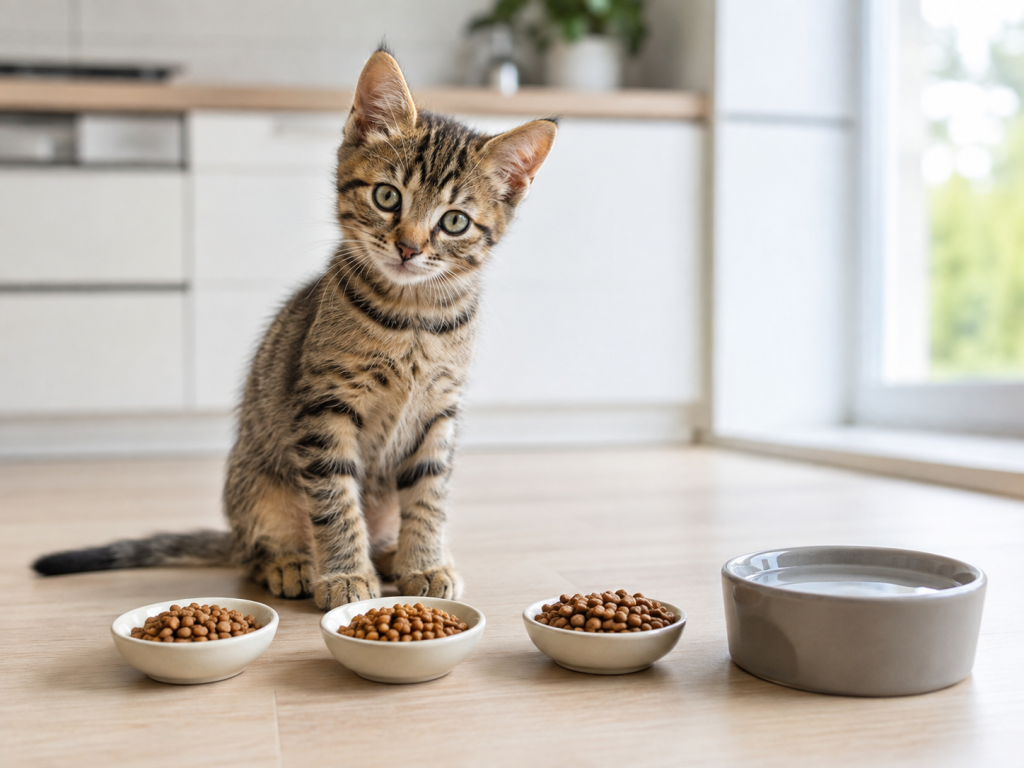
How often should you feed a kitten? Most young kittens need several meals each day because they are growing quickly and have relatively small stomachs. Merck Veterinary Manual recommends three to four meals per day for kittens younger than about 4 months, while Cornell advises that kittens generally do well with three meals a day until about 6 months and two meals a day from 6 months to 1 year.
The exact schedule should still depend on your kitten’s age, body condition, food, health, and veterinary recommendations. Kittens need more calories and nutrients relative to their body size than adult cats because they are supporting rapid growth.
The most important goals are to feed a complete and balanced kitten food, divide the daily amount into appropriate meals, monitor growth, and avoid assuming that every empty bowl needs to be refilled.
A Simple Kitten Feeding Schedule by Age
Feeding frequency gradually decreases as a kitten grows. Very young kittens need more frequent access to nutrition, while older kittens can comfortably transition toward an adult-style meal schedule.
A practical general guide is:
- Under 4 months: about 3 to 4 meals per day
- 4 to 6 months: about 3 meals per day
- 6 to 12 months: about 2 meals per day
- Around 9 to 12 months: begin transitioning toward an adult feeding routine when appropriate
Merck recommends three to four daily meals for kittens younger than 4 months and gradually decreasing the number of feedings as they mature. Cornell recommends three meals daily until approximately 6 months and twice-daily feeding between 6 months and 1 year.
These are useful starting points rather than rigid rules. Your veterinarian may recommend something different for a kitten that is underweight, recovering from illness, unusually active, or experiencing another health problem.
Why Kittens Need More Frequent Meals Than Adult Cats
Kittens grow rapidly during their first year, especially during the earliest months. Growth requires energy as well as adequate protein, fat, vitamins, minerals, and other nutrients.
Merck explains that growing kittens require additional calories, fat, protein, vitamins, and minerals compared with adult cats. They should therefore receive food specifically formulated for kitten growth.
At the same time, a young kitten cannot necessarily eat a large daily ration in one or two enormous meals. Dividing food into several smaller portions can make it easier to meet nutritional needs without overwhelming a small stomach.
Frequent meals can also create predictable routines and give owners several opportunities each day to notice whether appetite has changed.
What Should a Kitten Eat?
Choose a food labeled as complete and balanced for growth or an appropriate all-life-stages formulation.
AAFCO recognizes growth as a specific nutritional life stage and explains that a complete food contains all required nutrients while a balanced food provides those nutrients in the correct proportions.
This distinction matters because adult maintenance food is formulated for a different life stage. A growing kitten has greater nutritional demands and should not routinely depend on adult food unless your veterinarian has a specific reason for recommending it.
Check the nutritional adequacy statement on the package rather than assuming that every product displaying a kitten photograph is nutritionally appropriate.
How Much Should You Feed at Each Meal?
There is no universal number of tablespoons, cans, or cups that works for every kitten.
Food varies greatly in calorie density, and kittens differ in age, size, activity, metabolism, and body condition. Start with the manufacturer’s feeding directions for your kitten’s age and weight, then adjust based on growth and veterinary guidance.
AAFCO notes that feeding directions are guidelines and may need to be modified for an individual animal.
Divide the total daily amount into the number of meals appropriate for your kitten. For example, if the daily ration is intended to be divided into four meals, each meal should contain roughly one-quarter of that day’s total rather than four complete daily portions.
Avoid Feeding by Eye Alone
It is easy to overfeed when portions are estimated casually.
A scoop that looks small can contain a significant number of calories, particularly with calorie-dense dry kitten food. Adding a little extra at every meal can become a large excess over weeks or months.
Measure the daily ration using a consistent measuring tool or a kitchen scale when greater accuracy is needed.
Regular veterinary visits are also useful because body weight and body condition can be monitored as the kitten grows.
The goal is steady healthy development, not making the kitten as heavy as possible as quickly as possible.
Feeding Kittens Younger Than 4 Months
Kittens younger than about 4 months generally benefit from frequent meals throughout the day.
Merck recommends feeding kittens in this age range approximately three to four times daily.
For many households, this could mean breakfast, midday food, an evening meal, and a smaller later meal. The exact timing does not need to be identical to the minute every day, but a predictable routine can help.
Young kittens also deserve closer observation because poor appetite can become more concerning more quickly than it would in a healthy adult cat.
If a small kitten suddenly refuses food, becomes weak, develops repeated vomiting or diarrhea, or appears unusually sleepy, contact your veterinarian promptly.
Feeding Kittens From 4 to 6 Months
By around 4 months, many kittens can begin moving toward three structured meals per day.
Cornell states that kittens generally do well with three meals a day until approximately 6 months of age.
Breakfast, an afternoon meal, and dinner can work well for many families. If your schedule makes this difficult, a timed feeder may be useful for suitable foods.
Continue using kitten food during this period. Your kitten may look much larger than they did several weeks earlier, but physical growth is still underway.
Monitor body condition as well as appetite because an enthusiastic kitten can still consume more calories than necessary.
Feeding Kittens From 6 to 12 Months
Between 6 months and the first birthday, many kittens can transition to approximately two meals per day.
Cornell recommends twice-daily feeding between 6 months and 1 year as a general approach.
This schedule begins to resemble the routine many owners maintain during adulthood. However, feeding twice daily does not mean that every kitten must eat exactly at breakfast and dinner.
Some cats enjoy several smaller meals. You can divide the same daily calorie allowance into more portions if that better suits your kitten, provided the total amount remains appropriate.
When Should You Stop Feeding Kitten Food?
Kittens should generally continue eating food formulated for growth until they are approaching nutritional adulthood.
Merck recommends maintaining a nutritionally balanced kitten diet until approximately 9 to 12 months of age.
The timing may differ for individual cats, so discuss the transition during a veterinary visit.
Do not switch early simply because your kitten looks almost fully grown. Likewise, continuing calorie-dense growth food indefinitely after nutritional needs have changed can contribute to excess weight.
A gradual transition toward adult food is usually easier on the digestive system than an abrupt change.
Wet Food or Dry Food for a Kitten?
Both wet and dry kitten foods can provide appropriate nutrition when they are complete and balanced for growth.
Wet food provides substantial moisture, while dry food is convenient and works well with timed feeders or food puzzles. Some owners choose one format while others combine the two.
The important point is to count both toward the kitten’s total daily food intake.
If you feed wet food at mealtimes and leave a large bowl of dry food available all day, your kitten may consume far more calories than expected.
A mixed-feeding plan can work well when portions are measured intentionally.
Can You Mix Wet and Dry Kitten Food?
Yes. Mixing or alternating wet and dry food is acceptable when both products are nutritionally suitable for kittens and the total calorie intake is appropriate.
You might offer wet food in the morning and evening while using a measured portion of dry food for a midday meal or puzzle feeder.
Do not simply give the full package recommendation for wet food plus the full recommendation for dry food. Those feeding guides generally assume that the individual product is contributing a substantial part of the daily diet.
Calculate the total amount together.
If you are unsure how much of each food to combine, your veterinarian can help calculate an appropriate daily intake.
Is Free Feeding Good for Kittens?
Free feeding means leaving food available continuously so the kitten can eat whenever they choose.
Growing kittens have high energy needs, and Merck notes that growing kittens may be fed freely or several times daily to meet their needs.
However, unlimited feeding is not ideal for every kitten. Some cats regulate intake successfully, while others overeat whenever food remains available.
Structured meals make it easier to monitor exactly how much your kitten eats and notice appetite changes. This becomes increasingly useful as growth slows and the risk of unnecessary weight gain increases.
If you do free feed, monitor body condition and total food consumption rather than assuming kittens cannot become overweight.
Why Measured Meals Can Be Helpful
Measured feeding makes several aspects of kitten care easier.
You know how much food was offered, approximately how much was eaten, and whether appetite suddenly declines. This information can be valuable when a kitten becomes ill.
Measured meals also help prevent accidental overfeeding. Different family members may otherwise refill the same bowl without realizing someone else already fed the kitten.
Establishing structured feeding during kittenhood can make adult weight management easier later.
Should You Feed a Kitten at the Same Times Every Day?
A reasonably predictable schedule is useful.
Cats can learn household routines quickly, and regular feeding makes appetite easier to monitor. Your kitten may soon begin waiting near the kitchen shortly before normal mealtimes.
The schedule does not need to be perfectly rigid. Feeding at 7:05 one morning and 7:30 the next will not ruin the routine.
Try to avoid extreme unpredictability, especially for very young kittens that benefit from several meals spread throughout the day.
Should Kittens Eat at Night?
A healthy weaned kitten does not necessarily need the owner to wake repeatedly during the night to provide food.
Instead, divide the day’s meals across your normal waking hours in a way that prevents very long gaps for a young kitten.
A small meal later in the evening can be useful if breakfast will not be available until morning.
Very young orphaned kittens that are still bottle-feeding are completely different. They require specialized neonatal feeding schedules and should not be managed using the meal recommendations for a normally weaned kitten.
Feeding an Orphaned or Bottle-Fed Kitten
Bottle-fed newborn kittens require specialized care because they cannot yet eat ordinary kitten food.
The feeding frequency depends heavily on age, body weight, development, and health. Formula preparation, feeding technique, temperature, and stimulation for elimination can also be important in very young kittens.
These kittens should receive guidance from a veterinarian or experienced neonatal kitten caregiver.
Do not feed cow’s milk as a substitute for an appropriate kitten milk replacer.
The three- or four-meal schedule discussed for older kittens does not apply to neonates.
Fresh Water Should Always Be Available
Once a kitten is weaned, fresh drinking water should be continuously available.
Place the water somewhere clean and easy to reach. Many cats appreciate having more than one water station, especially in larger homes.
Wet food can contribute meaningfully to fluid intake because of its high moisture content, but it does not eliminate the need for access to drinking water.
Monitor significant changes in thirst. A kitten suddenly drinking far more or far less than usual may need veterinary assessment depending on the circumstances.
How Many Treats Can a Kitten Have?
Treats should remain a small addition to the diet rather than replacing balanced kitten food.
Kittens require carefully balanced nutrition for growth, so filling them with snacks can reduce how much complete food they eat.
Treats also add calories. A few extras after every play session can become significant when combined across the entire day.
You can use individual pieces of your kitten’s normal food as rewards for handling, carrier training, or other positive experiences. Simply subtract those pieces from the daily ration when necessary.
Can Kittens Eat Adult Cat Treats?
Some commercial treats may be appropriate for kittens depending on the product and age recommendations, but they are not a substitute for growth-formulated food.
Check the label carefully.
Avoid giving large, hard treats that are difficult for a small kitten to chew safely.
Human foods should also not become a routine part of kitten feeding. A nutritionally complete kitten diet should provide the foundation.
What If Your Kitten Acts Hungry All the Time?
Kittens can have impressive appetites because they are growing and active. Begging does not automatically mean the portion is inadequate.
First, check whether you are feeding the correct daily amount for the kitten’s weight and food. Then monitor body condition and growth.
A kitten that remains lean and grows appropriately may simply be enthusiastic about meals.
However, extreme hunger combined with poor weight gain, diarrhea, vomiting, a swollen abdomen, or other symptoms deserves veterinary attention because parasites or other health problems may interfere with normal nutrition.
How Can You Tell if Your Kitten Is Eating Enough?
Body weight and body condition are more useful than judging appetite alone.
A kitten should grow steadily rather than losing weight. Your veterinarian can track growth during routine appointments and assess whether the kitten is too thin, ideal, or gaining excessive fat.
At home, pay attention to energy, appetite, stool, coat quality, and general development.
A kitten that eats eagerly but fails to gain weight deserves investigation.
Likewise, a kitten that suddenly begins eating much less than normal should be monitored closely.
What If Your Kitten Eats Too Fast?
Some kittens consume meals extremely quickly, especially when they previously competed with littermates for food.
Smaller, more frequent meals can help reduce the size of each feeding.
You can also spread wet food across a shallow plate or use an appropriate slow-feeding dish. Dry food can sometimes be offered through a simple puzzle feeder once the kitten understands how it works.
Avoid making eating so difficult that the kitten becomes frustrated or fails to consume enough food.
Feeding Multiple Kittens
When several kittens eat together, it can be difficult to know whether each kitten receives an appropriate amount.
One may eat slowly while another finishes quickly and moves to the other bowls.
Separate bowls and supervised feeding can help you monitor intake. If one kitten consistently gains less weight, provide additional separation during meals.
This becomes even more important if one kitten develops illness or requires a different food.
Feeding a Kitten With an Adult Cat
An adult cat and a kitten may require different nutritional formulations and calorie amounts.
The kitten needs growth nutrition, while a healthy adult generally needs food formulated for maintenance. AAFCO recognizes these as different life stages.
If both cats can access the same bowls throughout the day, the adult may consume calorie-dense kitten food while the kitten eats adult food.
Separate meal locations, supervised feeding, or microchip-activated feeders can help when necessary.
Should You Change Food When Bringing a Kitten Home?
Avoid making unnecessary abrupt diet changes during an already stressful transition.
Cornell recommends initially continuing some of the food a new cat has already been eating and gradually changing to the new diet.
Ask the breeder, shelter, rescue, or previous caregiver what food and schedule your kitten knows.
If you want to use a different complete kitten food, transition gradually over several days unless your veterinarian recommends otherwise.
Sudden food changes can sometimes contribute to digestive upset.
What If Your Kitten Refuses a Meal?
One missed or partially eaten meal can occasionally happen because of stress or a temporary change in routine.
However, appetite loss in a young kitten deserves more caution than it might in a healthy adult.
Observe energy, water intake, vomiting, diarrhea, breathing, and general behavior. A kitten that refuses food and also becomes weak, unusually sleepy, or sick needs veterinary attention promptly.
Do not repeatedly replace meals with highly desirable human foods simply to make the kitten eat something.
Persistent appetite loss requires identifying the cause.
When Poor Appetite Is More Concerning
Contact your veterinarian promptly if your kitten’s reduced appetite occurs alongside:
- Weight loss or failure to grow
- Repeated vomiting
- Persistent diarrhea
- Severe lethargy
- Weakness
- Abdominal swelling
- Difficulty breathing
- Pain
- Significant dehydration
- Difficulty chewing
- Major changes in behavior
Young kittens can deteriorate more quickly than healthy adults because they have smaller energy reserves.
The younger the kitten, the less appropriate it is to wait several days hoping the appetite returns.
Common Kitten Feeding Mistakes
One common mistake is feeding adult maintenance food too early. Kittens require nutrition formulated to support growth during most of their first year.
Another is offering too much food simply because the kitten always appears hungry. Rapid growth does not mean unlimited calories are appropriate for every individual.
Too many treats can also reduce intake of complete food.
Finally, owners sometimes change diets repeatedly whenever the kitten hesitates at a meal. Frequent changes can encourage selectivity and make digestive problems harder to interpret.
An Easy Daily Feeding Routine
For a young kitten under approximately 4 months, divide the daily food allowance into three or four meals. Merck specifically recommends this frequency for kittens in that age group.
From around 4 to 6 months, three meals can work well for many kittens. By approximately 6 months, many can transition toward breakfast and dinner, as Cornell recommends twice-daily feeding between 6 and 12 months.
Keep fresh water available at all times and use a complete growth-formulated diet.
Monitor weight and body condition as the kitten develops, then discuss the transition to adult nutrition around 9 to 12 months.
Building Healthy Feeding Habits for Adulthood
So, how often should you feed a kitten? The answer changes as your kitten grows. Young kittens generally need several small meals, while older kittens gradually transition toward the two-meal schedule commonly used in adulthood.
For kittens younger than about 4 months, three to four daily meals are a useful target. From there, feeding frequency can gradually decrease. Cornell recommends three meals until approximately 6 months and two meals daily between 6 months and 1 year.
Meal frequency is only part of good nutrition. Feed a complete and balanced food formulated for growth, measure the total daily ration, provide fresh water, and monitor your kitten’s body condition and development. AAFCO specifically recognizes growth as a separate nutritional life stage.
Continue kitten nutrition until approximately 9 to 12 months unless your veterinarian recommends another schedule.
Most importantly, learn your kitten’s normal appetite. A healthy growing kitten should eat consistently and gain weight over time. Sudden food refusal, weight loss, repeated vomiting, diarrhea, weakness, or failure to grow deserves veterinary attention.