
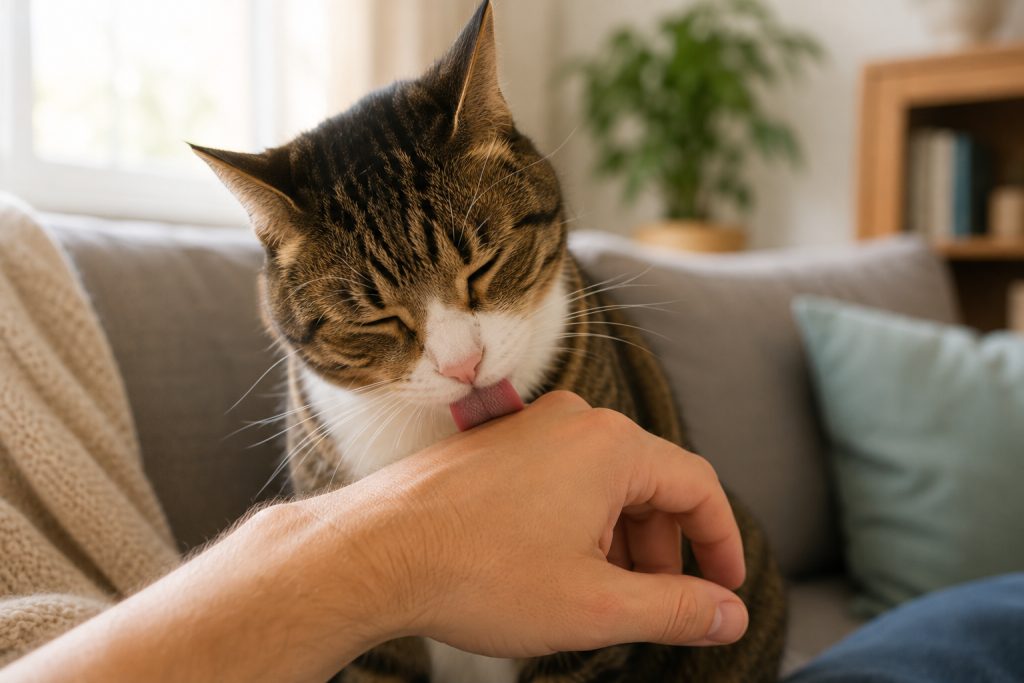
Why does my cat bite me and then lick me? In many cases, the behavior reflects a quick change in arousal rather than a contradiction. Your cat may become overstimulated during petting, give a warning bite, and then return to a calmer social behavior such as licking. Play, grooming-like behavior, attention seeking, and individual personality can also contribute.
A gentle nip followed by licking is very different from a hard bite accompanied by flattened ears, hissing, growling, or an attempt to escape. Cats communicate with their whole body, so the meaning becomes much clearer when you look at what happened immediately before the bite and how your cat behaves afterward. Merck Veterinary Manual notes that cats that bite during petting may have a low tolerance for physical contact or become overstimulated by it.
Your Cat May Be Getting Overstimulated
Petting-induced overstimulation is one of the most common explanations when a cat suddenly bites during an otherwise friendly interaction. A cat may initially enjoy being stroked but eventually reach a point where continued touch becomes uncomfortable or irritating.
This can make the behavior seem confusing. One moment your cat is lying beside you and enjoying attention, and the next they turn around and nip your hand. Merck explains that cats that bite during petting may have a lower tolerance for physical contact or may become overstimulated more easily.
The licking that follows does not necessarily mean your cat feels guilty. Cats do not need a human concept of apology to explain the sequence. Your cat may simply have moved from an irritated or highly aroused state back into a calmer social interaction.
Learning when your cat has had enough can reduce these incidents significantly.
Watch for Warning Signs Before the Bite
Cats often communicate discomfort before they bite, but the signals can be subtle. If you learn to recognize them, many apparently “random” bites become much easier to predict.
Your cat may begin moving the tail more sharply, turning the ears sideways or backward, tightening the body, looking toward your hand, or shifting position. Some cats also develop a rippling movement along the skin of the back as stimulation increases.
VCA notes that cats experiencing petting-related aggression can react when physical contact becomes uncomfortable or when they interpret handling as potential restraint. Fear or anxiety can also contribute in some situations.
Stop petting when you notice your cat becoming tense. Allowing them to decide whether to return for more contact can prevent the interaction from escalating.
The Bite May Be Part of Play
Cats naturally use their mouths and paws during play. Kittens especially may chase, grab, kick, and bite objects because play includes behaviors related to hunting.
If your cat gently grabs your hand, gives a light bite, and then begins licking, the entire interaction may be playful rather than aggressive. The body usually remains loose, and the cat may quickly return to chasing a toy or seeking attention.
Problems can develop when cats learn that human hands are toys. A kitten’s playful bite may seem harmless, but the same behavior can become painful when the cat grows larger.
Use wand toys, balls, soft toys, or other appropriate play objects instead of encouraging your cat to wrestle directly with your fingers. If a kitten begins biting during play, calmly ending the interaction can help teach that rough play makes attention stop. VCA recommends quietly ending interaction when kittens begin inappropriate biting or swatting.
Licking Can Be a Social Behavior
Cats spend a large amount of time grooming themselves, and some also groom familiar cats. Similar licking can occasionally be directed toward people.
VCA notes that cats may lick humans for several reasons, including social interaction, attention, familiar scent, and grooming-related behavior.
Therefore, a lick after a gentle bite may simply represent another part of a familiar interaction. Your cat may switch quickly between mouthing, grooming, rubbing, and resting.
This is particularly likely when the bite is soft and the cat remains relaxed. If your cat is purring, kneading, resting close to you, and licking gently, the overall interaction looks very different from true defensive aggression.
Is My Cat Trying to Groom Me?
Possibly. Cats sometimes direct grooming behavior toward familiar people, particularly their hands, arms, or hair. Licking may be part of the cat’s normal social routine rather than an attempt to clean you in the human sense.
The combination of licking and small nibbles can also resemble grooming behavior. Cats may use their front teeth during self-grooming to work through small areas of fur or debris.
However, you should avoid assuming that every bite followed by licking is grooming. If your cat bites hard after several minutes of petting and displays tense body language, overstimulation is a more likely explanation.
The sequence matters, but so does intensity.
Why Does My Cat Bite Me Gently and Then Lick Me?
A very gentle bite is often called a nip or mouthing behavior. When it does not break the skin and occurs during a relaxed interaction, it may be part of play, grooming-like behavior, or social communication.
For example, your cat may be resting beside you while you pet them. They gently take your finger in their mouth for a second, release it, and begin licking your hand. If the ears stay neutral and the body remains loose, there is usually little reason to interpret that as serious aggression.
Still, respect the bite as communication. Even a gentle nip may mean that the cat wants you to change what you are doing.
You do not need to punish the behavior. Simply pause and allow the cat to choose what happens next.
Why Does My Cat Bite While I Am Petting Them?
Petting can become too intense even when the interaction started positively. Cats vary greatly in how much physical contact they enjoy and which areas they prefer being touched.
One cat may enjoy several minutes of stroking along the back. Another may prefer only brief contact around the cheeks and head. Merck describes petting-related biting as a behavior that can occur when cats have a low tolerance for physical contact.
Keep early petting sessions shorter if your cat regularly bites. Stop while your cat is still relaxed instead of waiting until they become irritated.
Over time, you may discover a predictable limit. If your cat normally starts moving the tail after five or six strokes, ending at three or four can prevent the bite altogether.
Where You Pet Your Cat Can Matter
Many cats tolerate touch better around the cheeks, forehead, head, and shoulders than around more sensitive areas such as the belly, feet, or base of the tail.
Individual preferences matter more than any universal rule. Some cats love lower-back scratches, while another may immediately turn around and bite when touched there.
Observe your cat rather than assuming they should enjoy a particular type of petting.
If a previously comfortable area suddenly becomes painful or causes an unusually strong reaction, a physical problem may be contributing. A cat with joint pain, skin irritation, dental pain, or another medical issue can become more defensive during handling.
Is My Cat Showing Affection?
A gentle bite followed by relaxed licking can occur during friendly interactions, but it is better to look at the complete pattern rather than label the bite itself as affection.
A comfortable cat may approach voluntarily, rub against you, lie beside you, lick your hand, purr, or return repeatedly for interaction. When a soft nip occurs within that broader relaxed pattern, it may simply be one small part of the cat’s communication style.
However, a painful bite is still a bite even if your cat loves being around you.
Respecting boundaries strengthens the relationship more effectively than ignoring uncomfortable behavior because it seems affectionate.
Does My Cat Feel Guilty After Biting Me?
It is tempting to interpret the immediate licking as an apology. The sequence can look as though your cat bites, realizes they made a mistake, and tries to make peace.
There is no need to assume such a complicated explanation. The cat’s level of arousal may simply have changed. They may have communicated “stop” with the bite and then resumed another normal behavior once the unwanted stimulation ended.
Licking might also receive attention from you, which can encourage the pattern over time.
Understanding the behavior in terms of arousal, learning, and communication is usually more useful than assigning human motives such as guilt or regret.
Could My Cat Be Anxious?
Fear and anxiety can sometimes contribute to biting. VCA notes that cats may become defensive during petting if they feel afraid, anxious, or as though they might be restrained. Sudden noises or unfamiliar smells can even trigger redirected aggression toward a nearby person.
An anxious cat often shows additional signs. The ears may move backward, the muscles become tense, the pupils may enlarge, and the cat may attempt to leave.
Licking can also increase during stress. VCA notes that anxious cats may direct licking toward themselves, objects, or sometimes family members.
If biting and licking become frequent during stressful situations, try to identify what happens immediately beforehand.
What Is Redirected Aggression?
Redirected aggression occurs when something highly arouses or frustrates a cat, but the cat directs the resulting reaction toward another nearby target.
For example, your indoor cat may become intensely focused on an unfamiliar cat outside the window. If you touch your cat during that moment, they may turn and bite you even though you were not the original source of the excitement.
Merck explains that frustrated cats can redirect behavior toward another family pet or owner when they cannot reach the original trigger.
Avoid touching or picking up a highly aroused cat. Give them time and distance to settle before attempting interaction.
Should You Punish Your Cat for Biting?
Punishment is unlikely to teach your cat what you actually want and may increase fear or conflict.
If your cat bites during petting, calmly stop touching them. If the behavior occurs during play, end the interaction briefly and redirect future play toward appropriate toys.
For cats that have a serious pattern of biting or scratching, Merck recommends avoiding situations that trigger aggression while seeking qualified help. Preventing repeated aggressive interactions is important for safety.
Do not hit, shout at, or physically restrain your cat in response to a bite. Those reactions can make future handling more stressful.
When Is Biting a Sign of a Medical Problem?
A sudden change in behavior deserves more attention, particularly when a normally tolerant cat begins biting whenever a certain area is touched.
Pain can make cats defensive. Skin problems, arthritis, dental disease, injury, urinary discomfort, or other medical conditions can alter behavior.
Merck recommends considering medical causes when evaluating behavior problems and notes that physical and neurological examinations may be necessary to identify underlying conditions.
Contact your veterinarian if biting appears suddenly or comes with appetite changes, hiding, reduced activity, limping, litter-box changes, altered grooming, or unusual vocalization.
What Should You Do If Your Cat Bites Hard?
A hard bite is different from a gentle social nip. Stop the interaction and give your cat space rather than continuing to touch or restrain them.
Cat bites can puncture human skin deeply even when the wound looks small. Wash any bite promptly with soap and running water and seek appropriate medical advice if the skin is punctured, particularly for bites to the hands, joints, or areas that become swollen, painful, red, or warm.
For your cat, consider what triggered the incident. Serious or repeated aggression deserves professional evaluation because fear, pain, frustration, play, and other motivations can require different approaches.
Avoid repeatedly recreating the situation to “test” whether your cat will bite again.
Understanding the Bite-and-Lick Pattern
So, why does your cat bite you and then lick you? The most likely explanation depends on the circumstances. Gentle bites may occur during play or grooming-like social behavior, while bites that develop after prolonged petting can indicate overstimulation.
The licking that follows does not necessarily mean your cat is apologizing. It may simply represent a transition back to a calmer social behavior or another part of the interaction.
Pay attention to your cat’s ears, tail, muscles, eyes, and willingness to remain nearby. Merck’s veterinary behavior guidance emphasizes that cats that bite during petting may have limited tolerance for contact, while fear, play, frustration, and other motivations can also contribute to biting.
Most importantly, respect early warning signals. Stop petting before your cat becomes overstimulated, use appropriate toys for play, and allow your cat to control how much physical contact they receive.
If the biting becomes suddenly more intense, happens without an obvious trigger, causes injuries, or appears alongside other behavioral or physical changes, speak with your veterinarian. A change that looks behavioral can sometimes begin with pain or another medical problem.