
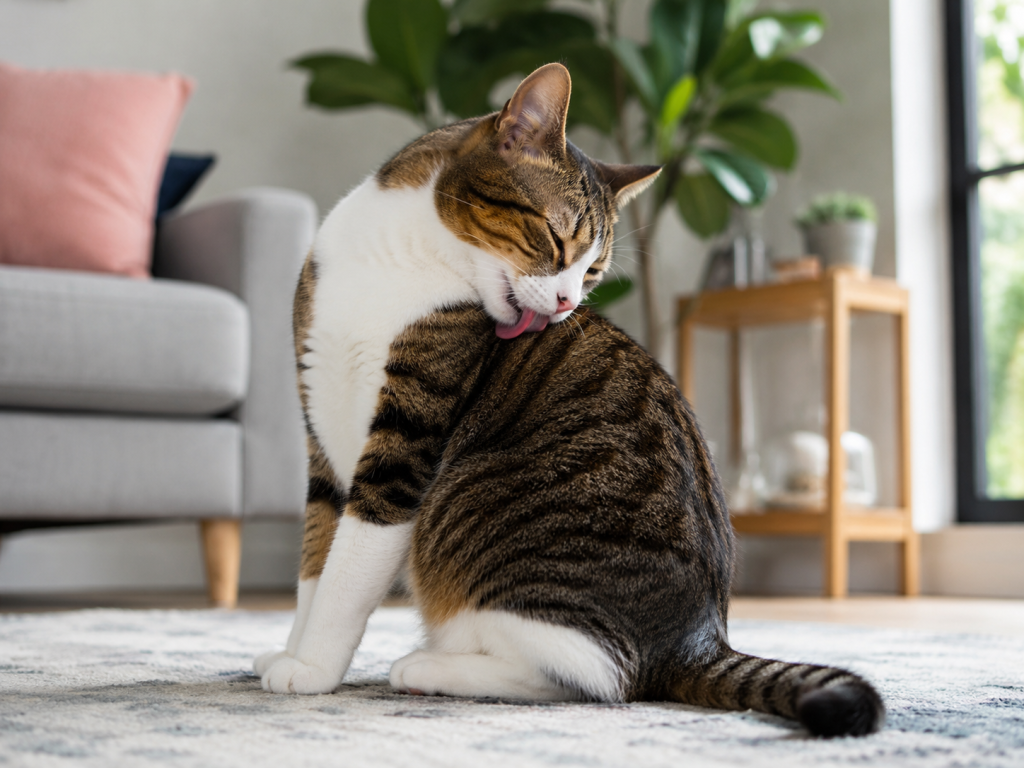
Why does my cat groom herself so much? Grooming is a normal and important part of feline behavior, so seeing your cat lick her coat frequently does not automatically mean something is wrong. Cats groom to keep their coat clean, remove loose hair, and maintain normal skin and fur. However, grooming becomes more concerning when it increases suddenly, causes bald patches, damages the skin, or repeatedly focuses on one particular area.
Excessive grooming can have several causes. Fleas, allergies, mites, fungal or bacterial skin disease, pain, and stress can all make a cat lick or chew herself more than usual. Because medical and behavioral causes can look very similar at home, persistent overgrooming should not simply be assumed to be anxiety.
The key is to understand what is normal for your individual cat. A cat calmly grooming after eating or waking up presents a very different picture from one repeatedly licking the same area until the coat becomes thin.
Grooming Is a Normal Part of Cat Behavior
Cats naturally spend a noticeable part of their day caring for their coats. They use their rough tongues to remove loose hair, debris, and material from the surface of the fur.
Normal grooming is usually distributed across different parts of the body. Your cat may lick her paws, wash her face, clean her chest and sides, and then stop to sleep, play, eat, or explore.
Regular grooming also means cats swallow some loose hair. Cornell recommends brushing or combing because removing loose fur externally can reduce how much hair the cat ingests during self-grooming.
Therefore, frequent grooming by itself is not necessarily abnormal. The concern begins when grooming becomes excessive enough to alter the coat, irritate the skin, or interfere with normal activities.
How Can You Tell if Your Cat Is Grooming Too Much?
The amount of time spent grooming can be difficult to judge because cats often clean themselves when their owners are not watching. Looking at the physical results can therefore be more useful than trying to count every grooming session.
Cornell considers grooming abnormal when licking leads to excessive hairballs or noticeable hair loss. If the licking becomes intense enough to damage the skin, secondary infection can also develop.
Look for areas where the fur has become shorter, thinner, or completely absent. The belly, inner legs, sides, back, and areas near the tail may be affected depending on the cause.
Redness, scabs, broken skin, dandruff, bumps, or crusting are additional reasons to investigate. A healthy coat should not gradually disappear because the cat cannot stop licking it.
Fleas Are an Important Cause of Overgrooming
Fleas can cause significant itching even when you do not easily see them. Some cats also develop flea allergy dermatitis, which means they react strongly to flea bites.
Merck Veterinary Manual notes that cats with flea allergy dermatitis can develop itching, skin lesions, and overgrooming, particularly around areas such as the back, neck, and face.
A cat may lick, chew, or scratch herself so effectively that owners see hair loss without ever noticing many live fleas.
Do not assume an indoor lifestyle completely eliminates parasite risk. Fleas can sometimes enter homes on other animals or through the environment.
If your cat suddenly starts grooming excessively, parasite exposure is one of the medical possibilities your veterinarian may consider.
Allergies Can Make a Cat Groom Constantly
Allergies can cause persistent itching, which cats may express through licking instead of obvious scratching.
A cat can potentially react to flea bites, environmental substances, or food-related allergens. The resulting skin discomfort may cause repeated grooming, hair thinning, and skin irritation.
Merck notes that allergies are among the common disorders associated with itching or pain that can lead to hair loss in cats.
The distribution of grooming may sometimes provide clues, but it cannot reliably identify the allergy at home. Several different skin disorders can produce almost identical patterns of hair loss.
Avoid repeatedly changing foods or adding supplements without a structured veterinary plan. Proper investigation is more useful than guessing which ingredient or environmental factor might be responsible.
Mites and Other Parasites Can Cause Intense Itching
Microscopic mites can irritate a cat’s skin and trigger scratching or excessive grooming. Some forms can affect the ears and surrounding skin particularly strongly.
Merck notes that mite infestations can cause redness, hair loss, inflammation, and itching. Ear mites can also lead to significant irritation of the ears and nearby skin.
You may notice head shaking, scratching around the ears, dark debris inside the ear, or thinning fur around the face and neck.
Because mites are not always visible to the naked eye, veterinary examination may be necessary.
Treating the wrong parasite or repeatedly cleaning irritated ears without a diagnosis can delay appropriate care.
Ringworm Can Cause Grooming and Hair Loss
Ringworm is a fungal skin infection, not a worm. It can cause broken hairs, bald areas, scaling, crusting, and inflammation.
Cornell lists excessive grooming and scratching among possible signs of feline ringworm. Circular areas of hair loss and broken or stubbly hairs can also occur.
Some infected cats have very obvious skin lesions, while others show much subtler changes.
Ringworm is especially important because it can spread between animals and people. If your cat develops suspicious bald or scaly patches, veterinary diagnosis can help determine whether a contagious fungal infection is involved.
Do not diagnose ringworm purely from a photograph. Several other feline skin diseases can look similar.
Pain Can Make Your Cat Lick One Area Repeatedly
Not all excessive grooming begins with itchy skin. Cats may repeatedly lick an area that feels painful.
VCA lists pain from conditions such as arthritis or bladder problems among possible causes of excessive grooming.
For example, a cat with discomfort around a joint might repeatedly lick the surrounding fur. A cat experiencing lower urinary discomfort may focus more intensely on the lower abdomen or genital region.
This is why location matters. Grooming concentrated in one specific area can sometimes provide information about where the cat feels discomfort.
If your cat suddenly begins obsessively licking one body part, particularly when combined with limping, reduced jumping, litter box changes, or sensitivity to touch, contact your veterinarian.
Why Is My Cat Licking Her Belly So Much?
The belly and inner legs are common places for overgrooming to become visible because cats can reach those areas easily.
Hair may become progressively shorter until the skin looks almost completely bald. The surface can sometimes remain smooth and normal even though the cat has removed much of the coat.
VCA notes that anxiety-related overgrooming may cause thinning around the abdomen, sides, inner legs, or back. However, medical causes need to be ruled out before concluding that anxiety is responsible.
Allergies, parasites, pain, and other skin conditions can produce a similar appearance.
A bald belly therefore does not automatically mean your cat is stressed.
Why Does My Cat Keep Licking Near Her Tail?
Repeated grooming around the lower back and base of the tail can be associated with skin irritation, including flea-related problems.
Merck describes overgrooming and itching as important signs of flea allergy dermatitis in cats.
Check the surrounding skin for small scabs, redness, thinning hair, or signs that your cat is biting rather than simply licking gently.
Another possibility is discomfort affecting the back or nearby structures, so the exact cause cannot be determined from location alone.
If the behavior becomes intense or persistent, a veterinary examination is more useful than repeatedly applying home treatments.
Could Stress Make My Cat Groom Too Much?
Yes, stress can contribute to overgrooming in some cats. Grooming can have a self-soothing component, and repetitive grooming may increase when a cat is anxious or struggling with changes in the environment.
Possible triggers can include moving home, introducing another pet, tension between cats, changes in routine, reduced access to important resources, or other stressful events.
However, behavioral causes should not be diagnosed too quickly. VCA emphasizes that a diagnosis of psychogenic alopecia is generally reserved for situations in which medical causes have been excluded.
Merck similarly notes that excessive grooming can cause hair loss but that itching or pain from allergies, parasites, and skin infections are also important causes.
If your cat begins overgrooming after a stressful event, tell your veterinarian about the timing, but still consider medical investigation.
Signs That Stress May Be Involved
Stress-related grooming usually makes more sense when it appears alongside other changes in behavior or after an identifiable environmental disruption.
Your cat may begin hiding more often, become less playful, avoid another pet, change sleeping locations, or appear increasingly alert in certain parts of the home.
The grooming may also appear repetitive. Instead of a normal grooming sequence followed by another activity, your cat may repeatedly return to the same body area.
Observe when the behavior happens. If your cat starts licking intensely whenever another cat enters the room or after loud household events, that information can be useful.
Keeping notes or recording a short video can help your veterinarian understand the pattern.
Changes in a Multi-Cat Home Can Matter
Cats do not need to fight physically for social tension to affect them. One cat may stare at another, block access to rooms, chase them from resources, or make certain areas of the home uncomfortable.
A stressed cat may respond by hiding, avoiding resources, changing normal routines, or developing repetitive behaviors.
Make sure cats have access to separate food, water, litter boxes, resting areas, scratching surfaces, and safe hiding locations.
Adding environmental choices may help reduce stress, but it should not replace medical investigation when overgrooming has already caused hair loss or skin damage.
Skin disease and household stress can occur at the same time.
Excessive Grooming Can Increase Hairballs
Because cats swallow hair while grooming, excessive grooming can increase the amount of fur entering the digestive tract.
VCA notes that excessive grooming, especially in cats with skin disease or allergies, can increase hair ingestion and therefore contribute to hairball formation.
Occasional hairballs can occur in cats, but frequent vomiting of hair should not automatically be considered normal.
Cornell notes that excessive grooming associated with frequent hairballs can be a sign that the grooming itself has become abnormal.
If your cat suddenly develops more hairballs while also losing fur, investigate why she is grooming more rather than treating only the hairballs.
Could Overgrooming Damage the Skin?
Yes. A cat’s tongue has a rough surface, and repeated intense licking can eventually irritate the skin.
Cornell explains that excessive licking can abrade the skin surface, after which infection may develop.
You may initially see only shortened fur. Later, the skin can become red, inflamed, moist, crusty, or damaged if the grooming continues.
Once the skin becomes painful or infected, discomfort may encourage even more licking. This can create a cycle that is difficult to stop without addressing the underlying cause.
Seek veterinary attention if you see open skin, bleeding, discharge, significant redness, swelling, or obvious pain.
Should You Stop Your Cat From Grooming?
Normal grooming should not be discouraged. It is an important part of feline self-care and behavior.
When grooming becomes excessive, simply preventing licking does not solve the original problem. An Elizabethan collar or protective garment may occasionally be recommended by a veterinarian to protect damaged skin, but those tools do not treat fleas, allergies, pain, infection, or anxiety.
Avoid punishing your cat for licking. She is not damaging her coat deliberately to misbehave.
Instead, focus on finding out why the grooming has increased.
Can Brushing Help?
Regular brushing can help remove loose hair and may reduce the amount your cat swallows during normal self-grooming. Cornell also notes that brushing gives owners an opportunity to monitor the skin for parasites and signs of disease.
Use a grooming tool appropriate for your cat’s coat and keep sessions comfortable. Do not repeatedly brush irritated, inflamed, or painful skin.
Brushing is particularly useful for long-haired cats and during periods of heavier shedding.
However, brushing cannot cure overgrooming caused by allergies, parasites, pain, or stress. Think of it as routine coat maintenance rather than a treatment for excessive licking.
Senior Cats Can Have Different Grooming Changes
Older cats may actually groom less effectively rather than more. Cornell notes that senior cats can have difficulty maintaining their coats, which can lead to matting, odor, and skin inflammation.
Therefore, a major grooming change in an older cat deserves attention in either direction.
A senior cat that suddenly licks one painful joint repeatedly may be uncomfortable. Another senior cat may stop grooming the lower back because arthritis makes reaching that area difficult.
Watch for changes in mobility, appetite, weight, thirst, litter box habits, and social behavior alongside grooming changes.
Do not assume unusual grooming is simply a normal part of aging.
What Is Feline Hyperesthesia?
Feline hyperesthesia is a condition or group of signs involving unusual sensitivity, often over the back near the tail.
Cornell describes hyperesthesia as extreme sensitivity of the skin, typically affecting the back. Merck notes that affected cats may show skin rippling, intense tail movement, sudden running, biting at the back or flank, and excessive self-grooming.
These episodes can look dramatic and may occur after touch or during periods of high arousal.
Hyperesthesia should not be diagnosed from grooming behavior alone. Several medical or behavioral problems can produce similar signs.
If your cat suddenly attacks her back, ripples the skin, races away, cries out, or repeatedly bites herself, record an episode if safe and show it to your veterinarian.
When Should You Take Your Cat to the Vet?
Veterinary assessment is appropriate when grooming clearly changes from your cat’s normal pattern or starts affecting the coat or skin.
Contact your veterinarian if you notice:
- Bald or thinning areas
- Repeated licking of one specific location
- Red, raw, or bleeding skin
- Scabs, bumps, flakes, or crusting
- Persistent scratching or biting
- Increased hairballs together with overgrooming
- Visible parasites or flea dirt
- Changes in litter box habits
- Pain or sensitivity when touched
- Reduced appetite or weight loss
- Significant behavioral changes
VCA specifically notes that excessive grooming can be associated with allergies, fleas, mites, ringworm, pain, and stress.
Do not wait until a large bald patch develops if your cat is already showing obvious discomfort.
What Will a Veterinarian Look For?
The veterinarian will usually begin with your cat’s history and a physical examination. The location of hair loss, condition of the remaining hairs, skin appearance, parasite-control history, and pattern of grooming can all provide clues.
Depending on the findings, testing may be needed to investigate parasites, fungal disease, infection, allergies, pain, or other conditions.
Behavioral stress may also be discussed, particularly if the physical investigation does not reveal another explanation.
Because cats can hide itching surprisingly well, Merck notes that it can sometimes be difficult to determine whether hair loss is caused by an itchy medical condition.
A structured investigation is therefore more reliable than assuming that symmetrical bald areas automatically mean anxiety.
How Can You Help Prevent Grooming Problems?
You cannot prevent every cause of excessive grooming, but basic health and environmental care can reduce several risks.
Use appropriate parasite prevention based on your veterinarian’s recommendations. Check the skin and coat regularly while brushing, and respond early when you notice itching, hair loss, or skin lesions.
Provide predictable routines, hiding areas, scratching opportunities, play, and enough resources for every cat in multi-cat households.
Keep a record of new symptoms if something changes. Photographs of hair loss and videos of unusual grooming episodes can make patterns easier to explain during a veterinary visit.
Most importantly, learn what your cat’s normal grooming routine looks like. Changes are easier to recognize when you know the baseline.
Understanding Why Your Cat Grooms So Much
So, why does your cat groom herself so much? In many cases, she is simply performing normal feline grooming. Cats naturally spend time cleaning their coats, removing loose fur, and caring for their skin.
The behavior becomes abnormal when grooming causes thinning fur, bald patches, skin damage, excessive hairballs, or repeatedly focuses on one location. Cornell specifically identifies grooming that produces hair loss or excessive hairballs as abnormal.
Medical problems should be considered first. Fleas, allergies, mites, fungal disease, other skin disorders, and pain can all make cats lick themselves excessively. Stress and compulsive grooming can also occur, but behavioral explanations are more reliable after underlying medical problems have been considered.
If your cat’s coat remains healthy and her grooming is distributed normally throughout the day, frequent cleaning may simply be part of being a cat. If she suddenly begins licking much more, develops bald areas, damages her skin, or shows other physical or behavioral changes, contact your veterinarian.