
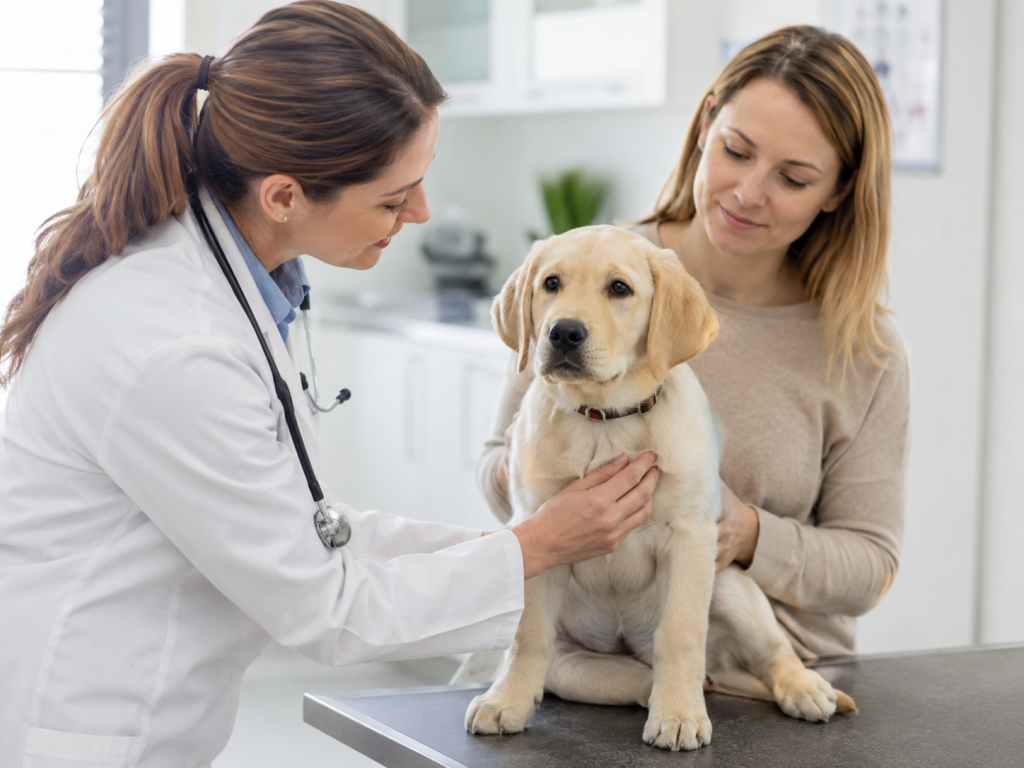
Bringing home a puppy means taking responsibility for one of the fastest periods of physical, behavioral, and emotional development your dog will ever experience. Puppy care during the first year involves much more than feeding and house training. Veterinary care, vaccinations, parasite prevention, socialization, sleep, exercise, dental care, grooming, nutrition, training, and everyday safety all play an important role.
The first year can also feel overwhelming because puppies change quickly. A routine that works at 10 weeks may need to change several months later. Instead of trying to make your puppy perfect immediately, focus on creating safe routines, rewarding desirable behavior, protecting health, and gradually teaching the skills your dog will need as an adult.
Veterinary guidance is especially valuable during this period. Puppies generally need repeated veterinary visits during their first months for examinations, vaccines, parasite management, and discussions about nutrition and behavior. Merck Veterinary Manual notes that puppies require significant care involving veterinary visits, feeding, training, socialization, and preventive health.
Preparing for Your Puppy’s First Days at Home
Your puppy’s first days should focus on security rather than excitement. Moving away from familiar surroundings, littermates, foster carers, or a shelter can be a major adjustment. A quiet routine gives the puppy time to learn where they sleep, eat, drink, and go to the bathroom.
Before bringing your puppy home, create a safe area with a comfortable bed, water, appropriate toys, and easy access to the place you plan to use for toilet training. Remove electrical cords, medications, household chemicals, small objects, toxic foods, and anything else a curious puppy might chew or swallow.
Avoid overwhelming your puppy with a constant stream of visitors during the first few days. Socialization matters greatly, but quality matters more than forcing the puppy into as many experiences as possible. New experiences should be controlled and positive rather than frightening.
AAHA recommends good management, supervision, positive reinforcement, housetraining, crate training, and thoughtful socialization during a puppy’s first days at home. These early routines can help build confidence while reducing opportunities for unwanted behavior.
Schedule a Veterinary Visit Early
A veterinary examination should be one of your first priorities after bringing a puppy home. Even if the breeder, rescue, or shelter has already provided medical records, your own veterinarian should review the puppy’s history and establish a preventive-care plan.
Bring any vaccination records, deworming information, medication details, microchip paperwork, and information about the puppy’s current food. Your veterinarian can check overall development, body condition, heart and lungs, teeth, eyes, ears, skin, joints, and other areas.
Puppies often require several visits rather than one initial appointment. Merck Veterinary Manual describes puppy veterinary visits occurring at frequent intervals during the first months, reflecting the need for repeated vaccination and preventive care.
This is also a good opportunity to ask about nutrition, parasite prevention, behavior, safe exercise, grooming, identification, and any breed-related concerns.
Understanding Puppy Vaccinations
Vaccination is one of the most important parts of preventive puppy care. Young puppies have changing levels of protection from maternal antibodies, which can interfere with vaccination at some ages. For this reason, veterinarians use a series of vaccinations rather than assuming one early injection provides complete protection.
Current WSAVA guidance recommends core vaccination against important canine infectious diseases and generally advises repeating core puppy vaccinations every few weeks until at least 16 weeks of age. In higher-risk situations, vaccination may continue until around 20 weeks.
AAHA also separates vaccines into core and noncore categories. Core vaccines are broadly recommended, while noncore vaccines depend on factors such as geographic location, lifestyle, travel, boarding, exposure to other dogs, and local disease risks.
Do not build your puppy’s vaccine schedule from a generic online chart alone. Exact timing should come from your veterinarian because previous vaccination history, local regulations, lifestyle, and disease exposure can alter the plan.
Core Puppy Vaccines
Core vaccination commonly protects against serious diseases such as canine distemper virus, canine adenovirus, and canine parvovirus. Rabies vaccination is also an essential part of canine preventive care, with timing influenced by vaccine labeling and local legal requirements.
Parvovirus deserves particular attention because puppies are vulnerable to severe disease. Avoid assuming your puppy is fully protected simply because they have received their first vaccination.
Your veterinarian can tell you when protection is expected to be adequate for higher-risk environments. Until then, socialization should balance behavioral development with sensible infection control.
Noncore Vaccines
Some puppies may also benefit from vaccines based on their lifestyle and environment. Examples can include vaccines related to Bordetella, leptospirosis, Lyme disease, or canine influenza depending on individual risk and geographic exposure.
AAHA specifically recommends selecting noncore vaccines after assessing the dog’s risk factors rather than using the same optional vaccine schedule for every dog.
A puppy that regularly attends daycare, travels, goes hiking, spends time around wildlife, or lives in a region where particular diseases are common may have different needs from a dog with very limited exposure.
Parasite Prevention During the First Year
Puppies can be exposed to internal and external parasites, and young dogs commonly require parasite evaluation and preventive care. Merck Veterinary Manual notes that puppies often have intestinal worms and frequently receive deworming as part of early veterinary care.
Your veterinarian may recommend fecal testing and a deworming schedule based on your puppy’s age and history. Flea, tick, heartworm, and intestinal parasite prevention also varies by location and lifestyle.
Avoid using a parasite product simply because it worked for another pet. Products differ in active ingredients, age restrictions, weight ranges, and the parasites they target.
Accurate body weight is especially important while puppies are growing rapidly. Follow veterinary instructions and product labeling carefully whenever medication is involved.
Feeding a Puppy Correctly
Puppies need food formulated for growth rather than simply receiving smaller portions of an adult maintenance diet. Growing bodies require appropriate amounts and balances of energy, protein, minerals, vitamins, and other nutrients.
Choose a food labeled as complete and balanced for growth and appropriate for your puppy’s expected adult size. Large and giant breed puppies deserve additional attention because inappropriate calorie intake or mineral balance during rapid growth can affect skeletal development.
Your veterinarian can help determine whether your puppy’s current food is suitable and how much to feed. Portions should be adjusted according to growth, body condition, calorie density, and activity rather than relying permanently on the number printed on a food package.
Avoid encouraging the fastest possible growth. The goal is steady, healthy development while maintaining an appropriate body condition.
How Often Should Puppies Eat?
Young puppies generally benefit from multiple meals throughout the day because their stomachs are small and their nutritional demands are high. As they grow, meal frequency can gradually decrease.
A consistent meal schedule also makes house training easier. Puppies often need to eliminate shortly after eating, so predictable feeding allows you to anticipate bathroom breaks.
Measured meals are usually more useful than continually topping up the bowl because they help you track exactly how much your puppy eats. They also make changes in appetite easier to notice.
Keep treats in proportion to the overall diet. Training can involve many rewards each day, so tiny treats or pieces of the puppy’s normal food can help prevent excessive calorie intake.
Monitoring Growth and Body Condition
A puppy’s weight should increase as they grow, but the number on the scale is only part of the picture. Body condition helps show whether the puppy is becoming too thin or carrying excessive fat.
Your veterinarian can teach you how to assess the ribs, waist, and overall body shape. Regular weighing during veterinary visits provides another way to track growth over time.
Sudden weight loss, poor growth, persistent diarrhea, a pot-bellied appearance, or changes in appetite deserve veterinary attention. These signs can have many causes and should not automatically be solved by increasing food.
Large and giant breed puppies may continue growing much longer than smaller dogs, so the transition to adult food should depend partly on expected adult size and developmental stage.
House Training Your Puppy
House training requires supervision, routine, and patience. Puppies do not arrive understanding where humans want them to eliminate, and their ability to hold their bladder develops gradually.
Take your puppy to the designated bathroom area frequently, especially after waking, eating, drinking, playing, and periods of excitement. Reward successful toileting immediately so the puppy can connect the location and behavior with something positive.
Accidents are information, not evidence that your puppy is being stubborn. If accidents happen repeatedly, the interval between bathroom opportunities may be too long or supervision may need improvement.
Clean indoor accidents thoroughly with an appropriate pet-safe cleaner. Avoid punishment after the event because the puppy is unlikely to understand why you are angry.
AAHA recommends using good management and positive reinforcement while teaching puppies appropriate household behavior.
Crate Training and Safe Confinement
A crate or puppy-safe pen can help with management when used appropriately. It can provide a secure resting space and prevent access to dangerous household items when direct supervision is not possible.
Introduce confinement gradually. Place comfortable bedding and safe toys inside, then reward the puppy for entering voluntarily. Short positive sessions are usually better than suddenly closing the puppy inside for long periods.
A crate should never become a substitute for exercise, interaction, bathroom breaks, or training. Puppies need significant human contact and opportunities to explore.
Some puppies settle quickly, while others need more gradual practice. If your puppy experiences intense panic during confinement, seek guidance rather than allowing repeated distress.
Puppy Socialization Is Essential
Socialization is one of the most important responsibilities during early puppy development. Puppies need positive exposure to the people, animals, environments, sounds, surfaces, handling, and everyday experiences they will encounter later in life.
The goal is not simply to expose your puppy to everything. The experience should help the puppy feel safe and capable. Forcing a frightened puppy toward unfamiliar people or dogs can have the opposite effect.
Veterinary behavioral guidance emphasizes that early experiences significantly influence later behavior. Merck Veterinary Manual notes that early and frequent appropriate socialization can improve a dog’s ability to interact with people and other dogs.
Useful experiences can include calm adults, supervised children, people wearing hats, different floor surfaces, household noises, car rides, grooming tools, veterinary-style handling, bicycles at a distance, and appropriate vaccinated dogs.
Always adjust the intensity to the puppy. Curiosity and relaxed body language are better signs than freezing, hiding, repeated attempts to escape, or obvious distress.
Socialization Before Vaccination Is Complete
Owners sometimes receive conflicting advice about socialization and disease prevention. Keeping an incompletely vaccinated puppy isolated until several months old can reduce disease exposure, but it can also cause them to miss an important developmental period.
The safer approach is controlled socialization rather than unrestricted exposure. AVMA guidance recommends limiting outings to environments that are not heavily used by unvaccinated animals while immunity is still developing.
Well-run puppy classes can also be appropriate in some circumstances. Merck Veterinary Manual reports that puppies may participate in carefully managed indoor socialization classes from around eight weeks under appropriate conditions.
Ask your veterinarian how to balance socialization with local infectious disease risk. Avoid high-risk environments such as heavily trafficked dog areas until your veterinarian considers them appropriate.
Teaching Your Puppy Basic Skills
Training should begin as soon as your puppy comes home, but early sessions do not need to look like formal obedience classes. Everyday life provides constant opportunities to reinforce useful behavior.
Start with simple skills such as responding to their name, coming when called, sitting, following you, settling calmly, releasing objects, and accepting gentle handling. Keep sessions short because young puppies have limited attention spans.
Reward-based training helps make desired behavior worth repeating. Food can be useful, but praise, toys, play, access to interesting places, and attention can also act as rewards.
Avoid waiting until unwanted behaviors become established. Teaching the behavior you want is often easier than repeatedly correcting the behavior you dislike.
Building a Reliable Recall
A strong recall can eventually become one of your dog’s most valuable safety skills. Begin indoors or in another low-distraction environment where success is easy.
Call your puppy enthusiastically and reward them generously when they reach you. Avoid repeatedly calling when you know the puppy is unlikely to respond because ignoring the cue can become a habit.
Never punish your puppy after they come to you, even if they were slow. You want reaching you to remain a positive outcome.
Practice gradually around increasing distractions while using a leash or long line where necessary for safety.
Teaching Appropriate Bite Inhibition
Puppies naturally explore and play with their mouths. During teething, biting may become especially noticeable because chewing can help relieve discomfort.
Provide plenty of appropriate chew toys and redirect biting toward them. If play becomes too rough, calmly pause interaction rather than escalating excitement.
Avoid encouraging puppies to use human hands as wrestling toys if you do not want that behavior as they become larger. Consistency among household members helps the puppy learn faster.
Persistent, intense, fearful, or aggressive biting deserves professional evaluation. Puppy biting is common, but not every type of biting has the same meaning.
Understanding Puppy Teething
Puppies lose their baby teeth and develop adult teeth during their first months of life. During this period, chewing often increases substantially.
Offer safe chew items appropriate for the puppy’s size and chewing style. Remove objects that could break teeth, splinter, or create a choking or intestinal obstruction risk.
Shoes, furniture, cables, children’s toys, and household objects can become attractive targets. Prevention is more effective than expecting a teething puppy to make adult-level decisions about what is valuable.
Regularly inspect chew toys for damage and replace them when pieces begin breaking off.
Caring for Your Puppy’s Teeth
Dental care should begin before dental disease develops. Introducing tooth brushing during puppyhood can make the process much easier later.
Start slowly by teaching your puppy to accept gentle handling around the muzzle and lips. Gradually introduce a dog-specific toothbrush and toothpaste.
Do not use human toothpaste because ingredients intended for people may not be appropriate for dogs.
The goal at first is creating a positive routine rather than achieving a perfect brushing session. A few seconds of calm practice can gradually develop into regular dental care.
Puppies Need Plenty of Sleep
Puppies often alternate between intense activity and deep sleep. Rest is essential for normal development, and an overtired puppy may become more bitey, restless, or difficult to settle.
Provide a quiet place where your puppy can sleep without constant interruption. Children and visitors should understand that a resting puppy needs space.
A puppy who suddenly becomes unusually lethargic is different from one who sleeps frequently but wakes energetic, eats normally, and behaves as expected.
If your puppy seems difficult to wake, refuses food, appears weak, or sleeps excessively alongside other signs of illness, contact your veterinarian.
How Much Exercise Does a Puppy Need?
Puppies need daily physical activity, but more exercise is not always better. Their bones, joints, and muscles are still developing.
Short play sessions, training, exploration, and age-appropriate walks can provide activity without turning exercise into forced endurance. The appropriate amount varies with breed, size, health, age, and individual energy.
Avoid assuming a universal rule applies perfectly to every puppy. A veterinarian can give more individualized recommendations, especially for large breeds or puppies with orthopedic concerns.
Mental activity is equally useful. Sniffing, simple training exercises, food puzzles, and exploring new environments can tire a puppy without requiring prolonged high-impact exercise.
Avoid Forced Exercise During Growth
Long-distance running beside a bicycle, repetitive jumping, or intense exercise designed for adult dogs may not be appropriate for a growing puppy.
Young puppies often self-regulate during free play by stopping, resting, and changing activities. Forced exercise can remove that choice.
Pay attention to fatigue, reluctance to continue, changes in gait, or soreness afterward. Do not push a puppy simply because they appear energetic at the beginning.
If your puppy develops persistent limping, stiffness, or pain, stop the strenuous activity and contact your veterinarian.
Grooming Should Start Early
Even short-haired puppies benefit from learning that grooming and handling are normal parts of life. Early positive practice can make future veterinary visits, nail trims, baths, and grooming appointments much easier.
Handle paws, ears, legs, tail, mouth, and body gently while providing rewards. Keep sessions brief and stop before the puppy becomes overwhelmed.
Brush according to coat type and check for skin irritation, parasites, tangles, or unusual lumps. Long-coated puppies may need substantially more frequent brushing than short-coated dogs.
Breed and coat type also influence bathing and professional grooming needs. Avoid unnecessary overbathing or harsh products that can irritate the skin.
Nail Care
Puppy nails can become sharp quickly, and regular trimming helps the puppy become accustomed to the process.
Start by touching the paws and briefly handling individual toes. Introduce clippers or a grinder gradually rather than restraining a frightened puppy for a complete nail trim immediately.
Ask your veterinarian or groomer to demonstrate safe nail trimming if you are unsure where to cut.
Frequent positive practice is often easier than waiting until nails become extremely long.
Ear Care
Healthy ears should be checked regularly, but they do not necessarily need constant cleaning. Some breeds are more prone to ear problems than others.
Look for redness, strong odor, discharge, swelling, head shaking, or frequent scratching. These signs can indicate irritation or infection and deserve veterinary evaluation.
Do not insert cotton swabs deeply into the ear canal. Use only veterinary-recommended ear products when cleaning is actually needed.
Puppyhood is a good time to teach calm cooperation with gentle ear handling.
Choosing Safe Toys
Puppies need legal outlets for chewing and play. Without appropriate options, furniture and household objects can become very attractive.
Choose toys that match your puppy’s size and chewing intensity. A toy should be large enough that it cannot easily be swallowed, yet appropriate for the puppy to carry and interact with.
Inspect toys frequently. Torn fabric, exposed stuffing, strings, loose squeakers, and broken plastic can create ingestion or choking risks.
Rotate toys rather than leaving every item available constantly. Rotation can help maintain novelty without requiring an endless collection.
Preventing Dangerous Ingestion
Puppies explore with their mouths and can swallow objects surprisingly quickly. Socks, underwear, stones, children’s toys, food wrappers, corn cobs, medication, string, and pieces of damaged toys can all become dangerous.
Management matters enormously during the first year. Keep tempting objects off the floor and use gates or puppy-safe areas when supervision is limited.
If you see your puppy swallow something potentially dangerous, contact your veterinarian rather than waiting for symptoms. The correct response depends on what was swallowed, its size, the puppy’s size, and how long ago it happened.
Repeated vomiting, abdominal pain, loss of appetite, lethargy, or difficulty passing stool can occur with gastrointestinal obstruction and require prompt veterinary attention.
Protect Your Puppy From Toxic Foods
Several human foods can be dangerous to dogs. Chocolate, grapes, raisins, xylitol-containing products, and certain other foods should remain inaccessible.
Puppies can reach counters, open bags, trash cans, backpacks, and tables as they become taller and more confident. A food that seemed safely out of reach at 10 weeks may become accessible a month later.
Do not intentionally make a puppy vomit unless a veterinarian or animal poison professional specifically instructs you to do so.
If your puppy consumes something potentially toxic, keep the packaging and contact a veterinary professional promptly.
Leash and Collar Training
Introduce a lightweight collar or harness gradually and make sure it fits correctly. Puppies grow quickly, so equipment that fit last month may become too tight.
Allow your puppy to become comfortable wearing the equipment indoors before expecting perfect leash walking outside.
Reward the puppy for staying near you and moving with a loose leash. Early walks should prioritize positive experiences rather than distance.
Identification tags and microchipping provide additional protection if your puppy becomes lost. Keep registration and contact details current after microchipping.
Alone-Time Training
Puppies need companionship, but they also benefit from gradually learning that short periods alone are safe. A puppy who is never separated from their owner may find sudden absences difficult later.
Begin with very brief periods while the puppy is relaxed. Provide an appropriate safe activity and return before distress escalates.
Increase duration gradually instead of jumping from constant company to several hours alone. Some vocalization may occur during adjustment, but prolonged panic is different from mild protest.
If your puppy shows severe distress when alone, including persistent attempts to escape, heavy drooling, self-injury, or intense panic, seek professional guidance.
Preventing Resource Guarding
Puppies should learn that people approaching food, toys, or valued objects predicts good things rather than loss.
Avoid repeatedly removing the food bowl simply to prove that you can. Instead, occasionally approach and add something desirable, or practice trading one object for another rewarding item.
Teach cues such as “drop” using rewards rather than force. This can become extremely useful when the puppy picks up something unsafe.
Growling is communication. Punishing a puppy for growling can suppress the warning without changing the discomfort that caused it.
If guarding becomes frequent, intense, or dangerous, involve a qualified behavior professional early.
Meeting Other Dogs Safely
Not every dog needs to greet your puppy, and more greetings do not automatically create better social skills.
Choose calm, healthy, appropriately vaccinated dogs with good social behavior. Supervise interactions and allow breaks if play becomes overwhelming.
Healthy play often includes pauses, role changes, and loose body movements. One puppy constantly chasing, pinning, hiding, or trying to escape may indicate that the interaction needs to stop.
Dog parks are not necessarily the best place for early socialization. Unknown dogs, uncertain vaccination status, intense interactions, and limited control can make them inappropriate for young puppies.
Puppy Fear Periods and Confidence
Puppies can temporarily become more cautious about things they previously accepted. If your puppy suddenly appears worried by a harmless object or situation, avoid forcing them closer.
Give the puppy distance, remain calm, and use food or play when appropriate to create a positive association.
Confidence grows when puppies learn that they can investigate at a manageable pace. Repeated overwhelming experiences can have the opposite effect.
If fear becomes intense or begins expanding to many situations, discuss it with your veterinarian or a qualified behavior professional.
Spaying and Neutering
There is no single ideal age for spaying or neutering every dog. Breed, expected adult size, sex, lifestyle, reproductive management, health, and individual risk factors can influence the decision.
Discuss timing with your veterinarian rather than selecting a date only because another puppy was altered at that age.
Your veterinarian can explain potential benefits, considerations, recovery, and how the recommendation applies to your particular dog.
Regardless of timing, prevent accidental mating once your puppy reaches reproductive maturity.
Adolescence: When Your Puppy Suddenly Seems Different
As puppies approach adolescence, owners often feel as though previous training has disappeared. A puppy who followed you everywhere may become more independent, distracted, energetic, or interested in the environment.
This does not mean your earlier training failed. Development and increasing confidence can make distractions more powerful.
Continue practicing foundational skills and manage situations where the puppy is not ready to succeed. A long line can provide more freedom while maintaining safety during recall training.
Adolescence is a poor time to abandon consistency. Calm repetition and realistic expectations help turn puppy skills into adult habits.
A Practical First-Year Puppy Timeline
Every breed develops at a different rate, so this timeline should be treated as a general guide rather than a strict medical schedule.
Around 8 to 12 Weeks
For many families, this is when the puppy first arrives home. Priorities include establishing veterinary care, reviewing vaccination and parasite prevention, beginning house training, introducing safe confinement, and building a predictable routine.
Socialization should begin immediately through safe, positive experiences. Keep training sessions short and focus on the puppy’s name, recall foundations, handling, toileting, and calm interaction.
Young puppies also need substantial sleep. Avoid filling every waking minute with activity.
Around 3 to 4 Months
Vaccination visits commonly continue during this period according to veterinary guidance. Core vaccine series typically extend until at least around 16 weeks, with longer schedules in some higher-risk situations.
The puppy becomes increasingly curious and confident, making continued socialization especially important. Training can gradually expand to loose-leash walking, settling, impulse control, and handling.
Teething behavior may also become more obvious. Provide safe chew outlets and continue preventing access to household objects.
Around 4 to 6 Months
Your puppy may look dramatically larger while still behaving very much like a young dog. Adult teeth continue emerging, coordination improves, and exercise possibilities expand.
Continue monitoring body condition because growth can make feeding needs change quickly. Adjust portions based on veterinary advice rather than automatically increasing food whenever the puppy appears hungry.
This period is also a good time to strengthen recall, leash skills, calm greetings, and comfort with grooming.
Around 6 to 9 Months
Many puppies are entering adolescence. Increased independence, distraction, excitement, and testing of established routines are common experiences for owners.
Continue structured training and provide appropriate physical and mental outlets. Avoid giving unrestricted freedom simply because the puppy now looks nearly adult.
Discuss reproductive maturity and spay or neuter timing with your veterinarian if you have not already done so.
Around 9 to 12 Months
Some smaller dogs may be approaching physical maturity, while large and giant breeds can still have substantial growing left to do.
Training should increasingly resemble the routines you want from the adult dog. Continue reinforcing recall, leash manners, household boundaries, calm behavior, and positive social experiences.
Ask your veterinarian when to transition from puppy food to adult food. The answer depends partly on breed size and developmental maturity.
When Should You Call a Veterinarian?
Puppies can become ill quickly, so significant changes should not be ignored simply because the puppy seemed normal earlier in the day.
Contact your veterinarian when your puppy develops persistent vomiting or diarrhea, refuses food, becomes unusually weak, has difficulty breathing, shows significant pain, develops severe coughing, or behaves dramatically differently from normal.
Seek urgent veterinary attention for collapse, seizures, breathing difficulty, suspected poisoning, serious trauma, repeated unproductive attempts to vomit, or other severe symptoms.
A young puppy with vomiting and diarrhea deserves particular attention because infectious disease, parasites, dehydration, dietary problems, and other conditions can all produce similar signs.
When in doubt, contacting your veterinary clinic is safer than attempting to diagnose a young puppy at home.
Common Puppy Care Mistakes
One frequent mistake is giving a puppy too much freedom too soon. A puppy that can roam the entire house unsupervised has many opportunities to chew dangerous objects, have toilet accidents, and practice behaviors you later need to change.
Another mistake is focusing heavily on physical exercise while overlooking mental stimulation and sleep. Puppies benefit from training, sniffing, exploration, and rest as much as they benefit from active play.
Owners can also underestimate socialization by thinking it simply means meeting dogs. Good socialization includes learning to feel comfortable with people, handling, sounds, surfaces, transportation, grooming, household life, and many different environments.
Finally, avoid comparing your puppy constantly with other dogs. Development varies considerably by breed, size, genetics, previous experience, and personality.
How to Raise a Confident Puppy
Confidence grows from successful experiences rather than constant exposure to difficult situations. Give your puppy opportunities to investigate the world while knowing they can move away when something feels overwhelming.
Use food, play, praise, and access to enjoyable experiences to reinforce behavior you want to see again. Management should prevent your puppy from repeatedly practicing unsafe or undesirable behavior.
Predictability is also valuable. Regular meals, sleep, bathroom breaks, walks, training, and calm time help a puppy understand what everyday life looks like.
Most importantly, remember that puppyhood is a learning process for both of you. Mistakes are inevitable. Consistent routines and thoughtful responses matter more than expecting flawless behavior.
Frequently Asked Questions About First-Year Puppy Care
How Often Should a Puppy See the Veterinarian?
Puppies generally require several veterinary visits during their first months because vaccines and preventive care occur as a series rather than a single appointment. Merck Veterinary Manual describes visits every few weeks during early puppyhood.
Your veterinarian will create the exact schedule based on age, vaccination history, health, parasite risk, and local disease exposure.
When Can a Puppy Start Socializing?
Socialization begins early and should not simply be postponed until every vaccination is complete. However, exposure needs to be managed carefully while immunity develops.
AVMA and veterinary behavioral guidance support controlled socialization while avoiding environments with unnecessary infectious disease risk.
Ask your veterinarian which environments and puppy classes are appropriate in your area.
When Can a Puppy Go for Walks?
There is no universal date because vaccination history and local disease risk matter. Your veterinarian can tell you when walking in particular public areas is appropriate.
Before then, puppies can still experience the outside world through controlled, lower-risk exposure. You may be able to carry the puppy, use a clean private yard, or introduce safe environments according to veterinary guidance.
Why Does My Puppy Bite So Much?
Mouthing and chewing are common parts of puppy development, especially during play and teething. Puppies need appropriate chew items and consistent guidance about what they can bite.
Redirect biting toward toys and pause overly rough play. Seek professional help if biting appears fearful, aggressive, unusually intense, or difficult to manage safely.
How Long Does House Training Take?
There is no exact timeline. Age, routine, supervision, previous environment, individual learning speed, and access to an appropriate toilet area all influence progress.
Frequent opportunities and immediate rewards usually make learning easier. Temporary setbacks do not necessarily mean training has failed.
When Should a Puppy Switch to Adult Dog Food?
The correct timing depends partly on breed size and physical maturity. Smaller dogs generally mature earlier than large and giant breeds.
Ask your veterinarian when your individual puppy should transition. Changing simply at 12 months because of the calendar may be too early or unnecessary for some dogs.
Does My Puppy Need a Puppy Class?
A well-managed puppy class can provide controlled training and socialization opportunities. Merck Veterinary Manual notes that appropriately run puppy classes can safely introduce puppies to people, dogs, and novel experiences under suitable conditions.
Choose a class that uses reward-based methods, manages interactions carefully, and has sensible health requirements.
How Much Should My Puppy Sleep?
Young puppies often sleep for substantial portions of the day. Individual needs vary, so focus on whether your puppy wakes alert, eats normally, plays, and develops appropriately.
Provide quiet opportunities to rest instead of keeping the puppy constantly entertained.
Sudden lethargy combined with poor appetite, weakness, vomiting, diarrhea, or other illness signs is different from normal puppy sleep and deserves veterinary attention.
Building the Foundation for a Healthy Adult Dog
The first year is not about creating a perfectly trained dog before a deadline. It is about building foundations that your puppy can carry into adulthood. Nutrition, preventive veterinary care, vaccination, parasite control, socialization, safe exercise, sleep, grooming, training, and household management all contribute to that foundation.
Early veterinary care deserves particular attention because vaccination and health needs change rapidly during puppyhood. Current AAHA and WSAVA guidance emphasizes a series of core vaccinations during early life, with schedules adapted to age and individual risk.
Behavioral development matters just as much. Puppies need controlled opportunities to learn that people, animals, handling, sounds, environments, and everyday routines are safe. Veterinary behavioral guidance supports early, positive socialization rather than waiting until puppyhood is almost over.
Your puppy will make mistakes, become distracted, chew things, have occasional accidents, and sometimes seem to forget skills they already learned. Those moments are part of development rather than proof that you are failing.
Good puppy care during the first year combines realistic expectations with consistent routines. Protect your puppy’s health, reward the behaviors you want, provide appropriate social and physical experiences, and ask your veterinarian for guidance when health or development raises concerns.
The puppy you bring home may change enormously over the next twelve months. By giving them thoughtful care during that period, you can help create the health, confidence, communication, and habits that support a safer and happier life as an adult dog.