
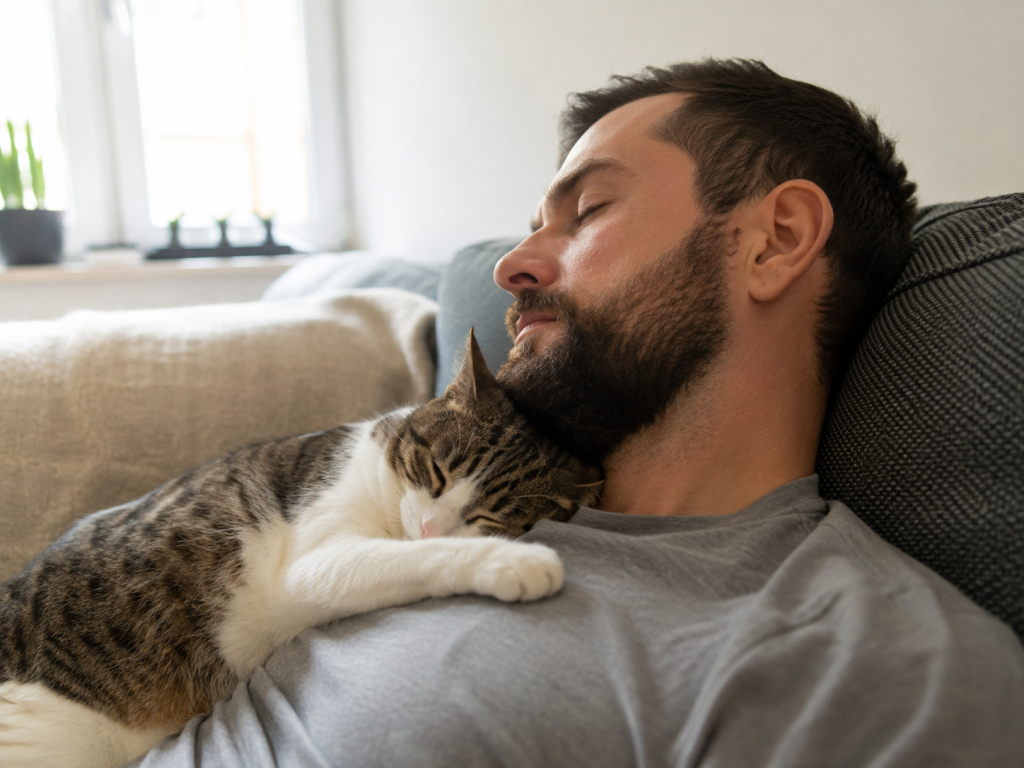
Why does my cat sleep on my chest? In most cases, your cat chooses your chest because it feels warm, secure, comfortable, and familiar. Cats often seek warm sleeping places, and resting directly on a trusted person can combine body heat with familiar scent, physical contact, and a protected place to relax.
For many cats, sleeping on your chest can also be part of a strong social bond. Your cat has learned that being close to you is safe, and your daily routine may make your chest one of their favorite resting places. However, every cat is different, so the behavior does not always have one exact meaning.
If your cat has always slept on you and otherwise acts normally, there is usually little reason for concern. A sudden major increase in clinginess or sleeping behavior, especially alongside appetite, litter-box, breathing, or energy changes, deserves more attention because behavioral changes can sometimes occur when cats are unwell.
Your Chest Is Warm and Comfortable
Warmth is one of the simplest explanations for why cats choose certain sleeping locations. Cats often seek warm resting areas, and International Cat Care specifically notes that many cats prefer warm places to sleep.
Your chest provides a steady source of body heat, especially when you are lying under blankets or resting in bed. From your cat’s perspective, this can make you more attractive than an empty section of the mattress or a cooler piece of furniture.
Cats also use sleeping positions that help conserve warmth. VCA notes that tightly curled sleeping positions may help cats retain body heat, while enclosed sleeping spaces can feel both warm and secure.
This may explain why your cat becomes more interested in sleeping on you during colder weather. A cat who spends summer nights at the end of the bed may suddenly become much more affectionate when the temperature drops.
Your Cat Feels Safe Around You
Sleep leaves a cat less aware of what is happening around them. For that reason, cats tend to choose resting locations where they feel reasonably safe and comfortable.
VCA explains that cats often choose snug sleeping spaces because those locations can offer both warmth and a sense of security. International Cat Care also recommends providing cats with quiet, warm, secure sleeping areas.
When your cat voluntarily falls asleep directly on your body, it can suggest that they are comfortable enough to relax in your presence. Your familiar smell, movements, and normal household routine may all contribute to that sense of predictability.
This does not necessarily mean every cat that avoids sleeping on people feels unsafe. Many perfectly comfortable cats prefer sleeping nearby rather than directly on their owners. Individual personality plays a major role in how cats seek social contact.
Sleeping on You Can Be Part of Social Bonding
Cats can develop strong relationships with familiar people, and physical contact may become part of that relationship. Some cats rub against their owners, head-butt them, groom them, sit beside them, or choose to sleep directly on them.
VCA describes head-butting and facial rubbing as behaviors associated with trust and social bonding. Cats also use scent glands around the face when rubbing against familiar people and objects.
Sleeping on your chest can fit into this larger pattern of comfortable social behavior. Your cat may not be consciously thinking, “I am showing affection,” in the human sense. Instead, they may simply choose closeness because being with you has repeatedly been safe and rewarding.
Pay attention to the complete interaction. A cat that approaches with relaxed muscles, rubs against you, settles on your chest, purrs, and falls asleep is displaying a very different pattern from a frightened cat that remains tense or constantly looks for an escape route.
Your Smell Is Familiar
Cats rely heavily on scent when navigating their environment and recognizing familiar parts of their territory. International Cat Care notes that familiar scents within the home can contribute to a cat’s sense of safety.
Your clothing, bedding, skin, and usual sleeping area all carry scents your cat encounters every day. Resting on your chest places your cat directly beside one of the most familiar scent sources in the home.
Cats may reinforce that familiarity through rubbing as well. Facial rubbing transfers scent from glands around the face, which forms part of normal feline communication.
This may be one reason some cats choose their owner’s clothing or side of the bed even when the person is not present. Familiar smells can make a resting location more appealing.
Your Breathing and Movement May Become Part of the Routine
A cat lying on your chest can feel your breathing and subtle body movements. There is limited evidence that cats specifically choose a human chest because they want to hear a heartbeat, so that popular explanation should not be treated as proven.
However, cats are very sensitive to predictable environmental cues. If your cat has slept on you many times, the movements, sounds, warmth, and scent associated with your body can become part of a familiar resting routine.
Cats commonly develop strong daily habits. They may sleep in one location in the morning, move toward a sunny window later, and join you on the couch at a particular time each evening.
Therefore, your chest may simply have become part of your cat’s normal sleep schedule.
Why Does My Cat Purr While Sleeping on My Chest?
Purring frequently occurs during relaxed social interactions, so it is common for cats to purr while settling beside or on a familiar person. Your cat may knead, circle around, lie down, and begin purring as they become comfortable.
However, purring should not be interpreted as an absolute guarantee that a cat feels healthy or happy. Cats can purr in different situations, so the rest of their behavior still matters.
A cat sleeping comfortably with soft muscles, normal breathing, relaxed ears, and normal behavior after waking presents a reassuring overall picture. A cat that suddenly becomes withdrawn, stops eating, or shows breathing difficulties requires a different interpretation even if they still purr.
The safest approach is always to consider the complete behavior rather than relying on one sound.
Why Does My Cat Knead My Chest Before Sleeping?
Many cats knead soft surfaces before settling down. They rhythmically press their front paws into blankets, beds, pillows, or people, sometimes while purring.
Kneading begins during kittenhood, and many cats continue the behavior as adults during comfortable or familiar situations. A soft shirt or blanket covering your chest provides an ideal surface.
If your cat uses their claws while kneading, the behavior can become uncomfortable. Instead of punishing them, place a thicker blanket between your body and their paws.
You can also gently redirect your cat to a nearby soft bed if necessary. The goal is to keep the interaction comfortable for both of you.
Why Does My Cat Sleep on My Chest but Not Someone Else’s?
Cats can have different relationships with different people in the same household. One person may feed the cat most often, another may play with them, while someone else provides their favorite sleeping spot.
Your smell, temperature, sleeping position, routine, and how you respond when the cat approaches may all affect their preference. If you consistently remain still and allow the cat to sleep without disturbing them, your chest may simply be the most predictable option.
This does not necessarily mean your cat dislikes other family members. Cats can show comfort and attachment in different ways with different people.
One cat may sleep on your chest but sit beside another person while they work. Both can represent comfortable social interactions.
Why Does My Cat Sleep on My Chest at Night?
Nighttime combines several things cats may find appealing. You are lying still for a long period, the room is usually quieter, and your bed provides warmth and comfortable surfaces.
If your cat has access to the bedroom every night, sleeping on you can become part of a predictable routine. Cats often return to places where they have previously rested comfortably.
Cold temperatures can strengthen the preference because your body provides additional warmth. Cats naturally seek cozy places, and older cats in particular may appreciate additional warmth.
Some cats remain for only a few minutes before moving elsewhere. Others may sleep on their owner for much of the night.
Why Does My Cat Sleep on My Chest in the Morning?
Morning routines can also shape the behavior. If you normally wake up and feed your cat soon afterward, your cat may learn that approaching you in bed is connected with breakfast.
Your chest also gives them a difficult-to-ignore position. A cat sitting directly on you is more likely to get your attention than one quietly waiting across the room.
Over time, this can become a learned routine. If waking up results in food, petting, conversation, or getting out of bed, your cat has several reasons to repeat the behavior.
The motivation may therefore include both comfort and expectation.
Does My Cat Sleep on Me Because They Love Me?
It is reasonable to view voluntary close contact as a sign that your cat is comfortable with you, but feline relationships should not be reduced to one behavior.
Cats express social bonds in several ways. They may rub against familiar people, seek physical proximity, head-butt them, groom them, or choose to rest nearby. VCA describes head-butting as a behavior connected with trust and bonding.
A cat sleeping deeply on your chest is choosing an extremely close form of contact. That can be a meaningful sign of trust and familiarity.
Still, do not worry if your cat never sleeps on you. Some affectionate cats simply prefer personal space or sleeping beside their owners instead.
Why Does My Cat Suddenly Want to Sleep on Me?
A sudden change deserves more attention than a long-standing habit. Sometimes the explanation is simple: colder weather, a new sleeping routine, changes in furniture, or another preferred resting area becoming unavailable.
Stress may also influence where a cat chooses to rest. A cat experiencing environmental changes may seek familiar locations and people more frequently.
However, sudden clinginess can occasionally accompany physical illness. VCA advises owners to pay attention to sudden changes in sociability, energy, appetite, litter-box habits, breathing, grooming, and general appearance because behavioral changes can indicate that a cat needs veterinary attention.
If your normally independent cat suddenly spends almost all day pressed against you and also seems lethargic, eats less, hides, loses weight, or behaves differently, contact your veterinarian.
What If My Cat Never Sleeps on Me?
There is nothing wrong with a cat that prefers sleeping alone. Cats differ considerably in personality, previous experiences, tolerance for physical contact, and preferred sleeping locations.
Some cats want constant contact, while others show trust by sleeping several feet away. A cat that rests nearby, approaches voluntarily, rubs against you, plays normally, and behaves comfortably may still have a strong relationship with you.
International Cat Care emphasizes providing cats with choices of safe sleeping and resting locations.
Allow your cat to decide where they feel most comfortable rather than repeatedly placing them on your chest. Voluntary contact is more meaningful than contact a cat is forced to tolerate.
Is It Safe to Let a Cat Sleep on Your Chest?
For most healthy adults and healthy cats, brief supervised resting together is usually a matter of personal comfort. However, safety depends on the circumstances.
You should be able to move and breathe comfortably, and the cat should always be able to leave freely. Avoid trapping a cat underneath heavy blankets or positioning them somewhere they cannot easily move away.
You may prefer to encourage another sleeping location if the cat’s weight makes breathing uncomfortable, if you have a medical reason to avoid having an animal on your chest, or if the behavior repeatedly disrupts your sleep.
Babies and very young children require different safety considerations and should not be left sleeping unsupervised with pets.
How Can You Encourage Your Cat to Sleep Somewhere Else?
If you enjoy your cat’s company but do not want them sleeping directly on your chest, you can make another resting place more attractive.
Place a soft cat bed or blanket near you in a quiet location. Cats generally prefer warm, comfortable sleeping areas, and familiar scents may help a new bed feel safer.
Reward your cat for choosing that location with calm attention or another appropriate positive experience. Avoid repeatedly pushing or frightening them away from your body because that can create unnecessary stress.
Consistency matters. If sleeping on your chest sometimes leads to an hour of cuddling and other times leads to immediate removal, it may take longer for your cat to understand the new routine.
When Should You Be Concerned?
Sleeping on your chest by itself is usually not a warning sign. Concern becomes more appropriate when the behavior changes dramatically or appears alongside other physical or behavioral symptoms.
Contact your veterinarian if your cat suddenly becomes much more clingy and also shows changes such as reduced appetite, unexplained weight loss, vomiting, diarrhea, unusual hiding, litter-box problems, low energy, difficulty moving, or changes in breathing.
VCA notes that sick cats may show changes in sociability, energy, appetite, grooming, litter-box use, breathing, and general appearance. Any significant sudden change deserves attention.
Seek prompt veterinary care if your cat has difficulty breathing, collapses, appears severely weak, or shows another serious symptom.
Why Your Chest May Be Your Cat’s Favorite Bed
So, why does your cat sleep on your chest? Most often, your cat has found a place that combines several things cats value: warmth, comfort, familiarity, security, and closeness to someone they trust.
Your body heat can make your chest especially appealing, while your familiar scent and predictable presence may help your cat relax. Cats also form individual social relationships, so sleeping directly on you can become part of the way your particular cat chooses to interact.
There is no need to worry if your cat prefers another sleeping location. Some affectionate cats sleep on people, while others choose the end of the bed, a nearby chair, or their own quiet hiding place.
Pay attention to what is normal for your cat. If sleeping on your chest is a familiar habit and your cat remains healthy and relaxed, it is most likely another comfortable part of your relationship. If the behavior changes suddenly alongside other signs of illness, however, a veterinary check can help rule out an underlying problem.